
Story For Children · 8 November, 2026
The Little Girl and the Seedling Asleep Beneath the Roof
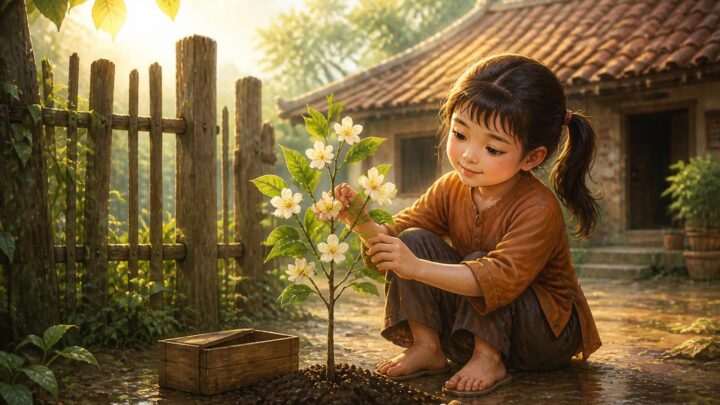
At the end of a red dirt road stood a low, tiled-roof house, with an old starfruit tree growing in front of it. In that house lived little Na with her grandmother. Na had bright eyes, hair that was always tied to one side, and a very special habit: she often picked up things other people considered useless and kept them in a wooden box.
Inside the box were a blue button, a pebble smooth as a marble, a chipped wooden spoon, and a rusted key. Na believed that every object had once had its own story. It was just that adults were too busy to have time to sit and listen to them anymore.
One afternoon after a rainstorm, Na saw a small brown seed beneath the doorstep. The seed lay in a thin shell beside a few wet strands of straw. Na picked it up, gently wiped it with the hem of her shirt, and took it to ask her grandmother.
“Grandma, what kind of seed is this?”
Her grandmother was sorting vegetables. She narrowed her eyes and looked at it for a while, then shook her head.
“I’m not sure. It could be the seed of some kind of plant. Why don’t you try planting it?”
Na was delighted. She took an old clay pot from behind the kitchen, filled it with soil, and placed the seed in the middle. She poured in a small dipper of water and set the pot beneath the eaves, where it would receive morning sunlight but would not be directly battered by the rain.
The next day, Na ran out to look. The soil was still perfectly flat. It was the same on the third day. By the fifth day, Na began to grow impatient. She used a bamboo stick to gently poke at the soil and see whether the seed had sprouted.
“Maybe it doesn’t want to grow,” Na said.
Her grandmother heard her and said, “Just because something is silent doesn’t mean it isn’t alive, dear. Some things need more time beneath the soil.”
Na listened to her grandmother and stopped poking the soil. Every morning, she watered it a little. Every afternoon, she moved the pot closer to the edge of the porch so it could enjoy the sunlight. She even used a piece of roof tile to make a slanted cover above it, so the rain would not wash away the soil.
The Seedling Was Unlike Other Seeds
During the days of waiting, Na began to realize that this seedling was very different. The beans her grandmother soaked in a bowl split open after only a few days. The corn planted in the garden bed also quickly poked its shoots above the ground. But the seed in the pot remained still, showing no sign of anything at all.
Na asked Uncle Tu, the neighbor who had a garden full of crops.
“What do you think I should do to make the seed sprout?”
Uncle Tu picked up the pot, tested the moisture of the soil with his finger, and said, “Don’t water it too much. And don’t leave it in the sun all day, either. Plants are like children: they need to be cared for, but they don’t like being pushed along according to someone else’s wishes.”
Na remembered his words. From then on, she no longer dug up the soil every day to check. She learned to observe the small signs: water it when the soil was dry, pull out the weeds growing among it, and place the pot closer to the warmer wall when the weather was cold. One day, she was busy playing and forgot about the plant. That evening, she remembered, hurried over to water it, and apologized to the seedling.
“I’ll try harder to remember. But if you’re not ready yet, that’s okay too.”
Na did not know that beneath the dark layer of soil, the seedling was listening to every word she said. It had lain in the earth for a very long time, ever since it was on a high branch in the forest behind the hill. Back then, a small bird had eaten the fruit and flown over the village. The seed fell onto a tiled roof, slid along with the water, and became lodged beneath the doorstep of Na’s house.
The seedling needed a cold season to pass before it could awaken. But no one knew that. If Na had been impatient, the seed might have been dug up and thrown away long ago.
A Day When Many Things Happened
At the beginning of the following month, a powerful windstorm swept through the village. The wind scattered dry leaves and made the chicken coop door bang against the wall with a clatter. Several potted plants at the neighboring houses were knocked over. Na’s seedling pot also tilted away from the porch step.
Just as Na ran over, a puppy from Uncle Tu’s house came rushing past in fright and struck the pot. The pot fell into the yard and broke into two pieces. Soil flew everywhere. Na stood frozen, her hands tightly gripping the hem of her shirt.
“It’s ruined,” she whispered.
Her grandmother came outside. She did not blame the dog or Na. She sat down beside the broken pieces of the pot and gently gathered the soil back together.
“We don’t know that yet. Let’s take a look.”
Na picked up handful after handful of soil. When her grandmother used a small spoon to loosen the layer underneath, the two of them saw a creamy-white sprout curling upward. It was very small, only as long as a knuckle, but at its tip was a pale green dot.
Na was so happy that she almost burst into tears. She and her grandmother moved the sprout into an old wooden box with holes bored into the bottom. Her grandmother also placed a little coconut fiber around its base to hold the soil in place. Na put the box somewhere more sheltered from the wind, but where it would still receive gentle sunlight.
“It’s awake now,” Na whispered.
That night, Na dreamed that she walked into a forest. In the middle of the forest stood a tall tree bearing transparent golden fruit. The tree did not speak in words, but Na understood that it wanted to thank her for not giving up. When she awoke, Na did not know whether the dream had been real. She only knew that she wanted to care for the sprout even more carefully.
Caring Does Not Mean Keeping Something Beside You Forever
The plant grew little by little. Its first two leaves opened, soft and bright. Then more leaves appeared, shaped like tiny hands. Na named the plant Little Sprout.
She took Little Sprout with her whenever she went into the yard, but her grandmother reminded her that the plant could not live in the box forever. Its roots needed more soil. One morning, her grandmother led Na to an empty patch of ground beside the fence.
“This is where Little Sprout can grow into a real tree,” she said.
Na looked at the wooden box. She did not want to be separated from the plant. For many weeks, she had watered it, protected it from the sun, and told it all kinds of stories. But when she saw the white roots tightly coiled inside the box, Na understood that loving something did not mean keeping it beside you forever.
She dug a small hole, placed the plant in it, and filled in the soil around its base. Her grandmother brought a bamboo stick to use as a support stake. Na arranged several stones in a circle to keep the chickens from scratching up the soil. She also hung a blue button on the fence as a marker to remember the tree’s location.
In the days that followed, Little Sprout had to endure many challenges. On some days, the scorching sun made the soil crack dry. On others, heavy rain left water pooled around the base. Na learned how to mound up the soil, make drainage channels, and cover the ground with dry leaves. Uncle Tu showed her how to tell when the plant lacked water by observing how its leaves drooped. Her grandmother taught her not to water at midday, because water on the leaves could harm the plant when the weather was too hot.
Na gradually understood that caring was not simply about doing as many things as possible. More important was doing the right thing at the right time and taking the trouble to observe what the thing being cared for needed.
A Gift Beneath the Leaves
A few months passed, and Little Sprout had grown almost as tall as Na’s shoulder. Its trunk was slender but resilient. Its leaves spread out in layers, shading a small patch of ground beside the fence. Yellow butterflies often flew around it. A little songbird also came to perch on its branches each morning.
Na still did not know what kind of tree it was. Little Sprout had not flowered or borne fruit. One day, she discovered round green buds appearing beneath the tree. Na called her grandmother, Uncle Tu, and several of the neighborhood children over to see.
Everyone guessed all sorts of things. Some said it was a fruit tree; others thought it would bloom with fragrant flowers. Na stopped guessing. She simply sat beside the tree’s base and waited.
One morning after a light rain, the green buds all began to open at once. Creamy white flowers appeared on the branches, each with a yellow dot in the center. The flowers were not as vivid as bougainvillea, nor as strongly scented as pomelo blossoms. Their fragrance was very gentle, just enough for someone sitting nearby to notice.
That afternoon, a little boy from the village got lost while chasing a kite. He walked all the way to Na’s fence and sat crying beneath Little Sprout’s canopy. The broad leaves shaded him from the sun. Na found him and brought him back to his mother.
From then on, the fence became a place where the children often stopped to rest. They did not pick the flowers or climb the branches. Na told her friends the story of how the seed had lain still for a very long time and awakened only when it was patiently given time. Everyone called the tree by different names, but Na still liked Little Sprout best, even though the tree was no longer little.
At the end of the season, Little Sprout produced round brown fruits. One fruit fell to the ground and split open, revealing several seeds inside. Na picked them up, sharing some with Uncle Tu and her friends and keeping a few to plant in a corner of the yard.
“This time, we’ll know that they need a cold season,” Na said.
Her grandmother smiled. “Learning one more thing can help us care for so many other things much better.”
That evening, Na opened the old wooden box. The blue button was still there, beside the pebble and the rusted key. She placed a new seed inside the box. Na understood that the seed was not a definite promise of a tree. It was only a small opportunity, needing soil, water, sunlight, and patience to become something great.
Before going to bed, Na went out to the fence. Little Sprout gently rustled its leaves in the quiet night. Na placed her hand on the trunk and whispered:
“Thank you for teaching me that not everything silent is something lost. Some things are growing in their own way.”
And beneath the little roof at the end of the red dirt road, new seeds lay quietly in the soil, waiting for the right season to begin their own stories.
Related articles
The Little Girl Who Kept Raindrops in a Cloth Bag
The Late Arrival of the Rain At the end of a red dirt road stood a small village nestled among rolling hills. Surrounding the village were cornfields, vegetable plots, and lush green bamboo thickets. The villagers lived simple lives; each person had their own work, going to the fields in the morning and returning to
Read more
The Boy Who Gathered the Wind and the Garden That Knew How to Listen
The Boy on the Hillside At the edge of a small village with brown-tiled roofs, towering areca palms, and a winding dirt road that ran all the way to the foot of the hill, there lived a boy named An. An was not the strongest boy in the village, nor could he run as fast
Read more
The Wind Chime That Called Kindness by Name
On the other side of the green hill, where the bur grass often clung to the hems of passersby’s trousers, there was a small village called Rustling Wind. The village was not wealthy, but every house had a flower garden and a wooden bench in front of the porch. In the mornings, the adults went
Read more
Little Mây’s Bag of Sun Seeds
At the end of the dirt road leading into Gió Nội Village stood a small tiled-roof house, with a yard full of yellow chrysanthemums. In that house, little Mây lived with her mother and grandmother. Mây had hair as soft as the clouds in the sky, clear, bright eyes, and a very unusual habit: every
Read more
The Seedling That Held the Sunlight
A Morning Without Sunlight At the edge of a small village stood a house with a blue-tiled roof, where little An lived with her grandmother. Behind the house was a garden that was not very large but was always full of sounds. In the morning, sparrows chirped as they hopped from branch to branch. At
Read more
The Wind Chime and the Garden’s Promise
At the end of the stone-paved road in the village of Young Shoots stood a small, forgotten garden. The garden lay behind a house with a blue-tiled roof, its weathered wooden gate kept shut all year round. Long ago, the place had been full of flowers, but over time, weeds grew taller than a person’s
Read more