
Story Collections · 18 November, 2026
The Clock Shop at the Bottom of the Hill and the Day Time Stopped

At the bottom of the hill leading down to the riverbank stood a small clock shop. The wooden sign in front of the door had faded, but the words carved into it could still be read: Repairing the Things That Missed Their Beat. The townspeople called it Mr. Bay’s shop, though no one knew what his real name was. He had come there so long ago that the children who once stood watching him through the glass window had since become parents, while he still sat behind the wooden workbench, head bowed over tiny gears.
Mr. Bay did not repair just any clocks. He repaired clocks that others had thrown away because they believed them to be worthless. One had fallen into a well, its glass cracked like a spiderweb. Another had rusted from the rainwater. One still ran but was always seven minutes slow, making its owner think they had missed every appointment in their life. He patiently took apart each component, cleaned every tiny axle, and then put everything back in its proper place. When handing a clock back to a customer, he often gave the same advice: “It’s running again, but don’t let it run your life for you.”
The only person who came to the shop regularly was An, a thirteen-year-old boy who lived with his mother in a house near the riverbank. An liked the sound of ticking more than any other sound. He said that ticking kept a room from feeling empty, because as long as a clock was still working, time was still there.
An’s mother sold cakes at the morning market. She always woke before dawn, kneaded the dough, lit the fire, and carried her goods into town. Every evening when she returned, she was so tired that all she could manage was to ask whether An had eaten dinner. An understood how hard his mother worked, but there was still a nameless sadness inside him. He wanted to tell her about things at school, show her the wooden boat he had just made, and ask why his father had been away for so many years without returning even once. Yet every time he saw his mother’s weary shoulders, he swallowed those words.
One afternoon, An found a pocket watch beside the river. It lay among the wet grass, its brass case tarnished, its front cover engraved with the image of a bird spreading its wings. He brought it to Mr. Bay. The moment he saw the watch, Mr. Bay remained silent for a long time.
“You know it?” An asked.
“I do. But first we have to see whether it still wants to run.”
He opened the back. Inside, there were no gears at all, only a small folded piece of paper. An was surprised, while Mr. Bay carefully removed the paper and placed it on the table. It contained only one blurred line: Meet when the final bell of the day rings.
“Who wrote that?”
“Someone who was once very afraid of missing an appointment.”
He said no more. He polished the brass case, oiled the tiny axles, and placed the watch beside the window. The watch had no hands, but at dusk it suddenly gave off a clear, bright chime. The sound drifted through the shop, followed the hill, and fell onto the river’s surface as it turned purple.
From that day on, An came to the shop every afternoon. He no longer asked about the person who had written the note. Mr. Bay did not tell him either. The two of them sat together, one repairing clocks and the other learning to distinguish the sounds made by the mechanisms of each kind. An realized that some clocks ran fast because their springs were too tightly wound, some ran slowly because dust had collected over the years, and some seemed to have died but would work again as soon as a single small screw was replaced.
“Are clocks like people, Mr. Bay?” An asked.
“Sometimes they’re more alike than you think. Impatient people often make themselves run too fast. Sad people carry too much dust from old matters. And people who think they have no hope left sometimes only lack a hand willing to sit beside them.”
The Day All the Clocks Stopped
One morning at the beginning of the rainy season, the town awoke to a strange silence. The clock hanging in the market tower stood still at twelve minutes past six. The clock in the clinic stopped at twenty minutes to nine. The noodle-shop owner’s clock, the mail carrier’s wristwatch, and the alarm clocks in every house all stopped at once, though no one had touched them.
At first, everyone thought it was merely a malfunction. They brought their clocks to Mr. Bay’s shop, filling the entire workbench, the windowsill, and the wooden chair on the porch. He took them apart one by one to inspect them. No gears were broken, no springs were snapped, and there was no sign of water or dust. Every component was intact; only the clock hands refused to move.
“How long will it take to fix them?” an impatient person asked.
Mr. Bay looked out at the hill. “Perhaps the clocks aren’t broken.”
“If they aren’t broken, then why aren’t they running?”
“Perhaps time is waiting for us.”
His answer only made everyone more irritated. Without clocks, they did not know when to open their shops, when the boat would leave the landing, or when the children would finish school. Work that had once been arranged by the clock suddenly became disorderly. People began arguing over lateness, complaining about having to wait, and blaming one another for a day that could not be measured.
Only An did not find it entirely frightening. Without seeing the hands of the clocks, he began to notice other signs of time. He knew morning by the smell of the cakes his mother baked, knew noon had arrived when the tree shadows grew short across the road, and knew evening was falling when the storks flew back toward the reeds beside the river. He also realized that his mother had placed her hand on his shoulder several times as if she wanted to say something, then stopped herself.
On the second day without clocks, the market closed early. On the third day, the school dismissed its students because the teachers did not know when to begin class. The people of the town went from irritation to unease. They crowded into Mr. Bay’s house in greater numbers, demanding that he find a way to make everything work again.
Mr. Bay did not argue. He simply took out the pocket watch with the bird on it and placed it in the middle of the table. The watch still had no hands, but every afternoon it continued to ring a single chime.
“When the bell rings,” he said, “each person should remember something they promised to do but never did.”
No one understood why they had to do that, but with no other option, they began to try. The noodle-shop owner remembered that she had promised to visit her sister in the neighboring village, but had not gone for five years. The mail carrier remembered a debt he had never repaid to an old friend. The teacher remembered an apology he had never given to a student he had wrongly reprimanded. And the market chief remembered his late father, beside whose grave he had never once sat long enough to tell him how he had lived.
The forgotten promises appeared one after another, quietly but heavily, like raindrops gathered on a porch roof. Some people tried to fulfill them at once. Some wrote letters. Some walked down the hill to knock on the door of a house they had not visited in a long time. There were also people who could not repair what had gone wrong; they could only stand before the truth and learn how to express their regret.
The Appointment by the Riverbank
An had a promise of his own. He remembered the night his father left. His father had sat by the riverbank for a long time and said that if he ever returned, he would take An to see the large boats beyond the mouth of the river. At the time, An was still small. He had stood beneath the porch roof waiting until late at night, but his father never came back. After many years, An stopped waiting, but that did not mean he had forgotten.
On the afternoon when the seventh chime rang, An led his mother to the riverbank. He did not explain why he wanted to go. His mother did not ask. The two of them sat on the stone steps, watching the last streaks of sunlight drift across the water.
“Have you ever promised to do something but never done it, Mom?” An asked.
His mother was silent for a while. “I once promised I would tell you about your father. But I kept thinking it could wait. Later, when you were older; later, when I was less tired; later, when it was easier to talk about everything.”
“Can you tell me now?”
She nodded. She told him that An’s father had not been a heartless man who simply walked away. He had worked on a cargo ship, been in an accident offshore, and never returned. During the first few years, An’s mother still hoped that one day he would appear at the bottom of the hill. Later, she did not know how to tell her son the truth, so she remained silent. The silence lasted so long that even she began to believe it was a way of protecting him.
An did not cry right away. He only looked at the river, where the water continued flowing into the distance even though there was no clock to measure it. After a while, he rested his head against his mother’s shoulder.
“You should have told me sooner.”
“Yes.”
“But I still want to hear it.”
“I know.”
The two of them sat that way until night fell. For the first time in many years, the silence between them was no longer a wall. It was simply a pause for them both to breathe, and then continue saying the things that had been held back for too long.
The next morning, ticking rang throughout the town. The clocks gradually began running again, not all at the same moment but each returning to its own rhythm. The market tower showed twelve minutes past six, then slowly moved on to the next minute. No one knew why they had started working again. Nor did anyone continue trying to find a single explanation.
Mr. Bay finished repairing the pocket watch, but he did not put hands on it. He gave it to An.
“Keep it.”
“If it can’t tell the time, what’s the use of keeping it?”
“To remember that some appointments do not lie on a clock face. They lie in the human heart, and the longer they are postponed, the harder it becomes to find the way back to them.”
A few months later, Mr. Bay left the town. No one knew where he went. The clock shop was entrusted to An, who looked after it after school. He continued repairing old mechanisms, cleaning each gear, and patiently listening to the tiny movements inside. The old words on the wooden sign grew fainter with each passing day, but An did not replace the sign.
Whenever someone brought him a clock that had stopped running, An usually did not hurry to open the back. He asked the owner how long it had been since they had called a loved one, how long it had been since they had returned to a familiar place, or whether there was something they kept saying they would do someday.
Only then would he sit down at the wooden workbench and begin repairing it.
Because An understood that a clock can tell us that a day is passing, but only people can decide whether that day has truly been lived.
Related articles

The Keeper of the Rainy Season and the Umbrella That Never Opened
At the end of the street lined with old golden shower trees, where the low-roofed houses gradually gave way to a stretch of land along the river, there was a man who often appeared just as the sky was about to rain. He was in his early sixties, thin, with mostly gray hair, and always
Read more
The Bougainvillea Wall at the End of the Alley
At the end of a small alley stood a wall covered in bougainvillea. Every sunny season, delicate clusters of flowers burst into bloom against the backdrop of peeling limewash, making the stretch of road that few people had ever noticed suddenly seem brighter. The people in the alley had grown so accustomed to the wall
Read more
The Wooden Bridge and the Guide for Those Who Are Lost
To the north of a small village stood a forest shrouded in mist all year round. The villagers called it the Misty Forest, not because the trees were too dense, but because anyone who entered easily forgot where they were going. Some people went in to gather firewood and returned a few hours later, but
Read more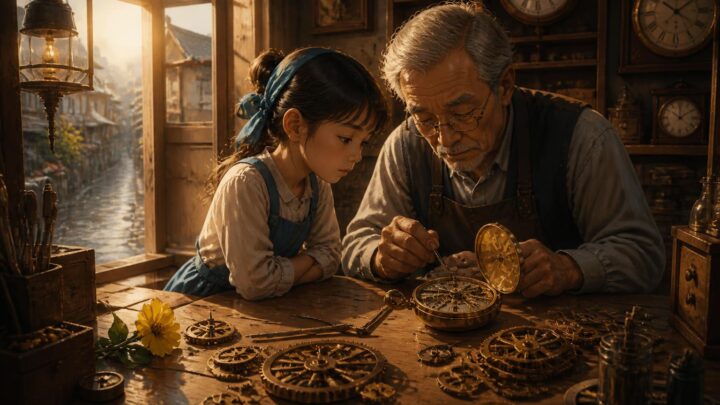
The Clock That Did Not Tell Time
At the end of a narrow street, where old rooftops leaned to reflect their shadows in a ditch thick with duckweed, there was a small shop called Moc Clock Shop. The wooden sign had faded with age, and the letters on it were almost impossible to read, but everyone in town still knew the place.
Read more
The Clock That Would Not Run and the Forgotten Letter
At the end of a small street stood a watch-repair shop that had been there so long that many people no longer remembered when it had opened. The wooden sign above the porch had faded, two letters in the shop’s name worn away by sun and rain, while the glass door was always covered with
Read more
The Garden Behind the Old Wall
When An returned, the small alley was still as narrow as she remembered. Low awnings followed one another along both sides of the street, providing just enough shade from the afternoon sun. The smell of freshly cooked rice drifted from some kitchen, mingling with the scent of damp earth after the rain, and she felt
Read more