

 Tiếng Việt
 日本語
日本語 한국어
한국어 中文 (中国)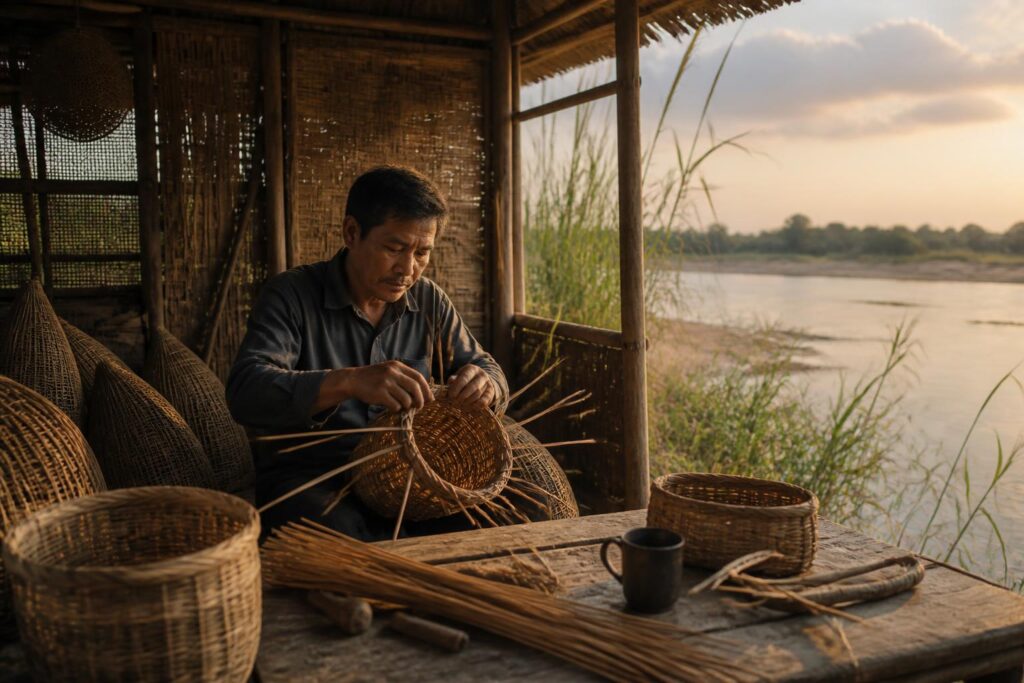
The River After the Flood Season
On the day Lam returned, the river had almost completely receded from the alluvial bank. Dark streaks of mud still marked the bamboo stalks, the feet of the posts, and even the stone surface in front of the small hut. After the flood season, the riverbank often wore the weary look of someone who had just come through an illness. The grass lay flattened, scraps of wood remained caught in the reeds, while the surface of the water moved silently, carrying clusters of water hyacinths that had faded in color.
Lam stood beside the leaning bamboo gate, holding the bunch of keys the village chief had sent him. This hut had once been where his father sat weaving baskets for more than forty years. It was also here, on the afternoons of his childhood, that Lam often heard the steady sound of a knife stripping bamboo, drifting out amid the smell of straw smoke and young mud. Back then, he never imagined that one day those sounds would become what made him remember his homeland more than any photograph could.
Lam’s father died at the end of the rainy season, after a prolonged fever. He passed so quietly that the neighbor only learned of it when he came over to invite him for tea and received no answer. On the low wooden table, the teapot still held half a pot of water; beside it lay several thinly split bamboo strips and an unfinished basket. Lam returned home for three days of mourning, then went back to the city. Work, appointments, and his cramped rented room pulled him away, as though his father’s death were merely a gap he had to step over temporarily.
Now, nearly a year later, he had finally returned to clear out the hut. The village chief had told him that the riverside land was soon to be developed into a materials storage yard. If Lam did not take away the things that could still be used, everything would be leveled. He had planned to hire someone to do it quickly, but when he held the key in his hand, he suddenly wanted to open that door himself.
The Baskets No One Had Claimed
The door creaked with a dry sound. Inside, almost everything remained as it had been. A bamboo daybed stood against the wall, several bundles of strips were stacked on a shelf, a small knife lay in a wooden box, and an oil lamp was covered with a thin layer of dust. Dozens of bamboo baskets hung silently from the crossbeam. Some were square for holding vegetables, some had wide mouths for use on fishing days, and some were so small they could hold only a handful of sticky rice.
Lam took down each basket, intending to sort them and give them to people in the village. But when he looked closely, he noticed that beneath every basket was a folded piece of paper. His father’s neat handwriting appeared, slanting slightly to the right.
“Mrs. Nam’s house, place it beside the stove.”
“Give it to Tin to take to the market.”
“Hanh, the small basket is for holding medicine.”
Lam opened several more pieces of paper. None of them listed a price. Some bore a person’s name, while others only mentioned an item that needed to be held. One basket was for a woman who had just given birth, one for an old man who often went gathering medicinal leaves, and one so an elderly woman selling sweet potatoes would not have to use a torn sack. His father had woven each one, then given it away or exchanged it for very small things, such as a basket of fish, a few gourds, or several bundles of vegetables.
In Lam’s memories, his father was a quiet and somewhat stern man. He rarely asked how his son was doing in school and hardly ever brought up matters of the heart. When Lam was accepted to a university in the city, his father had only nodded and said, “Go, but remember to take care of yourself.” Lam had once thought it was indifference. He did not know that his father had quietly sold several apricot trees in the garden to pay the first term’s tuition, nor did he know that the old bicycle his father kept repairing again and again was so he could save money to buy Lam a better raincoat.
The scraps of paper beneath the baskets suddenly made the hut feel cramped. Each small object seemed to contain a story his father had never told. Lam sat down on the bamboo daybed, still holding the basket with the misshapen rim. Outside, a kingfisher swooped down and flew up again, leaving a ring of water that spread quickly across the flowing surface.
The Father He Had Never Understood
That afternoon, the village chief brought Lam a pot of rice and a plate of braised fish. Seeing the baskets lined up, he smiled.
“Are you planning to sell them?”
“I don’t know yet. I thought Father made them to earn a living. I didn’t realize he gave so many away.”
The village chief picked up a piece of fish and said leisurely, “Your father had been weaving baskets since he was young. Back then, the whole village was poor, and there was a shortage of everything. Those who had money bought them; those who didn’t, he let pay later. Some took years to repay him, and he never mentioned it. He said a basket wasn’t worth much, and people needed to be able to keep their dignity.”
Lam remained silent. The village chief told him that when Lam went to the city for school, his father accepted extra orders from a shop in the district town. During the day he worked in the fields; at night he sat by the stove splitting bamboo. On days when his back hurt, he still tried to finish the orders because he wanted to send the money to his son on time. Once, the village chief had advised him to rest more, but he had simply replied that when a child stepped out of the village, he needed a decent pair of shoes to walk in.
“Why didn’t you tell me?” Lam asked.
“He wouldn’t let me. He said what happened in one’s family only needed to be known by the family.”
The village chief looked out at the river, his voice slowing. “Your father had a strange nature. Whenever he helped someone, he acted as though he were repaying a debt. When people thanked him, he became uncomfortable. He said that today, we might be a little healthier than someone else, so we should use that strength to do something useful.”
Night fell, and Lam slept in the hut. He spread the old mat on the bamboo daybed, but he could not fall asleep. Wind from the river blew through the gaps in the walls, carrying a chill and the sound of reed branches brushing against one another. He looked at the flashlight beside him and suddenly remembered nights long ago, when he was little and often woke to the sound of his father splitting bamboo.
Back then, Lam had once asked why his father did not buy a basket-making machine to make things easier. His father had replied, “Some things have to be made by hand before you can know where they need to be soft and where they need to be strong.” Lam had not understood at the time. He had only thought his father was stubbornly clinging to an old-fashioned trade. Only when he held the basket in his hands did he realize that every bamboo strip had a different curve. If forced too hard, the bamboo would break. If tied too loosely, the basket would not bear weight. Weaving an object was much like treating a person: one had to know when to hold firm and when to loosen.
Hanh’s Basket
The next morning, Lam went to find the people whose names appeared on the slips of paper. The first was Hanh, a woman who lived at the end of the hamlet. She recognized him at once, although they had not seen each other for a long time. Her house was small; in front of it stood several pots of medicinal plants and a child’s bicycle leaning against the wall.
“Your father said this basket was for holding medicine,” Lam said, handing her the basket with the low handle.
Hanh did not take it immediately. She ran her hand over the rim, then told him that many years earlier, her son had been in an accident and had needed long-term treatment in the district town. At the time, she had no money and often had to borrow small amounts from others. Lam’s father had woven this basket for her to carry medicine and food, and had also told her that if she needed anything, she could take rice from his house first and repay him when she was able.
“Did you repay him?” Lam asked, then immediately felt that his question was clumsy.
Hanh smiled sadly. “I did. But not your father. He wouldn’t accept it. Later, I helped someone else in the hamlet. I suppose that was what he wanted.”
On the way back, Lam stopped by Mrs. Nam’s house, Uncle Tin’s house, and several other families’ homes. Each basket opened a part of his father’s memory. One person said his father had repaired their roof after a storm. Another remembered that he had brought his last sack of rice to share among several families whose crops had failed. Someone said he often grumbled, but whenever anyone encountered trouble, he was always the first to appear.
Lam began to feel ashamed that over the years he had remembered his father only through the things he had once lacked. He remembered the meals his father ate in haste, the curt answers, and the times he had been unable to attend parent-teacher meetings. He had not seen the calloused hands, the eyes reddened by cooking smoke, or the nights his father sat weaving baskets so his son’s tuition would not be late.
A Work That Continues
By the third day, Lam still had not finished clearing out the hut. People from the village came to help, each taking away a few baskets. They did not take them all. Some said he should keep a few as mementos, while others suggested giving them to families who needed them. The village chief said it would be a shame to demolish the hut, because it was where many people had once received help from Lam’s father.
Lam looked at the untouched bundles of bamboo and the knife lying on the table. He did not know how to weave baskets. His job in the city was repairing equipment for a large shop, and every day he worked with machines, circuit boards, and mass-produced objects. He did not think he could sit for hours by the river splitting each bamboo strip as his father had.
Yet before leaving the village, he asked the village chief for permission to keep the hut for a while longer. He called a friend who worked in construction and asked him to reinforce the roof and posts. He also asked Hanh whether there was anyone else in the hamlet who knew how to weave baskets. That question led to an unexpected afternoon, when four elderly people and two children sat around the low table and showed him how to choose bamboo, soak the strips, and shape a basket’s rim.
Lam was so clumsy that he broke several bamboo strips in succession. Everyone laughed, but no one criticized him. Mrs. Nam told him not to use the strength of someone accustomed to working with machines. Bamboo strips did not resist him; they only needed to be guided along their natural grain.
Lam’s first basket took nearly a whole day to complete. It was crooked, the handle was askew, and the bottom was not quite flat. He was about to throw it away, but Mrs. Nam held on to it.
“Let me use it to hold vegetables. Vegetables don’t complain that a basket is ugly.”
Her words made everyone burst out laughing. Lam laughed along with them, feeling a lightness he had not experienced in a long time. Mrs. Nam took the crooked basket home, while Lam remained in the hut until nightfall.
What Remains by the Riverbank
A few months later, the hut had not been demolished. Lam asked permission to keep it and repaired it into a small place where people in the village could learn to weave baskets and make bamboo utensils. He did not give up his job in the city entirely, but he returned every weekend. At first, some people said he was doing it because he missed his father. Lam did not deny it. Regret is sometimes the first door that leads a person back to something meaningful.
But gradually, he realized that he was staying not only because of memory. Basket weaving gave the elderly more work and allowed the village children to learn a skill they had once thought had disappeared. The baskets were sold at the district market; part of the money went toward repairing the riverside road, while the rest was divided among the people who made them. For families in difficulty, Lam still followed his father’s way: those who did not yet have money could take what they needed first and, when convenient, repay it through another good deed.
In an old drawer, Lam found a thin notebook. His father had not recorded revenue or the number of baskets he had made. Each page contained only a person’s name and a few short lines. Some people had moved away, some were no longer alive, and beside some names was a small mark indicating that they had helped another family in return.
On the last page, his father had written: “Don’t let a good deed become a debt. If you do something, do it wholeheartedly, then let it move onward.”
Lam read the sentence many times. Outside, the river was rising with the season, touching the grass bank before receding. The river did not keep any leaf, but neither did it allow everything that had once passed through it to disappear completely. Silt remained beneath the surface, silently nourishing the seasons to come.
That afternoon, Lam hung the first basket he had woven on the wall. It was still crooked and unattractive, but inside it he placed his father’s notebook. When a child asked why he kept such an ugly basket, Lam replied that some things were not kept because they were perfect. They were kept because they reminded us where we came from and how we ought to live with the people traveling alongside us.
By the old riverbank, the sound of knives splitting bamboo rang out again. It was neither as steady nor as firm as before, but it was enough to awaken the hut after a long season of silence. Lam bent down and carefully curved a bamboo strip along its natural bend. For the first time, he understood what his father had once said: where something needs to be soft, one must know how to be soft; where it needs to be strong, one must know how to be strong. A basket can carry vegetables, fish, or small bundles of medicine. And a human life, if fortunate, can help carry others through a few difficult stretches before quietly flowing toward the distance.

ARTICLES IN THE SAME CATEGORY
The Bell Keeper and the Season of Low Water
The House with a Door Opening into Dawn
The Blue Garment Sewn for the Day of Return
The Clock That Did Not Run Through the Rainy Season
The Keeper of Seeds by the Dry River
The Room Waiting for Sunlight
ARTICLES IN THE SAME GENRE
Brown Squirrel’s Raincoat
The Wind Chime Finds Its Chime Again
Stepmother and Stepchild