

 Tiếng Việt
 日本語
日本語 한국어
한국어 中文 (中国)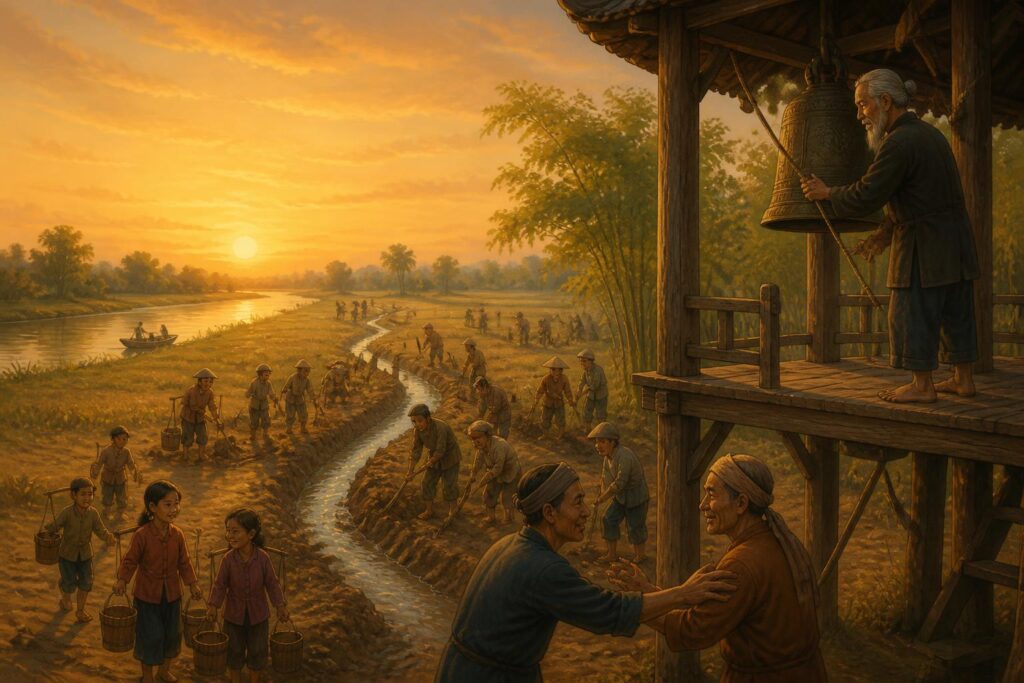
Long ago, at the edge of a great plain, there was a small village nestled beside a river that was full of water all year round. The villagers called it the Cloud River, not because the water was the color of clouds, but because each morning, mist rose in soft white ribbons, covering the bamboo banks, thatched roofs, and winding dirt paths. The Cloud River nourished the rice fields, carried fishing boats past the village, and was also where the village children often sat fishing on summer afternoons.
By the river stood an old shrine with a bronze bell hanging in a wooden belfry. The bell was not large, but its sound was clear and carried very far. For generations, whenever the sun set, the bell keeper would pull the rope and strike it three times. The first strike told those working in the fields that it was time to return. The second reminded the boats on the river to find their way to the landing. The third was a blessing of safety for everyone still far from home.
By the time of Mr. Lam, tending the bell had become more a promise than a job. He lived alone in a small house behind the shrine, sweeping the courtyard, polishing the bell, and checking the worn pulling rope day after day. His hair was completely white, his back slightly bent, and his steps slower than before, but not once had the bell been absent at dusk.
The villagers often did not understand why he observed the custom so strictly. On days when rain and wind made the trees bow and sway, he still put on his rain cape and climbed the belfry. On days when he had such a high fever that he could barely stand, he asked the neighbor boy to help him as far as the foot of the stairs. There were also days when no one was working in the fields and not a single boat was on the river, yet the bell still rang out across the quiet village.
The Promise by the Water Landing
Many years earlier, when Mr. Lam was still a young man, the village had endured a terrible flood season. The Cloud River rose quickly, sweeping away the bamboo bridge, submerging many rice fields, and eroding a stretch of the eastern bank. That night, the villagers fled to higher ground to escape the water. Amid the rain and the sound of collapsing roofs, they heard the shrine bell ringing again and again, guiding those trapped in the darkness.
At the time, Mr. Lam and his father rowed a small boat in search of people in danger. They rescued many families, including an old woman and her grandson named Khai. Khai was a few years older than Mr. Lam, strong and brave, but hot-tempered. When the boat returned to the landing for the last time, Mr. Lam’s father discovered that the mooring rope had been swept away by the current. He told his son to stay and hold the lantern while he jumped into the water to pull the boat in.
That night, his father did not return.
People found him the following morning, caught among bamboo groves far from the village. After the funeral, Mr. Lam hardly spoke for many days. It was only when Khai came to the shrine that the young man learned that, before leaving the landing, his father had said that if he could not return, Mr. Lam should take his place and keep the village bell ringing. The bell had to sound so that those who went far away would know that there was still a place here waiting for them to return.
Khai wanted to help Mr. Lam care for the shrine, but something happened between them that caused their friendship to fracture. While trying to rescue a stranded family, Khai had taken Mr. Lam’s father’s oil lantern without permission to light the way. The lantern went out in the middle of the current, causing his father to turn back and search for it. Khai always thought that he had caused his friend to lose his father, while Mr. Lam believed that Khai had acted too recklessly.
Neither of them spoke words of blame, but from then on Khai left the village. People heard that he had gone far away to trade, and then lost contact with him. Mr. Lam stayed behind, keeping the bell ringing as he kept his promise to his father, and also holding on to an anger he did not know where to lay down.
The Season of Receding Water
Years passed, and the Cloud River gradually changed. The upstream forests were cleared, the rains became erratic, and the riverbed was filled with silt and rocks. The water was no longer as abundant as before. During one drought-stricken summer, the river’s surface was reduced to only shallow pools scattered across cracked sandbanks. The fields failed, the village wells slowly dried up, and the people had to travel far to carry water home.
Faced with this situation, the village chief proposed that everyone dig a new canal to bring water down from the highlands. The work was extremely arduous and required many people to labor together for many days. Yet the villagers were accustomed to relying on the river, and everyone waited for someone else to begin. Those with strength feared working for nothing, those who owned land worried that the canal would pass through their fields, while the poor could only sit in front of their homes and watch their water jars grow emptier each day.
When Mr. Lam heard about it, he rang the bell earlier than usual. Three strikes echoed across the dry fields, making everyone look toward the shrine. Afterward, he went from house to house, asking neither for money nor blaming anyone. He asked each person only one question: “If the water does not return, what can we still preserve for one another?”
The question made many people uncomfortable. They thought that an old man who spent his days beside a bell could know nothing about digging a canal. Some even said that he should use his strength to repair his own roof instead of worrying about the whole village. Mr. Lam did not argue. The next day, he carried a hoe to the western field and began digging a small trench.
That morning, he was alone. By noon, a little girl brought him a gourd of water. As evening fell, several farmers passing by stopped to help him scoop out a few loads of earth. On the third day, the village chief called the young men of the hamlet to join in. The canal gradually took shape, winding through the fields toward the ancient well at the foot of the hill.
The Man Who Returned on a Windy Evening
On the very day the canal was nearing completion, a strange man appeared at the edge of the village. He was thin, sun-darkened, and accompanied by a horse carrying two sacks. No one recognized him at first, but Mr. Lam knew after a single glance that it was Khai.
Khai was no longer the hot-tempered young man of years past. His hair was streaked with gray, and a long scar ran across his face from his temple to near his cheek. He had brought iron tools to help the villagers dig, along with seeds of a drought-resistant plant. But when he saw Mr. Lam, Khai stood motionless beside the canal bank, afraid to approach.
That night, strong winds swept through the village. Part of the newly dug canal bank collapsed, and earth and stones buried nearly all the work of many days. The next morning, everyone was sad and exhausted, and they began blaming one another. One person said the soil on his land had been dug too deeply, another said Khai had brought the tools too late, while someone else claimed that the canal had always been impossible to build.
Mr. Lam quietly walked over to Khai. For the first time in several decades, he looked directly at his old friend.
“On the night of the flood,” he said, “my father turned back because your lantern went out. I thought that if you had not taken it down, my father would not have had to turn back.”
Khai lowered his head. “I know. I lived all those years with that thought. But I also want you to know that before he jumped into the water, your father told me to hold on to the lantern. I was afraid a family behind us would not be able to see the way, so I took it down. I did it the wrong way, but I never wanted anything to happen to him.”
Mr. Lam said nothing. The wind passing through the dry grass sounded like a sigh. After a while, he asked, “Why did you come back?”
Khai looked at the buried canal. “Because I heard the river was drying up. I thought that if I delayed any longer, this place would no longer be a village. And because I realized that some debts cannot be repaid by running as far away as possible.”
Mr. Lam sat down beside the earthen bank and scooped up a handful of sand. He had once thought he kept the bell to fulfill his promise to his father. But over the years, the bell had also kept him trapped in an old flood night, where he never stopped searching for someone to blame. The promise had helped him go on living, but his anger had kept him from truly stepping out of the past.
At last, he handed Khai a hoe.
“If you still have the strength, dig with me,” he said. “This canal is not finished.”
The Bell After the Drought
That day, the villagers came together again to repair the canal. Khai showed everyone how to reinforce the banks with stones and roots. Mr. Lam assigned the work, while the children brought water to each group. Those who had once been reluctant to give up part of their fields gradually understood that without the canal, no field would have enough water left for planting.
Three days later, water from the ancient well flowed down the canal. The stream was small and muddy, but when it reached the fields, it softened the earth. The villagers stood on both sides of the bank, and no one spoke loudly. They simply watched the water slip through the channels, as if witnessing something they had thought lost now return.
That evening, Mr. Lam climbed to the bell tower. Khai stood below, looking up at his old friend. When the first bell rang, those in the fields returned. The second rang out over the sandbanks, where several small boats were being dragged into the water. At the third strike, Mr. Lam paused longer than usual, then handed the rope to Khai.
Khai shook his head, but Mr. Lam said, “This promise is no longer mine alone.”
Khai pulled the rope. The bell trembled, its clear sound flying over the rooftops, across the newly dug canal, and over the fields waiting for the planting season. The villagers looked up toward the shrine. They suddenly understood that the bell did not merely announce the time to return. It also reminded everyone that a village is made by hands willing to shoulder work together, by people brave enough to admit their mistakes, and by forgiveness that does not make the past disappear but helps people stop being held back by it.
From then on, Khai stayed in the village. He repaired the small bridges, tended the canal, and taught the children how to find water sources during the dry season. Mr. Lam still kept watch over the bell every evening, but he no longer went alone. Some days it was Khai; on other days, it was the village children. The old bell continued to ring, not to call those who had left back to a place, but to remind those who were living to return to one another.
And although the Cloud River was sometimes full and sometimes low in the years that followed, the villagers still remembered what Mr. Lam had once asked: if the water does not return, what can we still preserve for one another? The answer lay in the small canal running through the fields, in the hand placed on the shoulder of someone who had made a mistake, and in the bell ringing every evening, steadfast as a promise passed from one generation to the next.

ARTICLES IN THE SAME CATEGORY
The House with a Door Opening into Dawn
The Blue Garment Sewn for the Day of Return
The Clock That Did Not Run Through the Rainy Season
The Keeper of Seeds by the Dry River
The Room Waiting for Sunlight
The Bellmaker and the Silent Monsoon
ARTICLES IN THE SAME GENRE
Stepmother and Stepchild