

 Tiếng Việt
 日本語
日本語 한국어
한국어 中文 (中国)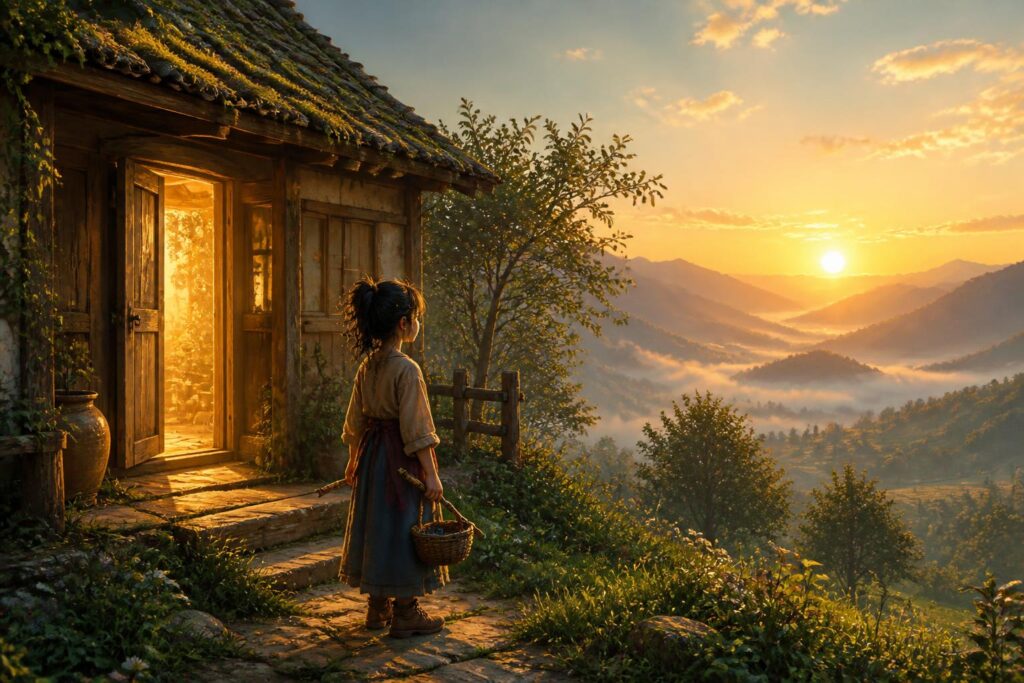
The House on the Hillside
At the far end of Moc Village, where the winding dirt road met the foot of the mountain, there stood a small house with a moss-green tiled roof. The villagers called it the House of Dawn, though no one had ever seen dawn step out through its weathered wooden door. The house was not large, consisting of only a kitchen, a sitting room, and a low attic so cramped that adults had to bow their heads. The strange thing was that the house was always clean, the kitchen never gathered dust, and on the doorstep there was always an earthen bowl filled with clear water.
No one knew who owned the house. The old people said that long ago, a carpenter had built it for his wife, who was often ill. Others claimed it had once been home to an old woman who specialized in healing, before she disappeared one morning when pink clouds covered the mountaintop. Some said the house was not empty at all. On clear nights, they heard the sound of chairs being dragged, firewood crackling, and sometimes someone singing very softly behind the door.
The village children often dared one another to run up the hillside, touch the doorknob, and run back down. None of them dared to stay long. An alone did not believe those stories. The thirteen-year-old girl had hair that was always tangled by the wind and eyes that looked at everything as though a secret were hidden beneath every stone. An lived with her mother in the house at the end of the village, where the two of them sold corn cakes to make a living. Ever since An’s father had died in a flood, her mother had grown much quieter. She still worked, still cooked, and still mended clothes for her daughter, but in that house there was a silence that no one dared touch.
An missed her father. She missed his calloused hands, the way he used to whistle while chopping wood, and his promise to take her to the mountaintop to watch the sunrise. That promise had never come true. After the flood, the adults told An that she had to learn to accept it. Her mother said nothing, only put her father’s old raincoat into a wooden chest and locked it away. Whenever An asked, she always replied that some things hurt more the more they were mentioned.
The Door That Refused to Open
One late afternoon at the end of the rainy season, An carried a basket of cakes up the mountain to deliver to a goatherd. On her way back, she saw a thin layer of mist creeping across the grass and stopping in front of the House of Dawn. The wooden door, which was usually tightly closed, had suddenly opened a crack. From inside came the smell of roasted corn cakes, exactly like the smell of the cakes her mother used to make when her father was still alive.
An stood for a long time before the threshold. She told herself she only needed to look inside for a moment, then she would go straight home. But as soon as her hand touched the doorknob, the door closed. An tried pushing, pulling, and even knocking three times, the way the villagers did when visiting one another. The door did not move.
Just then, a voice rang out behind her:
“This door does not open for someone who only wants to know.”
An turned around. An old woman stood beside an ancient elm tree. She wore a brown robe and held an oil lamp, though it was still light outside. Her face was wrinkled, but her eyes were bright and calm.
“Then whom does the door open for?” An asked.
“For someone who knows what she is looking for.”
“I want to know what is inside the house.”
The old woman shook her head. “That is curiosity, not searching.”
An grew angry, picked up her basket, and was about to leave. But before she started down the slope, she heard the old woman continue:
“Tomorrow, bring here something you have kept for too long.”
That night An tossed and turned. She thought of the things she had stored in a box, the broken hair clip, the stone she had picked up beside the stream, and the piece of cloth her father had once used to wipe away his sweat. The next morning, she took a bamboo whistle from a drawer. It was a gift her father had made for her before the flood. An had kept it for three years but had never blown it even once, afraid that the sound would make her miss him even more.
She carried the whistle to the House of Dawn. The old woman was already waiting beside the doorstep. An placed the object in the earthen bowl. The water in the bowl trembled slightly, then a drop spilled over the edge. The door remained closed.
“You have not brought the thing you have kept the longest,” the old woman said.
“This is something my father left behind.”
“No. You have kept your fear longer.”
An did not answer. She picked up the whistle, turned her back, and walked away. The road down the mountain seemed longer than usual that day. The old woman’s words kept echoing in her mind. An wanted to argue, but the harder she tried to deny them, the more she felt they were true.
What Lay Inside the Wooden Chest
That evening, An’s mother went to deliver cakes to the village chief’s house. An stood before the wooden chest in the corner of the room. She had not touched it in three years. She knew the key was hidden beneath the salt jar, where her mother kept important things. An took the key, opened the chest, and saw her father’s old raincoat neatly folded beneath a brown cloth. The coat had been dry for a long time, but it still carried the scent of damp earth.
Beneath the coat was a sheet of paper folded into quarters. An had never seen it before. The handwriting on the paper slanted awkwardly, yet was familiar. Her father had written that he wanted to take An up the mountain on the first day of the sunny season. He wanted to show her the sun rising behind the rocky peak, where the first light was pale purple before gradually turning gold. At the end of the paper, he wrote: “If one day I do not have time to keep my promise, do not think that the promise has disappeared. Some things that were never done can still light the way for those who remain.”
An read it over and over until her tears fell onto the paper. She had once been angry with her father for making a promise and failing to fulfill it. She had also been angry with her mother for always telling her not to ask. But beneath that anger was the fear that if she cried too much, her father would become someone who existed only in memory. So An tried to appear strong, tried not to mention his name, and tried to put everything away in the chest, as though she were storing an unopened room.
When her mother returned, An sat beside the fire and handed her the paper. Her mother took it and stared at it for a long time. She did not scold her daughter for opening the chest. She simply sat down beside her, folding her hands together.
“I found this paper after the flood,” she said. “I did not give it to you because I was afraid you would miss your father even more. In truth, I was afraid too. I thought that if we did not mention him, the pain would grow smaller. But perhaps it only lay still, waiting for a day when it would become bigger.”
It was the first time in many years that An’s mother had spoken about her father for so long. The two of them told each other the things they remembered. Her mother said that An’s father had clumsily cracked three pots simply because he wanted to cook porridge himself when she was ill. An told her about the time her father taught her to whistle, but all she could produce was a warped sound like the wind. At times they both burst out laughing, and then they cried again. That night, the house at the end of the village was no longer as silent as before.
Where the Light Begins
The next morning, An carried the paper to the House of Dawn. The old woman asked no questions. An placed it in the earthen bowl together with the bamboo whistle. This time, the water in the bowl did not spill over. The wooden door opened inward with a soft creak.
There was no treasure in the house, nor any ghost or dazzling magic. The sitting room contained only a wooden table, several chairs, a fire that had gone out, and many identical earthen bowls. No pictures hung on the walls, but honey-colored streaks of light streamed through the gaps between the planks. The light was not like the sunlight outside. It was warmer, like the light in the memory of someone who had just been called by name.
At the back of the room was another door. The old woman told An to open it. Beyond it was a stone path leading to the hilltop. An walked along it and realized that she was standing exactly where her father had once wanted to take her. The sun had not yet fully risen. The eastern sky was pale purple, then gradually turned gold. Below in the valley, Moc Village lay small beneath the mist.
An did not see her father. She did not hear his familiar whistle either. But she understood that she had never truly needed a figure to appear in order to know that a promise still held meaning. Her father had left her a way of looking, a story, and a way to welcome the morning. The rest was a path she had to walk herself.
“What does this house do?” An asked when they came back down.
The old woman poured water into the earthen bowl. “It helps people open the door they have locked inside their hearts. But the house cannot let go for anyone.”
“Who are you?”
The old woman smiled. “Someone who once kept a door locked for too long.”
An did not ask anything else. She knew that some secrets did not need to be explained in order to become meaningful.
The Mornings That Followed
From that day on, An often went up to the House of Dawn early in the morning. Some days she met a woodcutter who constantly blamed himself for not managing to save a horse. Other days there was a girl from the village holding a letter she had not dared to send to her brother, who was working far away. Each person brought something different. Someone placed an old scarf down, someone brought a broken comb, and someone merely placed a hand on the bowl and cried for a very long time.
The door did not always open at once. The old woman never hurried anyone. She only told them to sit beside the fire and call by its proper name the thing that was causing them pain. When a person stopped running away, the door would open by itself.
An gradually understood that the house did not grant anyone a new life. It only gave them enough quiet to look back at the life they already had. The woodcutter returned to care for the horses that remained. The girl sent the letter, though she did not know whether she would receive a reply. An’s mother took her father’s raincoat out into the sun to dry, then folded it and put it back in the chest instead of locking it tightly away.
One morning at the beginning of the sunny season, her mother asked An whether she wanted to go up the mountain with her. The two of them brought corn cakes and the bamboo whistle. They sat on the hilltop and watched the sun rise. An blew the whistle for the first time. The sound was still awkward, thin, and slightly off-key, but it carried far across the grass.
The House of Dawn stood behind them. Its door was open, welcoming the light as it poured into the small room. From then on, the villagers were no longer afraid of the house. They still called it by its old name, but no one asked what kind of magic lay inside. For true magic did not lie in what the house kept. It lay in the moment when a person dared to cross the threshold of their own heart, carrying their pain and learning how to turn it into light.

ARTICLES IN THE SAME CATEGORY
The Blue Garment Sewn for the Day of Return
The Clock That Did Not Run Through the Rainy Season
The Keeper of Seeds by the Dry River
The Room Waiting for Sunlight
The Bellmaker and the Silent Monsoon
The Lamplighter at the End of the Slope
ARTICLES IN THE SAME GENRE
Tam Cam Part 2: The Vengeful Spirits of the Palace
Tam and Cam: The Palace Intrigue and the Original Ending – Part 1
The world is never short of those who judge others by their material possessions; however, the most concerning poverty of all is the lack of wisdom and self-cultivation.
Stay Away from Foolishness: Seven Forms of Self-Deception and the Path to Awakening
Letting Go of Attachment to Overcome Anxiety: When What Exhausts Us Is Not Life Itself, but the Way We Hold On to It
Drinking Tea or Living Life: When People Get Lost in Material Glamour and Forget Themselves