

 Tiếng Việt
 日本語
日本語 한국어
한국어 中文 (中国)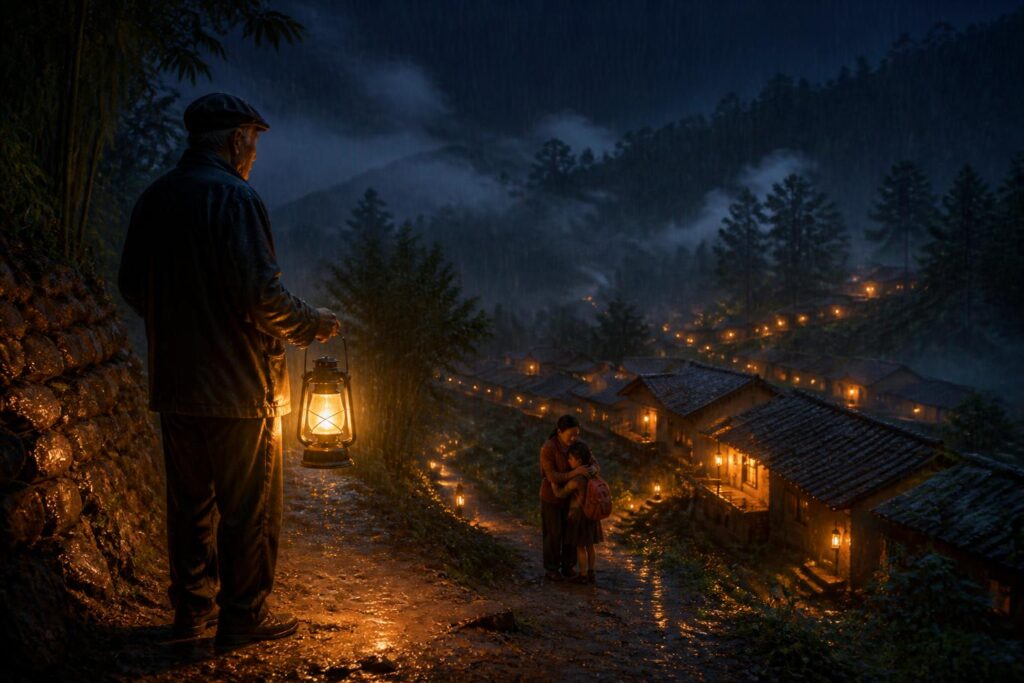
The Lamp Beside the Slope
At the edge of a village nestled in a valley, a winding slope led to an old forest. During the day, the slope was unremarkable, with nothing more than gray rocks, a few rose myrtle bushes growing along the roadside, and the calls of birds echoing through the leafy canopy. But when evening fell, the place grew dark faster than anywhere else. Clouds often hung low over the mountainside, while the tall trees made it difficult for moonlight to pass through.
That was why, many years earlier, the villagers had erected a lamppost at the head of the slope. The lamp was not large, with only a glass shade and a small oil reservoir, but it was enough to illuminate the first few steps. The person responsible for lighting it was Mr. Lam, a man who had spent more than half his life moving at an unhurried pace, with hands that always carried the smell of kerosene.
Whenever the sun disappeared behind the mountain peak, Mr. Lam would bring out the wooden ladder, climb up to wipe the glass, fill the oil, and then light the flame. He did this so regularly that the villagers did not need to look at a clock to know that night had begun. The children often called him the keeper of the stars, because they believed he could take a star from the sky and place it at the head of the slope.
Mr. Lam only smiled when he heard that. He knew his lamp could not drive away all the darkness. It merely created a small patch of light in the midst of the long night. But sometimes, a small patch of light was enough for someone who was afraid to find the next step.
The Little Girl Looking for Her Mother
One late afternoon at the end of the rainy season, just as Mr. Lam was closing the lid of the oil reservoir, he heard crying from the direction of the slope. The sound came and went, stretched by the wind into broken, interrupted notes. He took a storm lantern, walked down a few stone steps, and saw a little girl sitting beside the roots of a tree.
The girl was wearing a brown shirt soaked through with rain, and both hands were clutching a cloth scarf. When she saw him, she immediately stood up but did not run toward him. Her eyes were wary, and rainwater still clung to her cheeks.
“What is your name? Why are you sitting here alone?” Mr. Lam asked.
“My name is An. I’m looking for my mother.”
“Where is your mother?”
An shook her head. She said that in the morning, her mother had taken her to the neighboring village to trade some cloth for rice. On the way back, they had encountered a heavy rainstorm. Her mother had told An to shelter beneath the eaves of an abandoned house while she went back to look for the basket they had dropped. An had waited for a long time, but her mother never returned. Afraid that her mother might take the wrong path, she had followed the slope on her own, and the farther she went, the less she knew where she was.
Mr. Lam looked toward the forest. It was already completely dark. The path ahead was slippery, and puddles reflected the flickering lamplight. If he took An farther along the path, both of them could be in danger. If he left her there, he would not be at peace either.
“First, come into my hut and warm yourself,” he said. “Tomorrow morning, we’ll go look for your mother.”
An tugged at his sleeve.
“But what if my mother is looking for me?”
Mr. Lam was silent for a moment, then looked at the lamp above the slope.
“Then we’ll make the lamp shine brighter. Whoever is looking for you will know that someone is waiting here.”
Passing the Light Along
Mr. Lam’s hut was only a small wooden room, containing a bamboo bed, an earthen stove, and an old table. He lit a fire, gave An a set of his own dry clothes, and cooked a pot of thin porridge. While waiting for the porridge to finish, he took a wooden stick, tied a piece of red cloth to its tip, and planted it in front of the hut.
An asked curiously, “What are you doing?”
“So that people passing by can see us.”
“How will my mother see us from just one little flag?”
“One little flag isn’t enough. But if every house has a signal, the whole road will become a call.”
With that, Mr. Lam took the storm lantern and went down to the village. He knocked on every door, told the story of the lost girl, and asked everyone to hang a brightly colored piece of cloth outside their door or place a small lamp on the porch. No one asked why they should help. One person brought a bundle of torches, another brought blankets, and someone else brought food. A few young men planned to go into the forest immediately, but Mr. Lam stopped them because the rain could cause the earth and rocks to slide at any moment.
“Tonight, we won’t search in haste,” he said. “We’ll let the mother find her way back.”
Before long, points of light began appearing one after another, from the head of the village to the foot of the slope. Houses with oil lamps lit their oil lamps. Houses without lamps burned bundles of dry straw beneath their eaves. Someone even used a white shirt hanging on a pole as a signal. The road, which had been submerged in darkness, suddenly held a succession of patches of light like a golden stream.
An sat in front of the hut, looking at those points of light. She was no longer crying, but she still clutched the cloth scarf tightly.
“Mr. Lam,” she asked, “what if my mother can’t see them?”
“Then tomorrow morning, we’ll go look for her.”
“What if we still can’t find her tomorrow?”
Mr. Lam added another piece of firewood to the stove.
“Then we’ll look again the day after. Someone who has lost their way in the forest cannot be left behind just because darkness has fallen once.”
The Return in the Rain
That night, the rain fell relentlessly. Wind slipped through the gaps between the planks, making the fire in the stove lean and waver again and again. An slept for a while, then suddenly woke. She heard a voice calling from very far away, sometimes seeming to echo from the direction of the forest, and sometimes as though it came from the other side of the stream.
Mr. Lam heard it too. He stood up and opened the hut door. The entire slope was silent, except for the sound of water flowing beneath the stone slabs.
“Mother!” An sprang up.
The two of them stepped outside. Mr. Lam held the storm lantern high, while An carried the wooden stick with the red cloth tied to it. They stood still and listened. The call came again, faint but clearer:
“An!”
On the other side of the stream, a figure was clinging to a tree trunk. It was a woman whose clothes were smeared with mud, whose leg was scraped, and whose hand was still caught in a misshapen basket. She had gone around the mountainside looking for her daughter but had slipped down a low earthen bank. She was not seriously injured, but she could not cross the rising water on her own.
An wanted to run straight to her mother, but Mr. Lam held her back. He called the villagers. A short while later, several men arrived carrying ropes and long poles. They tied the ropes into a safe line, then guided the woman step by step across the stream. When mother and daughter threw their arms around each other, no one could say a word. The rain continued to fall, but it seemed as though the whole slope had grown lighter.
The mother thanked Mr. Lam and the villagers many times. He only shook his head.
“I only lit one lamp. It was everyone else who made the road bright.”
The woman looked at the row of lights stretching from the foot of the slope all the way to the village. She understood that if there had been only one solitary lamp, she might not have recognized the way home. It was the small signals beside each house that had guided her through the rain.
The Road Afterward
From that day on, the villagers kept the habit of placing a lamp outside their doors whenever heavy rain fell or someone who had gone away had not yet returned. At first, some people thought it was unnecessary. They said that a small lamp could not change the darkness of night. But eventually they realized that what mattered was not the brightness of each individual lamp, but the fact that they stood beside one another.
Mr. Lam continued to care for the lamp beside the slope. As he grew older, he could no longer climb the ladder as quickly as before. The villagers took turns helping him clean the glass, fill the oil, and inspect the shelter. The children grew up, and many of them went away to study, but whenever they returned, they always stopped by the wooden hut to ask how he was.
An came often too. The little girl she had once been was now grown and had become the village seamstress. Whenever rain threatened, An always hung a strip of red cloth outside her door. Once, a child asked her why she did it, and An told the story of the night she had lost her way, saying:
“When you’re afraid, you don’t need the whole world to become bright all at once. You only need to see one small sign telling you that you haven’t been left behind.”
Those words were passed from one person to another. People said that the slope in the village was no longer as frightening as it had once been. Not because the forest had grown thinner, the rain had become less frequent, or the darkness had disappeared. Darkness still came every night, just as it was meant to. It was simply that whenever darkness appeared, the people in the village knew how to stand closer together.
What the Lamp Reminds Us
In life, there are times when we hope for some grand solution to drive away all our anxiety. We want a perfect answer, someone strong enough to lead the way, or a miracle that can make every difficulty disappear. But often, what helps people keep going is not so grand. It may be a timely inquiry after someone’s well-being, a meal set aside, an open door in the middle of the night, or the patience of someone who refuses to give up.
Mr. Lam’s lamp did not make the road less slippery. It did not stop the rain, nor could it replace the feet of the person searching for the way. Even so, it gave the lost a place to begin. When those starting points joined together, a new road took shape—not a road without darkness, but a road in which darkness no longer made people alone.
And perhaps that is the kindest thing we can do for one another. We do not necessarily have to solve all of someone’s sorrow. Sometimes, simply staying, keeping a lamp lit, and saying, “Take one more step,” is enough to help them find their way home.

ARTICLES IN THE SAME CATEGORY
A Small Promise Can Keep a Family’s Warmth Alive
When the Meal Slows Down, Family Grows Closer
The Unextinguished Lamp at the End of the Alley
The Silence Between Two Moments of Haste
When Old Things Remind Us That We’ve Grown Up
The Basket Weaver by the Old Riverbank
ARTICLES IN THE SAME GENRE
Stepmother and Stepchild