
Story Collections · 29 November, 2026
The Lamplighter at the End of the Alley
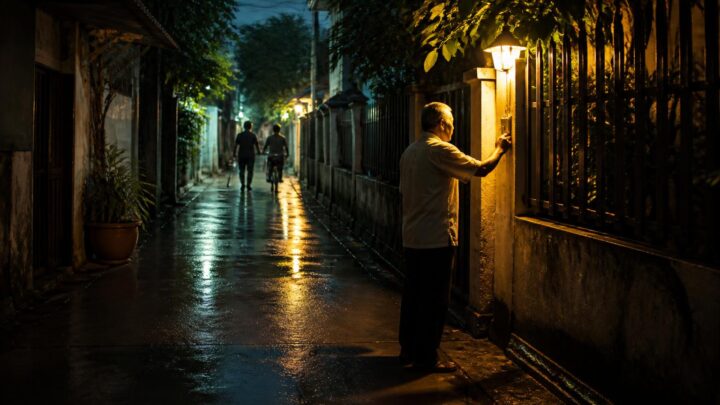
The Lamp Behind the Fence
At the end of the small alley, there was a lamp that was always lit before darkness had fully fallen. It was not hanging from a utility pole, nor did it belong to any shop or house. The lamp stood behind a low fence covered in Rangoon creeper, mounted on an old metal bar and directed toward the winding path leading to the vacant lot.
The man who lit it was Mr. Bay, a man in his sixties who lived alone in a corrugated-metal-roofed house near the mouth of the alley. Every afternoon, after sweeping the yard and watering a few bougainvillea pots, he would take a wooden chair and slowly walk down to the end of the lane. He wiped the glass, checked the electrical wire, and then flipped the switch. Only after the soft yellow light spread across the concrete would he return home.
At first, hardly anyone paid attention to what he did. The city had countless lights, and a small bulb in an alley was not enough to become something worth mentioning. But over time, everyone began to realize that the lamp had become a familiar part of the evening. Children returning from extra classes often looked at it to know they were almost home. Street vendors pushing their carts felt more at ease when their wheels did not have to feel their way through the darkness. Those returning late only had to see the glow cast onto the wall at the end of the alley to know that their homes were still somewhere ahead.
Those Who Returned at Night
Mr. Bay did not say much about why he lit the lamp. When people asked, he would only smile and say, “If the road is dark, you light it up. What is there to talk about?” The answer was so simple that everyone assumed it was merely a habit, like brewing a pot of tea every morning or watering the plants every afternoon.
Then, one rainy night, everyone understood what the lamp meant. That day, heavy rain had continued from the afternoon, water had overflowed from the drain, and a glistening layer covered the surface of the road. Nearly nine o’clock, Ms. Hanh, who worked at a garment workshop quite far from home, was cycling back. Because rain was blowing into her eyes, she did not see a section of loosened paving in the middle of the alley. Her bicycle swerved, she fell, and her leg was injured.
She tried to call out, but the rain swallowed the sound. As she struggled to find a way to stand up, she saw the light at the end of the alley. It was not bright, but it was enough for her to realize that she was only a few dozen meters from home. She braced herself against the wall and felt her way step by step toward it. When she drew near, the sound of the fallen bicycle prompted Mr. Bay to open his door. He ran out with a flashlight, helped her home, and then called her family.
The next morning, the story spread throughout the alley. Ms. Hanh came over on crutches to thank him. Mr. Bay waved his hand dismissively and said that even without the lamp, she would still have found her way home. Ms. Hanh did not argue; she simply left a bag of fruit in front of his door. From that day on, whenever she passed by, she would look up at the bulb and call into the house, “I’m home, Mr. Bay.”
Not long afterward, it was a boy named Minh who drew everyone’s attention to the lamp. Minh was in sixth grade. He was often afraid of the dark but did not want his friends to make fun of him. One evening, his mother was unable to pick him up because she had to stay at the hospital to care for a relative. Minh put on his backpack and walked home through the alley by himself. When he reached the end of the road, the electricity in the neighborhood suddenly went out. All around him, there was only the sound of barking dogs and water dripping from the eaves.
Minh stood still, gripping his backpack straps tightly. Just then, Mr. Bay appeared with an oil lamp in his hand. He did not ask why Minh was alone; he merely told the boy to stay close beside him. The two of them walked slowly through the dark stretch of road. When they reached home, Minh realized that he had neither cried nor trembled as he had always imagined he would.
The next day, Minh brought Mr. Bay a pencil drawing. In it was the alley with its low rooftops, several potted plants, and a very large lamp at the end of the road. The drawing had no words, but Mr. Bay looked at it for a long time before carefully sticking it to the wall in his living room.
What Mr. Bay Had Never Said
It was not until an afternoon near the end of the year that the people in the alley learned why Mr. Bay cherished the lamp so much. That day, a neighbor brought him some cakes and stayed for tea. The conversation happened to turn to the old houses, the people who had moved away, and the changes in the alley.
Mr. Bay looked out at the yard and said that many years earlier, his wife had suffered from a serious illness. At that time, his house did not have this lamp. One night, she suddenly had difficulty breathing, and he had to run out to find someone to take her to the hospital. The alley was plunged into darkness because a light bulb had been broken for a long time. He tripped several times, and the cart carrying his wife became stuck on a rough section of road. Everyone still managed to help in time afterward, but the delay that night became a burden of regret he carried for many years.
His wife did not survive after a period of treatment. When he was left alone in the house, he repaired the metal bar in front of the fence and installed a new lamp. He told the worker that he did not need a beautiful lamp; he only needed one that could shine all the way to the end of the alley. From then on, he began lighting it every evening.
He did not see it as a way to atone, nor did he think he was doing anything extraordinary. To him, it was enough that other people would not have to feel their way through the night as he once had. Some losses cannot be changed, but people can still choose not to let their sorrow become darkness for someone else.
When the Light Was Passed On
After that story, the people in the alley no longer regarded the lamp as Mr. Bay’s private responsibility. Each household contributed something. One person provided electrical wire, another brought a new bulb, and someone quietly repaired the section of ground where water often collected. Ms. Hanh bought a plastic box to cover the switch when it rained. Minh took responsibility for wiping dust from the glass on Saturday afternoons.
At first, Mr. Bay was hesitant, saying that he could still manage on his own. But then he understood that some things could last only when many people helped care for them. He gave Minh a soft cloth and told him never to climb onto the tall chair by himself. The boy nodded seriously, and later invited several friends from the neighborhood to sweep the leaves around the base of the lamp.
The lamp did not shine any brighter than before, but the alley seemed warmer. People who had once merely exchanged hurried greetings began stopping to ask how one another were doing. A young woman who had just moved in learned where to buy medicine nearby. An elderly man living in the house in the middle of the alley had someone accompany him home when it rained. The children became less hesitant to visit one another’s houses to study in the evening.
What changed was not the physical light. It was the feeling that there was always a point of light waiting for them at the end of the road. In a large and hurried city, that feeling was sometimes worth far more than many words of concern. People might not know one another’s names or fully understand one another’s stories, but they could still leave each other something small that made the road home feel less cold.
An Evening Without Mr. Bay
During the rainy season the following year, Mr. Bay came down with a fever and had to stay in bed for many days. On the first evening he did not go out to light the lamp, everyone in the alley felt that something was missing. Ms. Hanh walked past his house and stopped. Minh stood at the gate and called in to ask whether Mr. Bay needed anything.
Mr. Bay said that the bulb was still working; he simply did not have the strength to go and check it. Ms. Hanh immediately got her raincoat and brought along the cleaning cloth. Minh took a flashlight and went with her. They took turns checking the electrical wire, wiping the glass, and clearing broken branches blocking the path. That evening, the lamp was still switched on at the usual time, even though the person standing beside the switch was not Mr. Bay.
In the days that followed, everyone divided the work among themselves. One person checked it at the beginning of the week, another watered the plants, and someone else replaced the bulb when necessary. Mr. Bay lay beside the window, watching each person pass by and smiling. He had once thought he was keeping the alley’s light alive, but it turned out that the alley was quietly holding on to him as well.
When he recovered, the first thing he did was walk to the end of the road. The wooden chair was still there, the metal bar had been wrapped with an additional layer of protective wire, and the area around it was cleaner than before. Minh handed him the cleaning cloth and said, “From now on, you don’t have to do it alone.” Mr. Bay took it, his eyes turning red, but he only nodded.
The Light of a Place to Return To
Some things in life do not begin with a grand plan. One person simply wants to make the stretch of road in front of his house less dark; someone else leaves a bag of fruit to say thank you; a child draws a picture in response to being protected. Small acts follow one another, eventually creating a bond of affection that no one has time to name.
The lamp at the end of the alley is still not strong enough to drive away all the darkness. On days of heavy rain, its light is even blurred by the water. But it reminds everyone that darkness does not always need to be defeated by extraordinary things. Sometimes, all it takes is one person willing to flip a switch, another willing to wipe away the dust, and a few people standing together for the road to become easier to travel.
From then on, every evening when they returned, the people in the alley often looked toward the end of the road before opening their doors. They looked at the lamp, then over at the houses where the kitchen lights were still on. Perhaps no one said it aloud, but everyone understood that this place was more than just a passageway. It was where strangers learned to recognize one another, where an old sorrow was transformed into kindness, and where each person knew that they were not entirely alone on the way home.
Related articles

When an Apology Comes at the Right Time
In many relationships, what drives people apart is not necessarily a very serious mistake. Sometimes the distance begins with an unthinking remark, a prolonged silence, or a forgotten promise. The incident may initially seem small, but the feeling of hurt lingers longer than one might expect. When neither person is willing to speak first, each
Read more
The Scent of Rain in a Wooden Suitcase
The day An returned to the village, the rain had just stopped. The dirt road leading into the old neighborhood still glistened with water, while the two rows of bamboo bent over the pale pools of afternoon light. The bus dropped him off at the foot of the slope and continued on, leaving behind a
Read more
The Umbrella Repairman and the Late-Arriving Rainy Season
At the end of the old street stood a small shop just large enough for a wooden table, a rack, and a low chair worn down by the years. On the faded sign, people could still read the words: “Umbrella Repair.” Several strokes of the lettering had peeled away, but Mr. Lam had never once
Read more
The Clock That Wouldn’t Run and the Lesson About the Things Worth Waiting For
On a weekend afternoon, the small street behind the market still moved at an unhurried pace. The shops gradually pulled down their shutters, the sound of brooms sweeping dust blending with the motorcycles growing sparser on the road. At the end of the row of old houses, Mr. Lam’s clock-repair shop still glowed with a
Read more
The Stone Bench Beneath the Old Banyan Tree
Minh returned to the village one late-October afternoon, when the dirt roads had dried after several days of rain. The bus dropped him off at the head of the slope and drove away, leaving behind a thin cloud of dust suspended in the pale sunlight. He pulled his small suitcase past the areca palms at
Read more
The Lighthouse Keeper and the Map of Returns
At the far end of Vạn Chài Village stood a short lighthouse, its body painted white but streaked with salt stains. During the day, people almost forgot it existed. Only when evening fell, and the boats offshore began switching on their lights, did the lighthouse become the clearest point of brightness along the long stretch
Read more