

 Tiếng Việt
 日本語
日本語 한국어
한국어 中文 (中国)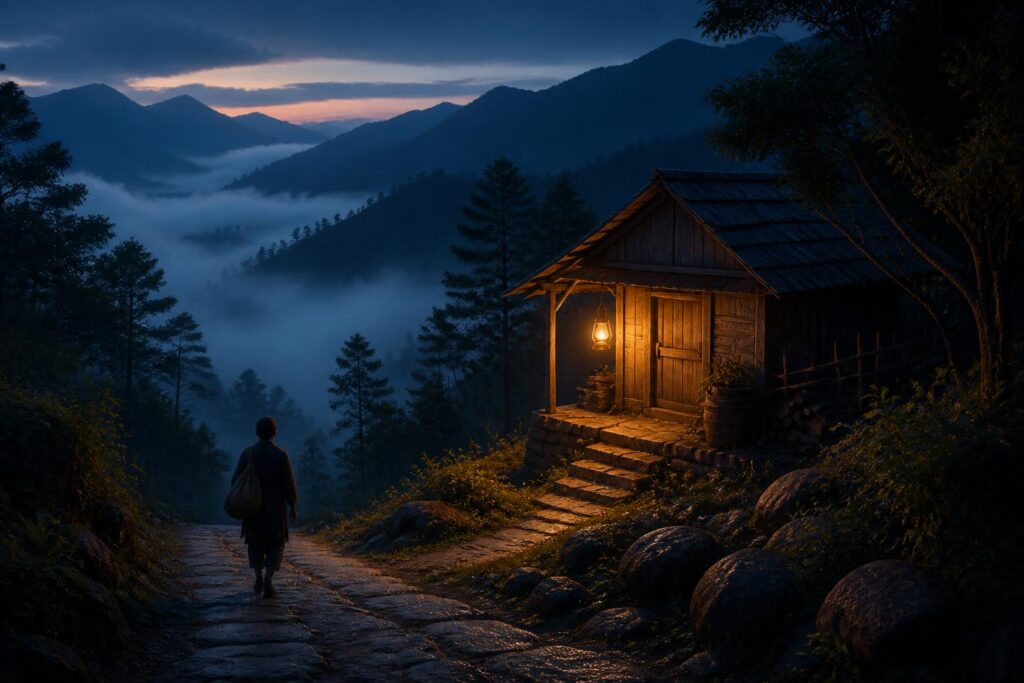
At the far end of White Cloud Village was a long, winding slope, twisting like a thread someone had dropped halfway down the mountainside. During the day, the slope was unremarkable apart from its jagged stone steps and the two rows of wild grass that were constantly bent sideways by the wind. But when evening fell, the place became much harder to traverse. Mist crawled up from the valley, blanketing the bends, while the sound of the stream below echoed upward and easily caused travelers to lose their bearings.
Right at the foot of the slope stood a small wooden hut. Inside were an old table, a kettle, a few bundles of dry firewood, and an oil lamp hanging from a crossbeam. The man who lived in that hut was Mr. Lam, a man over sixty. Every day, just as the sun disappeared behind the mountain peak, he would wipe the lamp’s glass, add more oil, and light it. The lamp was not large; its glow was only bright enough to illuminate a few paces of ground, but it had been lit regularly for many years.
The villagers called him the lamplighter. Some were fond of him, while others thought he was wasting his time on something that brought no benefit. The slope did not lead to the market, pass through good farmland, or serve as the main road into the village. Those who traveled along it were mostly woodcutters, peddlers, or a few villagers returning late after visiting the neighboring village.
“The road is already there. Whoever needs it knows how to use it,” someone once said. “Whom can a little lamp like that possibly help?”
Mr. Lam merely smiled. He never argued. Whenever he heard that question, he would look at the flame flickering behind the glass and reply, “Some people need only a little light so they won’t give up.”
The Lamp of a Promise
Many years earlier, Mr. Lam had not been a lamplighter. When he was young, he worked as a woodcutter and often crossed the slope after dark. One rainy season, rocks and earth slid down from the mountain and obscured the path. In the heavy rain, he slipped and fell into a rocky hollow. His leg was injured, and he could not get back up on his own. His cries were drowned out by the rushing water and the wind.
He thought he would remain there until morning. Then, when he was nearly desperate, he saw a faint streak of light in the distance. It came from the lamp of an old woman who lived in the house at the end of the slope. She heard a strange sound, took the lamp, went searching, and called the villagers to help. Thanks to that light, they saw the trail of his slip in the mud and found him before the stream rose too high.
The old woman died a few years later. Before she passed away, she gave the lamp to Mr. Lam and said, “If you still pass along this slope in the future, remember to leave a little light for those who come after you.”
Mr. Lam gave his word. At first, he lit the lamp only on rainy nights or when he knew that woodcutters would be returning late. Later, he lit it every evening, even on clear nights when the road was utterly deserted. The promise that had initially been made to one person gradually became the way he lived with everyone who might appear on the slope.
Those Who Passed Through the Night
On some nights, no one came by the hut. Mr. Lam sat beside the fire, listening to the steady chirping of insects and the corrugated metal roof trembling in the wind. From time to time, he would go outside to look at the lamp, raise his hand to shield it from the wind, and then go back inside. The silence lasted so long that one might think his work was completely pointless.
But on other nights, the lamp became an anchor for someone who was frightened and confused.
Once, a little girl named An got lost while picking bamboo shoots with her mother. When darkness fell, the frightened girl followed another path and wandered farther and farther away from the group. After crying until she was hoarse, An saw the light at the end of the slope. She followed it and Mr. Lam brought her into the hut, gave her warm water to drink, and sat beside her while they waited for her family to find her.
Another time, a cloth seller returning from a distant village developed a stomachache along the way. Mr. Lam added more firewood, brewed ginger water, and helped the traveler inside to lie temporarily on the bamboo bed. The next morning, feeling better, the cloth seller wanted to give him some money, but he refused to accept it. He only said, “Whenever you meet someone who needs help, remember not to pass them by.”
There was also a night when a young man stood in front of the hut for a long time without coming in. Mr. Lam saw him standing beneath a tree, his shoulders slumped and his shoes covered in mud. He did not immediately ask why the young man was sad. He simply placed a bowl of hot porridge on the doorstep. Near midnight, the young man finally came in to eat and told him that he had just argued with his father and left home in a fit of anger. He did not know whether he should keep going or turn back.
Mr. Lam said, “When your heart is full of noise, every road looks like a dead end. Just sleep for one night first. Tomorrow morning, if you still want to leave, go when you can clearly see where you are stepping.”
The next morning, the young man returned to the village. Several months later, he came back to help Mr. Lam repair the hut’s roof. Neither of them mentioned the old story, but from then on, whenever the wind began to rise, the young man would bring dry firewood and place it in front of the door.
When the Lamp Went Out
One winter, Mr. Lam came down with a severe fever. He lay unconscious in the hut, too weak even to go outside for water, let alone light the lamp. On the first night, the lamp went out. The same happened on the second night. The villagers began to notice that the familiar light at the end of the slope was gone.
On the third night, a group of people quietly made their way up to the hut. An, the little girl from years before, was now a young woman and brought medicine. The young man who had once left home brought firewood and porridge. The cloth seller from years earlier also came, along with several others whom Mr. Lam had helped. They took turns caring for him, clearing the path, and repairing the rotten wooden door.
Without anyone telling them to, as soon as the sun set, one person from the group would wipe the glass, add oil, and light the lamp. The lamp continued to shine, even though Mr. Lam was not yet able to get up.
When he awoke, the first thing he saw was light cast across the wall of the hut. He thought he was still delirious. An sat beside him and laughed: “You rest. There isn’t just one lamplighter on this road.”
Mr. Lam turned his face toward the door. Outside, many figures moved beneath the small light. One person chopped wood, another swept leaves, and another replaced the oil. The once-desolate slope suddenly felt as warm as a home where many generations joined hands to keep the fire burning.
What Remained After the Light
After his illness, Mr. Lam was no longer strong enough to do everything as before. He continued living in the hut, but could only light the lamp at the beginning of the evening, while others took turns looking after it until morning. Someone suggested erecting a larger, brighter lamp post so that there would be no need to keep replacing the oil. Mr. Lam agreed, but reminded everyone not to forget to keep the old lamp in the hut.
“A large light can shine far,” he said, “but this lamp reminds us why we began.”
The slope was later repaired. The stone steps were arranged neatly, with wooden railings on both sides. The villagers added a small shelter where travelers could take refuge from the rain. The hut was no longer Mr. Lam’s private home; it became a resting place for anyone who needed a cup of water, a bowl of porridge, or a few quiet minutes.
Even so, although the road had become safer, the lamp was still lit every evening. People realized that its light was not only meant to help others see the stone steps. It was also a silent reminder that there were still people in this world willing to wait for us, even when we did not yet know that we needed someone to wait for us.
Mr. Lam’s story does not teach that every good deed must be repaid. On the contrary, during the first years he lit the lamp, he received almost no thanks. On some nights, no one knew that he had risen in the cold wind to shield the flame. On some mornings, he had to chop his own firewood after a long night of waiting. The value of what he did did not lie in the number of people who saw it, but in its ability to preserve a little hope for those who happened to pass by.
In life, we often want to know immediately how much good our actions have done. We want to hear praise, see results, or receive something equivalent in return. But not every seed sprouts before the eyes of the person who planted it. A word of encouragement may be remembered by someone for many years. A single act of reaching out to help may make a desperate person believe that they still have a chance to start over. A seemingly small act of patience can sometimes be enough to prevent a separation, a rash decision, or a step taken in the wrong direction.
What matters is not whether we can light the sun for the entire world. Often, we only need to keep the small lamp beside us from going out. That may mean listening to a loved one, keeping a promise, doing decent work even when no one is checking, or treating gently someone who is fumbling because they have not yet learned how to get through their pain.
In the final evenings of his life, Mr. Lam often sat in front of the hut watching people pass by. On some days, he saw a child lead their grandmother by the hand across the slope. On others, a stranger stopped beneath the lamp post and looked up as though wanting to remember this place. He did not know what they would say about the road, nor did he need to know whether they would remember his name.
As long as the light was still there, he felt that the promise made long ago was continuing.
And so, at the end of the winding slope, whenever night fell, a lamp quietly shone. It did not call out the name of the person who had lit it, nor demand that anyone bow in gratitude. It simply illuminated enough for one step, and then the next, so that those on the road would not forget that they were not entirely alone.

ARTICLES IN THE SAME CATEGORY
The Well That Could Hear the Truth
The Bridge That Appears Only When One Knows How to Return
The Lamp by the Desolate Ferry Landing and the Man Who Asked for Nothing in Return
The Well That Does Not Keep Water for Itself
The Library at the End of the Alley and the People Learning How to Open Doors for One Another
After an Argument, What Needs to Be Repaired First?
ARTICLES IN THE SAME GENRE
Stepmother and Stepchild