

 Tiếng Việt
 日本語
日本語 한국어
한국어 中文 (中国)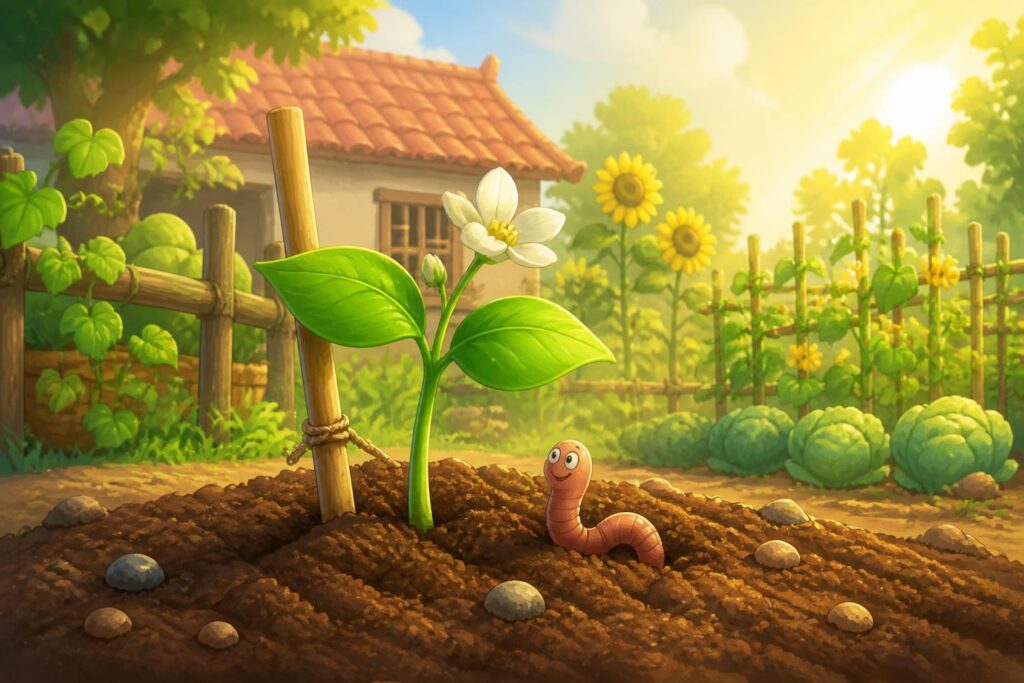
The Bean That Did Not Want to Wait
At the far end of a garden behind a red-tiled house, there was a bed of soft brown soil. Every morning, Na’s grandmother would go there to loosen the soil, pull weeds, and water the little seedlings. She called the garden the Garden That Knows How to Wait because she believed that plants, like people, could not grow strong if they were rushed.
One day, she gave Na several round bean seeds. Na dug small holes, placed the seeds inside, and covered them with a thin layer of soil. Among those bean seeds was one that was very special. Its name was Little Bean because it was slightly smaller than the others and had a brown spot on its shell.
Little Bean heard Grandmother tell Na to water the seeds just enough each day, not to dig up the soil to check on them, and to patiently wait for the seedlings to appear. But Little Bean did not like waiting. It wanted to burst out of the ground immediately, see the sky, find out what the birds were singing, and catch the attention of everyone in the garden.
“I don’t want to lie here in the dark forever,” Little Bean thought. “If I try hard enough, maybe I will grow faster than the others.”
The First Days Underground
On the first day, Na watered the bean bed. The water seeped through the soil, cool and gentle as it embraced Little Bean. The bean seed felt its shell stretch a little.
“Ah, I’m about to grow!” Little Bean cheered.
It tried to push itself upward. However, the soil was still heavy, its roots had not had time to grow, and its green shoot was not yet strong enough. Little Bean became too tired and had to lie still.
On the second day, Na watered the seeds again. An earthworm crawled past and saw Little Bean frowning.
“What’s wrong?” the earthworm asked.
“I want to get outside right now. I don’t understand why I have to lie in the soil for so long.”
The earthworm smiled. “The soil isn’t a box keeping you prisoner. It is keeping you warm and giving you a place to begin. Let your body prepare.”
“But I want to see the sky,” Little Bean replied.
“You will. It just isn’t time yet.”
Little Bean did not completely believe the earthworm. It thought that the earthworm was used to living underground and therefore could not understand its wish.
The First Green Shoot
On the third day, Little Bean’s shell cracked open. A tiny white root pushed downward, winding through the little grains of soil. Little Bean was both surprised and delighted.
“I’m really growing!”
The root clung to the soil, drawing in moisture and the nutrients it needed. Above it, a curved shoot began to reach upward. Little Bean realized that growing was not like taking one leap out of the ground. It happened slowly, little by little, but every little step mattered.
That night, the wind rose. The large leaves in the garden rustled. A heavy rain poured onto the tiled roof, and then water streamed through the garden beds. Little Bean was frightened. The soil around it trembled, and some places were being washed away.
“I’m going to be buried!” Little Bean cried.
The earthworm quickly dug a small channel alongside it, helping some of the water drain away. A pebble lying right beside Little Bean also kept the soil around it from being swept away.
“Don’t be afraid,” said the pebble. “You don’t have to face everything alone yet.”
Little Bean fell silent. For the first time, it realized that the garden had more than sunshine and water. There were also friends here who quietly helped one another.
The Race with the Grass
A few days later, Little Bean’s shoot emerged from the soil. It saw the blue sky, the red roof, and Na’s delighted face. The child bent down and clapped when she saw the first two leaves open.
Little Bean was immensely proud. However, beside it, a weed had also grown very quickly. The weed was taller than Little Bean and was always swaying as if it wanted to show off that it had reached upward first.
“See?” the weed said. “If you want to grow, you have to grow really fast. Anyone who is slow will be left behind.”
Hearing this, Little Bean began to worry. It wanted to be taller than the weed, have more leaves, and receive more praise from Na. It tried to stretch upward even though its roots were still weak. Whenever the sun came out, it leaned toward the light. When the wind blew, it tried to stand straight instead of bending down to avoid it.
One afternoon, Little Bean’s stem became utterly weary. A strong wind made it lean completely to one side. One leaf was torn along its edge. Sadly, Little Bean said:
“Maybe I really am too slow. I can’t match the weed.”
Grandmother saw that the little bean plant was weak, so she stuck a bamboo stake beside it and tied the stem with a soft piece of string. She also pulled out the weed so that it would not compete for water and sunlight.
“Every plant has its own way of growing,” she told Na. “A bean plant needs support during its early days. When its roots grow stronger, it will stand firmly on its own.”
Little Bean heard Grandmother’s words. Suddenly, it understood that needing help did not mean being weak. Sometimes, knowing how to accept care was also a way of growing up.
The First Flower
Time passed. Little Bean no longer tried to race the weed. Each morning, it welcomed just enough sunlight. Each afternoon, it listened to the sound of water soaking into the soil. Its roots grew longer and held on more firmly. New leaves opened one after another, lush green and soft.
Na often came to the garden bed and told Little Bean about things that had happened at school. She talked about a new friend, a picture she had drawn of a house beside a river, and the time she had spilled a glass of milk but cleaned it up herself. Little Bean could not speak, but whenever it heard Na’s voice, its leaves trembled as if they were smiling.
One morning, Na discovered a small flower bud between the leaves. The bud was tightly closed, pale green, and tiny.
“Grandma, the bean plant is about to flower!” Na called loudly.
Little Bean was so happy that it wanted to jump. But it remembered the earthworm’s words: good things take time. It did not try to open the petals right away. It simply quietly received the sunlight, welcomed the water, and let the flower bud prepare on its own.
The next day, the bud was a little larger. The day after that, a gentle white color appeared at the tips of the petals. On the fourth morning, the flower bloomed fully. It was not the largest flower in the garden, nor was it as brilliant as the flowers planted in pots, but it had a beauty of its own. Small white petals embraced the golden center, looking like a tiny star that was smiling.
Na bent down and gazed at the flower for a long time. Grandmother said gently:
“You see, if you had dug up the soil every day to check whether the bean had grown, the seedling might have been hurt. Some things can appear only when we know how to wait.”
What Little Bean Wanted to Share
Little Bean looked around the garden and remembered its early days. It had once thought that the darkness underground was frightening, but that very place had protected it. It had once thought that it had to grow very quickly, but its slow, steady progress had helped its roots become strong. It had once been embarrassed about needing a bamboo stake and Grandmother’s caring hands, but being supported had enabled it to stand firm in the wind.
The weed beside it had been pulled out, but Little Bean was not happy that it had won the race. It understood that the weed had simply been growing in its own way. Every living thing in the garden had its own time to sprout, grow leaves, flower, and bear fruit.
A few weeks later, the little flowers fell, leaving green bean pods behind. Na carefully held a long bean pod, amazed to learn that it contained many new seeds.
“From one little bean seed, we have a whole season of beans,” Na said.
Hearing this, Little Bean’s heart filled with joy. It no longer wanted everyone’s attention because it had grown quickly. It was happy because it could give new seeds back to the garden.
Grandmother harvested the ripe bean pods, set some aside to cook for dinner, and saved several seeds for the next season. Na carefully placed those seeds in a small box. Among them was a seed with a brown spot exactly like the one Little Bean had had long ago.
The Lesson from the Garden
From then on, whenever Na became impatient because something had not yet succeeded, Grandmother would take her to visit the bean bed. She did not tell Na to sit still and wait for everything to happen by itself. She taught her to do her part: plant the seeds properly, water them just enough, care for them regularly, and accept that results take time.
Little Bean also wanted to tell everyone who was growing up that they did not need to keep comparing themselves with others. Some friends sprout early, while others need many more days underground. Some like to reach upward, while others spread across the ground. What matters is not who moves the fastest, but whether each person is being cared for, making an effort, and moving forward in a way that suits them.
The Garden That Knows How to Wait still lay behind the red-tiled house. Each new season, seeds were sown again. They slept in the soil, quietly preparing for another journey. And if any seed became eager to grow very quickly, the friends in the garden would gently remind it:
“Be patient. You are growing, even when you cannot see it yet.”

ARTICLES IN THE SAME CATEGORY
A Little Raindrop Finds Its Way Back to the Cloud
The Wind Chime and the House of Sounds
The Promise of the Flying Leaf
The Raindrop Keeps Its Promise to the Little Bean Plant
The Little Bell Beneath the Banyan Tree
The Little Girl Who Sewed a Coat for the Wind
ARTICLES IN THE SAME GENRE
The Wind Chime That Awakened the Garden
The Button That Went Looking for Someone Who Keeps Their Word
Tam Cam Part 2: The Vengeful Spirits of the Palace
Tam and Cam: The Palace Intrigue and the Original Ending – Part 1
Tam Cam
Coconut Skull