

 Tiếng Việt
 日本語
日本語 한국어
한국어 中文 (中国)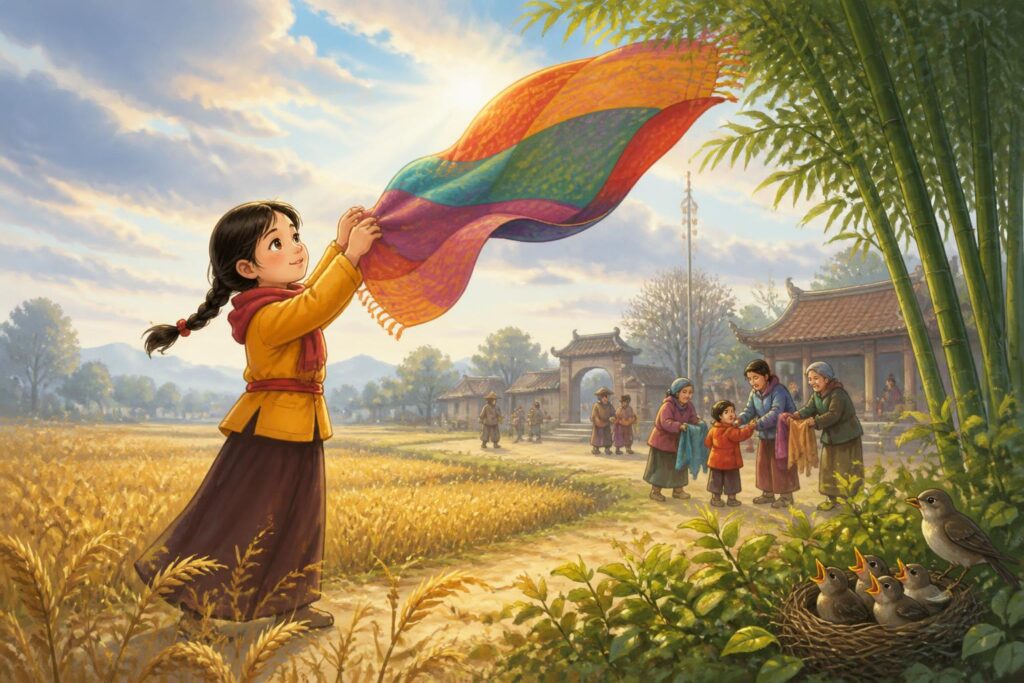
The Little Girl and the Wandering Wind
At the edge of a village nestled in the middle of a vast field stood a red-tiled-roof house, with an old starfruit tree planted in front of it. In that house, a little girl named An lived with her grandmother. An did not have many toys, but she had a pair of eyes that always saw the things others often overlooked. She noticed the calico cat that curled up beside the stove whenever the weather turned cold, knew when the ten-o’clock flower became sad from a lack of water, and could hear the faint creak of the wooden gate each time its hinges ran dry.
An was also familiar with a special friend. It was the wind that often passed through the village every afternoon. The wind had no clear shape. Sometimes it slipped through the bamboo grove, making the bamboo leaves rustle; sometimes it ran and played across the fields, making the rice bend into waves. On some days, the mischievous wind would toss up the hair over An’s forehead, then hurry off to hide behind the banana bushes.
“Wind, where are you going today?” An would often ask.
The wind did not answer with words. It simply blew gently across her cheek, making the clay bell hanging beneath the eaves jingle. An understood that this was its greeting.
That winter came early. The sky was grayer, the pond lay still, and the roadside grasses were covered with a layer of white frost every morning. The villagers put on extra clothes, closed their windows tightly, and gathered around the fire. Only the wind still had to travel everywhere. It slipped through the alleys, skimmed across the fields, climbed into the treetops, and then ran down to the riverbank.
One afternoon, An stood by the gate waiting for her friend. The wind blew past, but it was not mischievous as it was on other days. It only brushed her hand lightly before trembling and flying away. An watched it go and saw the dry leaves being swept into a small circle.
“Are you cold?” An called after it.
The wind did not turn back. It slipped through the bamboo grove, making a long, sorrowful sound like a sigh.
The Idea of a Coat
That evening, An told her grandmother about the wind shivering with cold. Her grandmother was sitting beside the oil lamp, carefully mending an old woolen scarf. After listening, she smiled.
“The wind has no hands to hold a bowl of rice, and no house to shelter from the cold. But I think the wind can be warmed in some way.”
An looked at the balls of yarn and scraps of fabric beside her grandmother. Suddenly, an idea came to her.
“I’ll sew a coat for the wind.”
Her grandmother stopped sewing, then gave a gentle laugh.
“Sewing a coat for a person is easier. The wind passes through every crack under the doors, so how could it wear a coat?”
“I’ll think of a way. If the coat can’t hold on to the wind, perhaps it can hold warmth in the places the wind passes through.”
Her grandmother did not stop An. She took from a wooden chest some leftover scraps of fabric: a yellow piece from an old dress, a sky-blue piece from a worn-out shirt, and several strips of red and brown fabric. She also gave An a spool of soft wool thread.
All evening, An sat by the window. She cut the pieces of fabric into leaf shapes, then stitched them together into a long strip. The yellow fabric represented sunlight, the blue was the color of the river, the red was the fire in the stove, and the brown was the soil of the fields after the harvest. An did not know whether a coat for the wind needed sleeves or a collar, so she sewed it into a very wide scarf, light as a butterfly’s wing.
When the needle pricked her finger, An winced but did not give up. Her grandmother put medicine on it and told her:
“Doing something good does not have to be grand. As long as you do it sincerely, even a small gift can warm a long day.”
The Coat Flies Across the Village
The next morning, An took the scarf out to the fields. It was still cold. The harvested rice stalks were reduced to bare stubble, and sparrows hopped across the ground searching for grains. An stood in the middle of the dirt path, raising the scarf high with both hands.
“Wind, I made you a coat!”
At first, nothing happened. The scarf hung limp in An’s hands. Then, from the direction of the bamboo grove, a thin current of wind came running. It circled her feet, skimmed across the scarf, and lifted the strip of fabric into the air. The yellow, blue, red, and brown pieces trembled in the air.
The wind carried the scarf along the fields. It did not wear the coat the way people wore clothes, but the scarf flew together with the wind—spreading wide over bushes at one moment, lightly catching on a bamboo branch the next, and then skimming across the surface of the pond. Everywhere it went, the colors of the fabric pieces appeared like little spots of sunlight.
An ran after it, laughing as she ran. She imagined that the wind was wearing its new coat and feeling happier after so many cold days.
But at the end of the fields, a strong gust suddenly rose. The scarf was swept over the fence and flew toward the village. An chased after it, but her legs could not move as fast as the wind. The scarf skimmed over rooftops, across the communal courtyard, and then disappeared behind the slope.
An returned sadly. She thought the coat might have been torn or caught in some tree. As she passed the carpenter’s house, she heard a child crying. The carpenter’s door stood wide open, and inside was a little boy trembling from the cold. His mother had just washed their only blanket, but it had not dried yet.
An looked around. On the fence in front of the house, the colorful scarf was spread wide, swaying in the wind. It turned out that the wind had brought the coat there.
“May I borrow the scarf for a little while?” An asked.
The carpenter nodded. An brought the scarf over and draped it across the boy’s shoulders. The pieces of fabric were not thick enough to keep his whole body warm, but the boy stopped trembling. His mother poured An a bowl of hot sweet potatoes, while the carpenter took another small plank and used it to block some of the gap under the door.
By afternoon, the scarf flew away again. An did not hold it back; she simply followed quietly to see where the wind would take the coat.
A Gift for Those Who Needed It
The scarf flew past the little hut of the old woman who sold vegetables at the head of the market. The old woman had been sitting in the cold all morning, her hands reddened from tying bundles of vegetables and counting each small coin. The scarf landed on her shoulders, making her look around in surprise. She pulled it over her hands, then smiled when she saw the bright fabric pieces.
After that, the wind carried the scarf to a bird’s nest lying low in a jujube bush. Three baby birds huddled together inside. The scarf caught on a branch, forming a soft shelter that blocked some of the cold wind blowing through. The mother bird flew back, holding a strand of dry grass in her beak, and chirped as if she were saying thank you.
The wind continued on. It carried the scarf to the village well, where a woman was waiting for her child to return from herding buffalo. The woman wrapped the scarf around her shoulders. It flew to the stone bench beside the communal courtyard and covered the back of an old dog that was sleeping. It caught on a chrysanthemum bush, helping keep the blossoms from being knocked off by the wind.
An gradually understood that the coat did not belong to the wind alone. The wind was merely the one carrying the gift from place to place. True warmth came from people who knew how to give one another a little of their comfort, who knew to stop when they saw someone cold, tired, or lonely.
The next day, An told her grandmother everything. After listening, her grandmother slowly said:
“Some gifts grow greater the more they are passed on. A scarf may be enough to cover one person’s shoulders, but if it is passed from one person to another, the whole village will learn how to warm one another.”
The Coat That Never Grows Old
The colorful scarf remained in the village throughout the winter. Whenever someone needed it, they used it. When the weather grew warm, they washed it, dried it, and placed it in the basket beside the communal courtyard so others could find it. People began contributing more scraps of fabric, balls of yarn, and old blankets. The carpenter built a wooden rack with a roof over it. The old vegetable seller placed a basket of hot sweet potatoes beside it. The little boy’s mother often brought small cakes.
No one knew who had first thought of it, but from then on, at the far end of the communal courtyard there was always a corner called the Warm Coat Corner. Those who had more left things there. Those who needed something took it to use. Afterward, they washed it and returned it, or contributed something else in its place.
And the winter wind continued to pass through the village. It still ran across the fields, slipped through the bamboo grove, and swayed the clay bell beneath the eaves of An’s house. But ever since the Warm Coat Corner had appeared, the wind no longer sounded as sad as before. Each time it blew across the communal courtyard, it made the pieces of fabric on the wooden rack tremble, as though it were wearing hundreds of little coats.
One afternoon, An stood beneath the old starfruit tree, listening to the wind lightly touch her hair.
“Do you like the coat?” she asked.
The wind circled the tree, making a few starfruit blossoms fall onto An’s shoulder. The clay bell rang clearly.
An smiled. She knew the wind did not say thank you with words. The wind spoke by carrying warmth from one house to another, by stirring the hands that were ready to share.
From then on, whenever the cold season returned, An would sit and sew more new scarves. She no longer tried to sew a coat that fit the wind. She sewed coats for people, for baby birds, for old dogs, and for anyone who needed a little warmth. And the wind continued to do its work: carrying gifts far away, so that kindness would not lie still in one house but could fly across the entire village.
And if one day you hear leaves rustling beside your window, perhaps the wind is telling you that somewhere, someone has given away something small of their own. That small thing, passed through many hands, has become a warm season for everyone.

ARTICLES IN THE SAME CATEGORY
The Boy Who Kept a Raindrop in a Seashell
The Seed That Knew How to Listen
The Bridge of Kind Words
The Wind Chime That Awakened the Garden
The Seed Asleep Beneath the Fig Tree
Brown Squirrel’s Leaf Bridge
ARTICLES IN THE SAME GENRE
Stepmother and Stepchild