

 Tiếng Việt
 日本語
日本語 한국어
한국어 中文 (中国)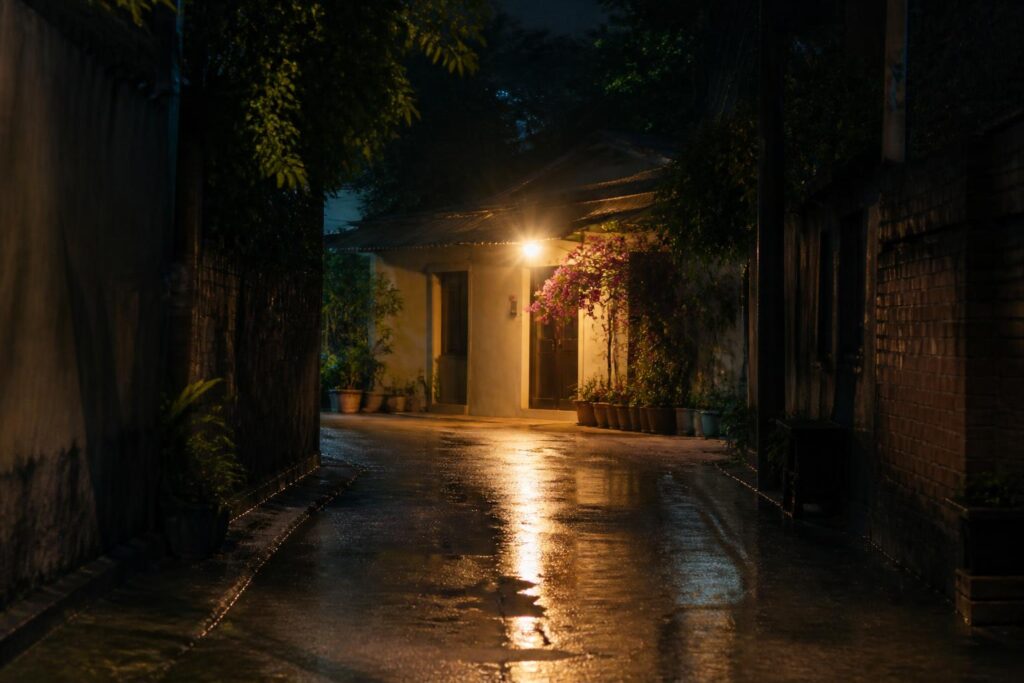
At the end of the alley where I live, there is a yellow lamp. It is not bright enough to make the whole road glow, nor is it new or beautiful in any way. The light bulb is installed beneath the eaves of a low house, casting its glow onto the patchy cement ground and a withered bougainvillea stump. And yet, whenever dusk falls, that lamp is switched on. It is switched on when it rains. It is switched on in strong winds. On days when the power goes out, the woman who lives in that house even places an oil lamp outside the door.
The woman’s name is Mrs. Van. She has lived alone for many years, her silver hair usually tied neatly at the nape of her neck, her voice soft but clear. During the day, she tends to several potted plants, sweeps the narrow yard, and then sits sewing perfectly even stitches into an old shirt. In the evening, she often opens the door and looks out into the alley for a long while before turning off the light and going to bed. No one knows whom she is waiting for. People in the neighborhood once guessed that she had a child working far away who might suddenly return. Others said it was simply a habit she had kept since she was young.
The children in the alley called it the lamp that waits for someone. At first, they said it mischievously, as if sharing a secret story. Later, the name became how everyone referred to the house at the end of the alley. “Slow down—once you pass the lamp that waits for someone, you can run.” “It’s dark already. Remember to turn in when you see Mrs. Van’s lamp.” A small object gradually became a landmark by which people found their way, but no one ever really asked her why she lit it every evening.
The Woman and the Habit No One Understood
I first came to know Mrs. Van when I was still in elementary school. Back then, I would often cycle home after extra classes. The alley did not have many streetlights, and in the evening, all it took was for clouds to gather for everything to become pitch-dark. Once, I dropped one of my sandals and spent a long time searching beside a bush. Hearing the noise, Mrs. Van opened her door and came out carrying a flashlight. She did not ask why I was home late. She simply bent down to search with me and wiped the sandal with a piece of cloth.
“Next time, if it’s dark, just stay close to the side with the light,” she advised. “Don’t hesitate to knock on anyone’s door if you need help.”
I forgot those words for a long time. It was only after I grew up, left the alley to study and then work in another city, that I realized I had once taken the presence of that lamp for granted. It was there every evening, like the familiar calls of street vendors or the sound of the neighbor’s iron gate opening in the morning. Quiet things are often remembered least while they are still beside us.
Many years later, I returned one evening near the end of the year. The alley had changed quite a lot. A few houses had been renovated, the road was smoother, and the electrical wires had been bundled more neatly. The children from back then had grown tall; some had gone away for work, while others had started families. Mrs. Van’s house was still at the end of the alley, though the walls had grown more faded. And the yellow lamp was still shining beneath the eaves.
I stopped by to ask after her. She recognized me after a few seconds, smiled kindly, and poured me a cup of hot tea. On the table were a sewing kit, a plate of boiled sweet potatoes, and a small radio playing an old music program. I asked whether she was still waiting for a relative to return. The moment the question left my mouth, I realized I had been somewhat clumsy. Some things are maintained for so long that outsiders assume they must be tied to a specific story.
Mrs. Van was silent for a moment before saying that she had once had a younger brother. When they were young, her brother worked at a mechanical workshop in the neighboring town. One rainy night, on his way home, his motorbike broke down on an empty stretch of road. Not wanting to worry the family, he tried to push it onward. It was almost dawn when he finally reached home, drenched and burning with fever. After that incident, Mrs. Van began leaving a lamp outside the door on rainy nights, as a sign that someone was still awake inside and that the road ahead still led to somewhere one could seek refuge.
Her younger brother later moved elsewhere. The siblings stayed in touch, but their lives went in different directions. When their parents died, Mrs. Van stayed in the old house, while her brother made a living far away in the South. The lamp, originally lit for one person, gradually became part of her routine. She no longer knew whether she was waiting for her brother, for a neighbor returning late, or simply wanted the darkness at the end of the alley to contain a little more light.
Light for Those Passing By
“Some people tell me I’m wasting electricity,” she said, looking out toward the porch. “I know that. But turning on one light bulb doesn’t make us that much poorer. And sometimes, when other people see it, they feel less afraid.”
Her words reminded me of the many nights that have passed through my life. Sometimes we do not need grand advice, nor do we need someone to solve our problems for us. We only need to know that somewhere there is still a door we can knock on, someone willing to listen, or a small glow bright enough to show us our next step. Help does not always appear in extraordinary forms. It can be a bowl of rice set aside for someone, a phone call asking whether they have arrived home, or a lamp switched on earlier than usual.
Mrs. Van did not see herself as someone doing a good deed. She was simply doing something familiar and consistent, something for which she was hardly ever thanked. Perhaps that was why her light endured more steadfastly than many actions carried out in moments of emotion. She did not light it to receive praise, nor did she know exactly who would see it. She simply believed that if she could make one stretch of road a little less dark, then she should.
From that day on, I began paying more attention to the people who quietly keep life running. The security guard who opens the gate very early, the street cleaner who sweeps the sidewalk before the streets grow crowded, the vendor who leaves a bottle of water for the delivery worker at midday. They do not appear in the great stories, but without them, an ordinary day would become much more difficult. Some contributions make no sound; they merely leave us with the feeling that everything is still all right.
The same is true in families. A mother reminds her child to bring a raincoat, a father fixes the door lock, an older brother quietly pays a bill, a grandmother waits by the door until she hears the familiar sound of a motorbike. These things are often called duties, to the point that the recipients can easily forget that behind every sense of security is someone who has given their time, energy, and care. When someone stops doing something, only then do we realize that what seemed natural had never been natural at all.
Not Every Waiting Requires a Return
I asked Mrs. Van whether she ever grew tired of maintaining the habit. She smiled and said that on days when her back hurt too much, she asked the neighbors to turn it on for her. On some nights, she fell asleep and forgot; the next morning, she would feel guilty, even though no one blamed her.
“Actually, I don’t need to wait for anyone,” she said. “When people pass by and see the light, they know this is a place where they can stop. That’s enough.”
That was the first time I understood that not every act of waiting is directed toward a return. Some people wait to preserve a memory. Some wait because it is how they express love. Others wait simply to give someone else the feeling that they are not completely alone. Mrs. Van’s waiting had moved beyond her family’s private story. It had become a way of life, simple yet capable of spreading outward.
In a world that often measures value by speed and results, such slow, deliberate acts are easily dismissed as unnecessary. People may ask what the point is of lighting a lamp when the street already has electric lights, of keeping the door open for one another when everyone has a phone, or of remembering someone who has not appeared for a long time. But people do not live only by conveniences that solve problems. We also live by small signs that show we are cared for. A message containing no special information, a towel laid out to dry, a meal waiting with someone at the table—these all remind us that life is not merely a list of tasks to be completed.
A few months later, Mrs. Van fell in the yard and had to rest in bed for several days. The news spread quickly through the neighborhood. One person brought porridge, another bought medicine, someone swept the yard, and someone else replaced the old light bulb. That evening, a boy who lived at the entrance to the alley took it upon himself to switch on the lamp in front of her house. He had heard his mother tell stories about the lamp that waited for someone, but he had never imagined that one day he would be the person keeping it lit.
Mrs. Van gradually recovered. When she was able to step onto the porch, she saw the lamp shining down onto the road. The boy stood beside the switch, looking serious, as though he had just completed an important mission. She did not say much, only patted him on the head. That evening, the lamp was switched on earlier than usual.
Keeping a Lamp Lit for Ourselves
Every one of us can become a small lamp for someone else without having to do anything extraordinary. It may mean listening when someone is overwhelmed, keeping a promise in small matters, taking the initiative to check on someone we have not contacted in a long time, or giving our loved ones a safe place to return to after exhausting days. What matters is not how strong the light is, but how consistently it is kept burning.
At the same time, we also need to learn how to receive light. We do not always have to appear strong, solve everything on our own, and refuse every offer of help. Sometimes allowing others to care for us is also a way of appreciating them. A door has meaning only when someone dares to knock, and a lamp truly fulfills its purpose only when someone sees it.
The alley where I live now has many more lights. White light from modern bulbs covers the road, clearer and broader than before. And yet, whenever I pass the house at the end of the alley, I still recognize the familiar yellow glow beneath the eaves. It does not compete with the other lights. It simply exists quietly, like a reminder that amid the vastness of life, what sometimes keeps us moving forward is not a perfect answer, but the feeling that somewhere, someone still cares.
Mrs. Van is no longer waiting for any particular person. Perhaps she is waiting for anyone who needs to see that light. And perhaps, on nights when our spirits sink, each of us needs a lamp like that as well. It does not necessarily have to be at the end of an alley. It might be found in a phone call, a kitchen, a friend, or the very kindness we have learned to preserve within ourselves.

ARTICLES IN THE SAME CATEGORY
The Silence Between Two Moments of Haste
When Old Things Remind Us That We’ve Grown Up
The Basket Weaver by the Old Riverbank
The Bell Keeper and the Season of Low Water
The House with a Door Opening into Dawn
The Blue Garment Sewn for the Day of Return
ARTICLES IN THE SAME GENRE
Brown Squirrel’s Raincoat
The Wind Chime Finds Its Chime Again
Stepmother and Stepchild