

 Tiếng Việt
 日本語
日本語 한국어
한국어 中文 (中国)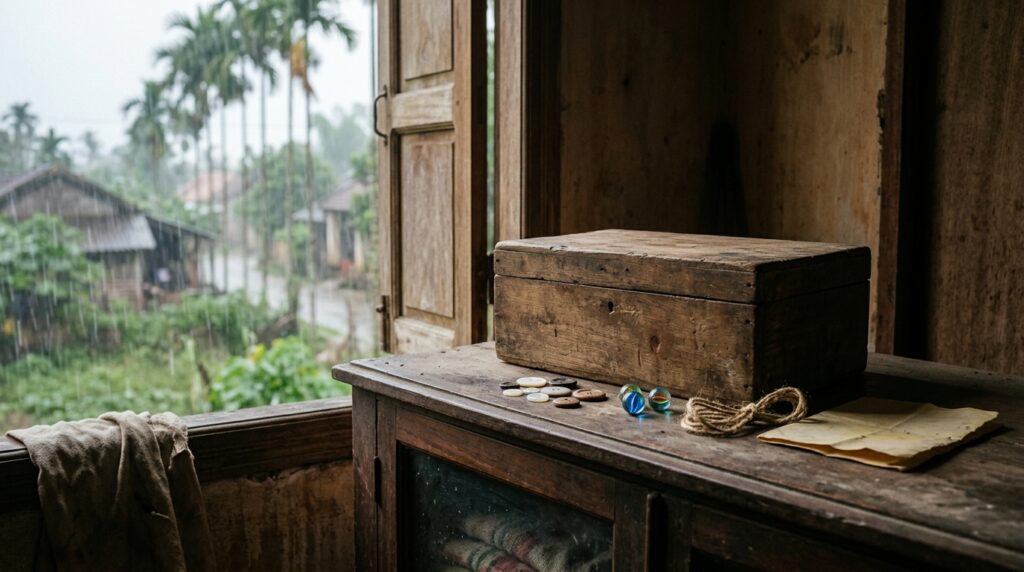
At the end of the dirt road leading down to the old ferry landing stood a small house with brown tiled roofing. In front of the porch, year-round, there was a low wooden chair and several chipped plant pots. People in the area called it Mr. Lam’s house. He was a carpenter who specialized in repairing things that seemed beyond saving.
Mr. Lam was over seventy. The veins stood out on his hands, and his fingertips were hardened by wood splinters and the smell of polishing oil. He could look at a wobbling chair and immediately know where it was broken. A squeaking door did not trouble him either. After hearing it a few times, he could tell whether the hinges were misaligned or the grain of the wood had absorbed moisture.
And yet, in his house there was one thing he had never repaired: the wooden box placed on top of the cupboard.
The box was not large, just big enough to be held securely in both hands. Its surface was made of darkened jackfruit wood, its four corners firmly joined, and its lid was carved with an image of a cloud drifting past a crescent moon. The box had no lock and no latch. Even so, every morning, after sweeping the yard, Mr. Lam would stand on a chair and wipe the dust from the lid with a soft cloth.
People rumored that there was gold inside. Others said it contained letters from a woman he had once loved. The neighborhood children believed he was hiding a stone that could glow at night. Mr. Lam merely smiled when he heard these rumors, neither confirming nor denying them.
The Day the Box Was Placed on Top of the Cupboard
When Mr. Lam was twenty-eight, that rural area went through a very long rainy season. Water from the mountain stream rose, flooded the fields, and carried away dry firewood, straw, and even part of the wooden bridge connecting the two hamlets. Many families had to evacuate to the communal house on high ground. In those days, Mr. Lam was still only an apprentice, often going with his father to repair villagers’ roofs.
One afternoon, in the middle of a torrential downpour, he heard children crying from the house at the far end of the flooded plain. He and his father rowed a small bamboo boat there and discovered a young woman trapped with her little son. The water had risen almost to the windows. The child’s father was not home, and the mother, panic-stricken, did not dare step into the boat.
Mr. Lam swam inside, tied a rope around his body, and brought the mother and son out one by one. Just as the boat pulled away from the house, a section of the wall behind them collapsed. The woman held her son tightly and cried without being able to say a word.
That night, at the communal house, she went to where Mr. Lam and his father were sitting and drying their clothes. She had nothing with which to thank them, so she took a small piece of wood from her pocket. It was part of the lid of a sewing-supplies box that had been swept away by the water. The image of a cloud and a crescent moon was still visible on the wood.
She said that if he ever made a new box, she hoped he would preserve that carving. It was part of an object her husband had made for their son before he died in a flood a few years earlier. She wanted a place to keep the things that could not be carried along when fleeing the rushing water.
A few months later, Mr. Lam finished the box. He used old jackfruit wood, smoothed every surface, and carved the cloud again on the lid. He brought the box to the woman, but she did not accept it. She said her family had moved to the highlands, and the box should remain with him, because he was the one who had helped mother and son survive that rainy season.
From then on, the box remained in Mr. Lam’s house. But inside it there was no gold or love letters. Each year, he placed inside it a small object connected to someone he was afraid he might forget.
The Things That Could Not Be Sold
The first object was a mother-of-pearl button. It had belonged to his father. His father had died after a brief illness, leaving his son an old set of tools and the advice that whatever work one did, one must never destroy another person’s trust.
The second object was a frayed length of hemp rope. He had kept it from that flood season. Every time he saw the piece of rope, he remembered the little boy he had brought out of the flooded house. Many years later, the boy became a ferryman. Whenever someone needed to cross the river at night, he usually did not charge them.
The third object was a piece of paper folded into quarters, bearing only a few clumsily written lines. It was a letter from a young carpenter who had once worked for him. The young man left after ruining an expensive set of doors for a customer, forcing Mr. Lam to sell his motorbike to pay compensation. Before leaving, he wrote that he was ashamed and did not dare return.
Mr. Lam searched for him for many years. At last, he learned that the young man was working at a woodshop more than a hundred kilometers from his hometown. He went there, did not scold him, and only asked whether he still wanted to learn the trade. The young man returned to work with him for another ten years, and afterward managed to open a small workshop of his own.
The piece of paper in the box was the letter he had sent after leaving. Mr. Lam kept it not to remember the young man’s mistake, but to remember that some people, if given just one more chance, could step onto a different path.
The box also held a blue glass marble, a broken hair clip, a clumsily embroidered scrap of fabric, and a key that no longer worked. Each object came with a story. Some stories were happy, some sad, and some so old that the people involved no longer remembered them; only Mr. Lam still did.
His Granddaughter Returns
Mr. Lam had a granddaughter named An, who lived in the city and returned to the countryside only on special occasions. An worked for a design company and was accustomed to brightly lit rooms, packed schedules, and the constant sound of notifications from her phone. She loved him but did not understand how he could sit for hours repairing an old chair for a neighbor without taking any money.
Once, after seeing him wipe the wooden box, An asked:
“What is in there that you take such good care of it?”
“Things that should not be lost,” he replied.
An laughed. She thought he was joking. To her, things that should not be lost were documents, money, family photographs, or data backed up on a computer. An old button or a piece of hemp rope had no value.
A few months later, Mr. Lam fell while repairing the porch roof. The injury was not too serious, but it forced him to rest in bed for many days. An took leave from work to return and care for him. During that time, she realized that people were almost always coming to his house. Some brought vegetables, some brought medicine, some came to replace a lightbulb, and some merely sat down for a cup of tea and asked whether his pain had eased.
One afternoon, the ferryman from years ago came to visit. He was old, with hair that had turned almost completely white, but he still clearly remembered that flood season. He said that when he was little, he had thought Mr. Lam possessed special strength because he could swim against the current. Only after growing up did he understand that the man who had saved him that day had been just as frightened as anyone else; it was simply that Mr. Lam had not let fear make the decision for him.
An sat beside them, listening in silence. For the first time, she looked at the box on top of the cupboard not as an old object, but as a place holding the invisible threads that connected one person to another.
What Mr. Lam Wanted to Leave Behind
The night before An returned to the city, Mr. Lam called her over to the cupboard. He took the box down, placed it on the table, and opened the lid. There were not as many things inside as An had imagined. Perhaps over the years, he had thrown away things that were no longer needed or returned them to the people connected to them.
An recognized the button, the hemp rope, the blue marble, and the paper folded into quarters. At the bottom of the box was a small piece of wood bearing the image of a cloud and a crescent moon. He said it was what remained of the old box from the flood season, the piece the woman from long ago had given him.
“Why do you keep so many stories like these?” An asked.
Mr. Lam looked out into the yard, where rain was falling at an angle through the row of areca palms.
“So I know that I have been helped by other people,” he said. “And so that whenever life feels too confining, I remember that I am not living alone.”
An asked whether he was afraid the box might be lost. He shook his head. He said the box was only a shell. If one day termites ate it away completely, the things inside would still remain in the way people treated one another.
Before going to sleep, An took out her phone, intending to photograph each object. But then she put the phone back in her pocket. She sat down and listened as he retold each story from the beginning. Some were stories he had told many times, some An was hearing for the first time, and in some parts he no longer remembered the exact years, but he remembered very clearly the eyes of the people who had once stood at his door.
The next morning, An returned to the city. Before getting on the bus, she told him that she would come back the following weekend to repair the sign for the house. He smiled and said the old sign was still usable. An replied that she was not repairing it because it was broken, but because she wanted to do something for him.
On the way, An received a message from a friend who was going through a difficult time. In the past, she might have replied casually that everything would be all right. But that day, she called and sat listening to her friend for nearly an hour. She did not rush to offer advice. She simply stayed there, like the people who had once sat beside the low chair on Mr. Lam’s porch.
The Rainy Season Was Not Kept in the Box
Many years later, after Mr. Lam had died, An kept the house at the end of the road. The wooden box still sat on top of the cupboard. An did not lock it, nor did she place expensive things inside. Whenever someone did something kind without being named, she wrote a small note, recorded the date and the story, and placed it in the box.
One note told of a boy who gave his raincoat to a friend. Another recorded the story of a shopkeeper returning a lost wallet. One contained only a few words about a neighbor who quietly cooked porridge for a family with a sick member. These stories did not change the whole world, but they made someone’s day a little less cold.
The box gradually filled up. An understood that Mr. Lam had called it the box that held the rainy season not because it preserved wet days, but because in every rainy season there were always people ready to extend a hand when someone else was struggling to stay afloat.
No one can avoid life’s storms. At times we are the ones who need shelter; at times we are strong enough to stand beside someone who is losing heart. What matters is not that we can save everyone, but that in a moment when we are able to help, we do not turn away simply because we think what we are doing is too small.
For a raincoat offered at just the right moment, a nonjudgmental listening ear, or an additional chance can all become precious things in another person’s memory. And who knows, years later, in the midst of a sudden rainy day, those simple acts may remind us that life once treated us with kindness.

ARTICLES IN THE SAME CATEGORY
The Watchmaker and the Forgotten Moments
Tam Cam Part 2: The Vengeful Spirits of the Palace
Tam and Cam: The Palace Intrigue and the Original Ending – Part 1
THE STORY OF SOWING SEEDS
The Power of Silence
Buy Virtue
ARTICLES IN THE SAME GENRE
Stepmother and Stepchild