

 Tiếng Việt
 日本語
日本語 한국어
한국어 中文 (中国)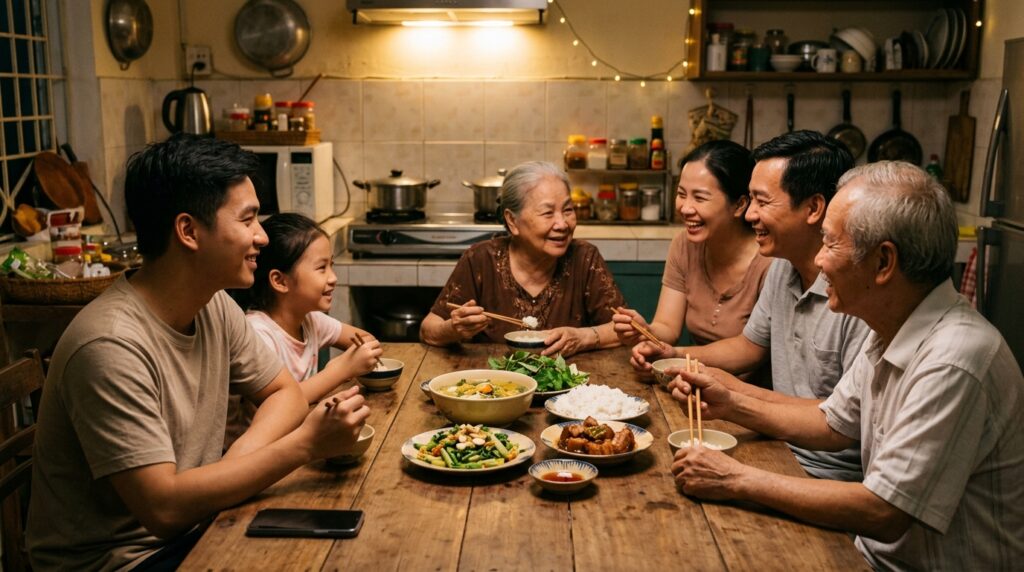
In the rhythm of modern life, a family meal can sometimes be difficult to arrange. One person comes home late from work, young children have their own class schedules, older family members need to rest early, while unfinished tasks continue to appear on phone screens. On some days, members of the same household live under one roof but only manage to see one another in hurried moments. One person leaves while another is still asleep, someone returns after the kitchen has already been cleaned, and the familiar question “How was your day?” gradually gets replaced by brief messages.
Yet the value of a family meal has never lain solely in the food. It is a period when people temporarily step away from work, appointments, pressures, and notification sounds to return to one another’s presence. The meal may be simple, sometimes consisting of only a few familiar dishes, but if everyone truly sits together, listens to one another, and does not regard it as a burdensome obligation, it can become a place that nurtures a sense of belonging. In a family, peace often does not come from grand things but is created by small habits repeated over many days.
The Meal as a Necessary Pause for the Family
A busy day draws each person into a different role. Adults may be employees, managers, salespeople, or customer-care workers. Young children are students with homework, expectations, and relationships of their own. When they return home, they still carry the echoes of conversations, tension, and unresolved problems. Without a pause, those emotions can easily spill into the way they speak with their loved ones.
A meal creates a soft boundary between the outside and the inside. Simply sitting down for a few dozen minutes gives everyone a chance to shift from a state of coping to a state of connection. This does not mean that every meal has to be cheerful or that every family member is always ready to share. Some days one person is exhausted, another is upset, and sometimes the whole family is silent. Even so, continuing to sit together shows that the relationship is still valued. Closeness is not always expressed through words; sometimes it lies in serving one another a dish, waiting for someone who is late, or asking whether they need help today.
In many families, people tend to pay attention only to major conversations about school, money, work, or important decisions. But closeness is often formed through very small stories. A child talks about a friend in class, a father mentions the rain on the way home, a mother says that the vegetables are a little too salty today, or the grandparents recall an old memory. These seemingly trivial fragments help family members know how one another are living, what they care about, and what changes are taking place in their hearts.
The Atmosphere of the Meal Matters More Than the Elaborateness of the Food
Many people feel pressured by the idea that a family meal must include enough dishes, be beautifully presented, or take place at exactly the right time. This notion can turn caring for the family into a burden. In reality, a simple but comfortable meal often has more value than an elaborate spread accompanied by tension and reproaches.
What creates the atmosphere of a meal is not the value of the food but the way family members treat one another. A gentle comment can make the person who cooked feel that their effort has been noticed. An attitude of gratitude, even if expressed only through a brief thank-you, helps ensure that caring for the family is not taken for granted. Conversely, constant complaints, comparing one person with another, or turning the meal into an interrogation can gradually make everyone avoid sitting together.
A family does not need to turn a meal into a serious meeting. Not every issue needs to be resolved at the dining table. When a family member is tired, what they sometimes need is not advice but a space safe enough for them to remain silent. When a child tells an incomplete story, adults can listen patiently instead of rushing to judgment. Small reactions like these create the feeling that each person is respected even when they are not perfect.
Phones and the Fragmentation of Presence
Phones are not the enemy of family life. They help people communicate, support work, and provide many conveniences. The problem arises only when a device takes up all of someone’s attention while family members are together. One person eats while replying to messages, another continually watches videos, while a young child tries to start a conversation in the gaps between the adults’ glances down at their screens. At that point, everyone may be sitting in the same place but living in separate worlds.
Establishing a phone-free period during meals can be a simple way to restore connection. This should be practiced in a spirit of voluntary participation and equality, not as an order directed only at children. Adults will find it difficult to persuade children to focus if they themselves keep checking work. When the whole family sets their devices aside, the message is very clear: time together deserves to be protected.
However, this principle should not be turned into a reason for reproach. There may be situations requiring an urgent call to be handled or work that cannot be postponed. What matters is that everyone agrees on a way to use devices that suits the circumstances. A strong family is not built through rigid rules but through the ability to adjust, empathize, and ensure that the original purpose is not forgotten.
From Eating Together to Learning Gratitude
A meal is a natural opportunity to practice gratitude. No long speeches are necessary; each person only needs to recognize that the food in front of them is the result of much effort. Someone goes shopping, someone prepares the ingredients, someone cooks, someone sets the table, and someone washes the dishes after the meal. In some families, this work is repeated so often that it is regarded as an invisible obligation. When no one acknowledges it, the person responsible for it can easily feel unrecognized.
Gratitude does not mean praising everything reluctantly. It is the ability to see the effort behind familiar things. A sincere statement such as “Thank you for waiting for everyone to come home so we could eat together” or “I’ll set the table today” can change the feeling of the entire evening. Gratitude also needs to be accompanied by action. If they want one family member to feel less tired, the others can proactively share the housework instead of merely offering words of encouragement.
Young children learn gratitude primarily through what they observe. If adults regularly treat caregiving as the responsibility of only one person, children may develop the belief that someone else’s sacrifice is simply to be expected. If the whole family shares in preparing the meal, thanks one another, and cleans up together, children will understand that a home is created through the contributions of many people. This is a lesson in responsibility and altruism that is more convincing than any words of instruction.
When Eating Together Every Day Is Not Possible
Not every family has the conditions to maintain a shared meal every day. Some people work shifts, some have to travel far, and some families have children studying in another city. Therefore, a single model should not be used to assess how close a family is. What matters is not the number of times people sit at the same table, but how they find ways to stay in touch and show care for one another under their actual circumstances.
A brief call at a suitable time, a shared meal on the weekend, or preparing a dish together when there is an opportunity to meet can all become connecting threads. For someone far away, a photo of a meal sent to them cannot replace physical presence, but it can show that they are still remembered. For someone who is busy, proactively informing the family of when they can come home to eat together can help the others feel valued.
What should be avoided is turning someone’s absence into a reason for constant reproach. Complaints may stem from missing someone, but if repeated too often, they make the listener feel guilty and even more inclined to avoid the situation. Instead of simply saying, “You’re always busy,” the family can clearly express its wish: “We miss you; if possible, let’s have dinner together this weekend.” This way of expressing it opens an opportunity for cooperation rather than putting everyone on the defensive.
Keeping the Meal from Becoming a Place of Judgment
Every family has sensitive topics. Matters of education, income, marriage, child-rearing, or personal choices can easily become causes of conflict. A meal does not necessarily have to avoid every difficult issue, but there must be limits so that it does not become a place where one person is cornered in front of the others. When a conversation begins to turn into an attack, pausing may be wiser than trying to talk it through to the end.
Listening does not mean agreeing with every viewpoint. A person can express disagreement without diminishing another person’s dignity. Questions such as “What are you most worried about?” or “What part can we help you with?” often create more opportunities for dialogue than hasty conclusions. When people feel heard, they tend to be more open; when they feel judged, they usually only try to defend themselves.
A peaceful family is not a family without disagreements. It is a family that knows how to return to one another after disagreements. A timely apology, cooking a meal again after a day of arguing, or proactively checking on someone who is sad are all ways of repairing a relationship. These actions do not diminish the seriousness of the issue; rather, they remind everyone that family bonds matter more than winning an argument.
Starting with a Manageable Habit
To restore family meals, there is no need to begin with a complicated plan. Each household can choose a suitable time, such as one evening during the week or a weekend breakfast. During that time, everyone can help prepare a small part of the meal, limit distracting devices, and give one another sincere attention. Once the habit becomes established, the family can naturally expand it without feeling forced.
The most important thing is not to wait until everyone is completely free, because that day may never come. Connection is often created during the limited periods of time that we deliberately protect. A modest meal, a kind question, and a few minutes of listening may not solve every difficulty, but they help each person know that they do not have to face life alone.
Over many years, people may remember trips, major holidays, and special gifts. But sometimes what remains most deeply is the image of the whole family sitting around a familiar table, the gentle clinking of bowls and chopsticks, a story told again and again, and the feeling that someone is waiting for them to return. A family meal therefore does more than nourish the body. It nourishes memories, gratitude, and the belief that amid a world always urging us to move faster, there is still a place to slow down, listen, and belong.

ARTICLES IN THE SAME CATEGORY
The Quiet Between the Noise: Learning to Reclaim Our Own Attention
Creating a Home That Knows How to Listen, So Everyone Has a Place to Return To
Small Promises and How They Quietly Rebuild Trust
Gratitude in Modern Life: From a Fleeting Emotion to a Sustainable Way of Living
Keeping Promises to Yourself in Days When Giving Up Feels Easy
The Art of Saying No Without Making Yourself Seem Cold
ARTICLES IN THE SAME GENRE
Stepmother and Stepchild