

 Tiếng Việt
 日本語
日本語 한국어
한국어 中文 (中国)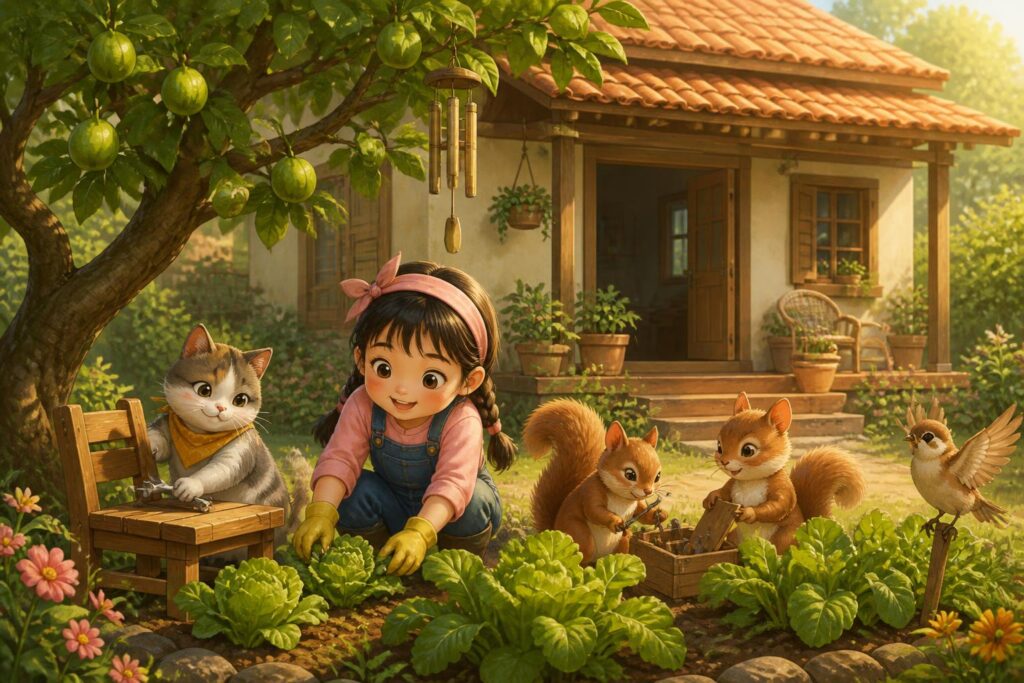
The Chime by the House Porch
At the end of a blue-stone-paved road stood a small house with a brown tiled roof, a bougainvillea fence, and a garden that smelled of mint leaves all year round. In front of the porch, An’s grandmother hung a very special wind chime. The chime was made from slender bamboo tubes, an old brass spoon, and a round wooden bead polished smooth like a longan. Whenever the wind blew through it, the chime rang out with crystal-clear sounds, sometimes like birds calling to one another, sometimes like a stream flowing through a rocky crevice.
Grandmother told An that the chime did more than make sounds. It also knew how to keep the good things that happened in the house. A laugh, a word of thanks, a helping hand, or an afternoon when everyone sat together would all make the chime’s sound clearer.
An loved the chime. Every morning, before going to school, the little girl would stand beneath the porch and listen to it ring. She had even named it Chime-Chime. But one morning, just as the first rays of sunlight touched the tiled roof, An did not hear the familiar sound. The bamboo tubes still swayed in the wind, and the wooden bead still moved, but the chime was completely silent.
An reached out and gently touched one of the bamboo tubes. There was no chime. The little girl shook it harder. Still, there was nothing but the rustling of leaves.
“Maybe Chime-Chime is sick,” An said worriedly.
Grandmother stepped onto the porch, looked up at the chime, and smiled kindly.
“The chime isn’t sick. Maybe it is waiting for us to find what made it lose its sound.”
An did not quite understand, but she decided to find the answer before sunset.
The Investigation in the Garden
An began with the places closest to the chime. She checked the hanging cord, the bamboo tubes, and the wooden bead. None of the parts was broken. She even used a soft cloth to wipe away the thin layer of dust clinging to the brass spoon, but when the wind blew through, no sound appeared.
Just then, Brown the sparrow flew down onto the fence. He tilted his head at An and asked:
“What are you looking for?”
“I’m looking for Chime-Chime’s sound. Do you remember when you last heard it?”
Brown flapped his wings, trying to remember.
“Yesterday, I heard the chime when the gardener was watering the plants. After that, I flew to the star-fruit tree and fell asleep. Maybe you should ask him.”
An thanked the sparrow and went to the vegetable bed. The gardener was bent over pulling weeds, but his face was not as cheerful as usual. An asked him about the chime. He looked up at the porch and sighed.
“I find it strange too. These past few days, there have been many unhappy things in the garden. Bugs have eaten the mustard greens, the water hose is leaking, and the wooden chair beneath the guava tree is wobbling. Everyone has been busy, so no one has had time to fix them.”
“Are those things related to the chime’s sound?” An asked.
“I don’t know. But a garden that no one pays attention to must feel very sad too.”
An thanked him and continued on. Beneath the guava tree, Mun the cat was curled up beside the wobbling chair. The cat usually loved lying there and listening to the wind chime, but today he kept frowning.
“Mun, do you know what happened to Chime-Chime?”
Mun opened one eye.
“I only know that no one has sat beneath the porch to read for the past few days. The children in the neighborhood don’t play together anymore either. Yesterday, Brown Squirrel and Gray Squirrel even argued over a pinecone, then angrily walked away.”
“Did you tell them?”
“I meant to, but no one asked me.”
An suddenly realized that everyone in the garden had something they wanted to tell, but everyone was so concerned with their own business that no one was truly listening to anyone else.
The Forgotten Sounds
An went to find the two squirrels. One was sitting on a branch, while the other was hiding behind a fern bush. The pinecone lay between them, but neither of them wanted to look at it anymore.
“Why are you two angry with each other?” An asked.
“He took the pinecone first,” said Brown Squirrel.
“But I found it this morning,” Gray Squirrel replied.
An did not rush to judge. She sat down at the base of the tree and told the two squirrels to take turns explaining everything from the beginning. Brown Squirrel said that he had seen the pinecone fall first, but he had to run off to call his little sibling and had not had time to pick it up. Gray Squirrel said that when he returned, he saw the pinecone lying on the ground and thought no one had claimed it.
After hearing this, both squirrels fell silent. It turned out that neither of them had intentionally taken the other’s things. They had only become angry because each one knew half of the story.
“If we had talked sooner, we wouldn’t have spent the whole morning feeling sad,” said Gray Squirrel.
Brown Squirrel pushed the pinecone toward his friend.
“We can split it in half. There should be enough seeds inside for both of us.”
The two squirrels laughed together. At that very moment, a very soft sound came from the porch, like bamboo tapping against bamboo. An turned around, but the sound quickly disappeared.
She ran back to tell Grandmother. Grandmother nodded thoughtfully.
“Perhaps Chime-Chime heard something good. But one laugh is not enough to awaken the whole chime. We need to care for the garden through specific actions.”
An immediately called everyone together to work. The gardener repaired the water hose. Mun gently scratched around the tree roots to find a fallen nail. Brown the sparrow flew off to call the other birds to catch the bugs on the mustard greens. The two squirrels picked up the dry branches caught in the fence. An took Grandmother’s small toolbox to repair the chair beneath the guava tree.
At first, the work was not easy. The water hose was stuck at a joint, one leg of the chair was shorter than the others, and the bugs were hiding very carefully beneath the leaves. At one point, An dropped a whole handful of nails onto the ground. Mun was frightened by the noise and ran up the tree, while Brown Squirrel and Gray Squirrel became distracted arguing over the small pair of pliers.
Grandmother did not scold anyone. She only said:
“Working together does not mean that everyone has to do the same thing. What matters is knowing how you can help and knowing when to make room for one another.”
Hearing this, An handed the pliers to the gardener, asked Gray Squirrel to pick up the nails, Brown Squirrel to hold the wooden slats, and Mun to sit a little farther away and give warning whenever something rolled beneath the chair. Brown the sparrow flew around to see whether any dry branches were caught on the porch roof.
When the Chime Returned
By midday, the mustard greens were free of bugs, the hose no longer leaked, the fence had been tied back together, and the wooden chair was sturdy again. Everyone sat beneath the guava tree to rest. Grandmother brought out a basket of hot sweet-potato cakes. An divided the cakes into portions, but when she saw Mun sitting alone, she broke her own portion in half and placed one half in front of the cat.
Mun looked at An in surprise.
“I thought you liked sweet-potato cakes more than you liked talking to me,” the cat said.
“I like both. But if I hadn’t asked, I wouldn’t have known that you were sad because no one paid attention to you.”
Mun lowered his head, and his tail swayed gently.
“I’m sorry too for not saying anything.”
Brown the sparrow landed on the edge of the chair. Brown Squirrel and Gray Squirrel sat beside each other, nibbling their cakes. The garden suddenly became quiet, but it was not the heavy silence of the days before. It was a pleasant quiet in which everyone could hear the leaves, their breathing, and their friends’ soft laughter.
A breeze from the fields blew through. Chime-Chime’s bamboo tubes gently tapped against one another. Ting. A crystal-clear sound rang out across the garden.
Everyone looked up.
The wind blew harder. The brass spoon trembled lightly, the round wooden bead struck the bamboo tubes, and then the chime spread into a chain of sparkling sounds. It was like the sound of flowing water, singing birds, and someone laughing with great delight all at once.
An ran beneath the porch.
“Chime-Chime is well again!”
Grandmother smiled.
“The chime did not recover from an illness. The garden found its joyful rhythm again.”
An gazed at the chime for a long time. She understood that Grandmother did not mean the chime literally stored laughter inside its bamboo tubes. Perhaps what was special was that whenever people heard the chime, they remembered the good things they had done together. And when everyone lived more kindly, that familiar sound seemed to become clearer too.
The House That Knew How to Listen
From that day on, the children in the garden formed a new habit. Every afternoon, before running home, they spent a few minutes looking around to see whether anything needed help. One watered the plants, another picked up leaves, and another checked the fence. If something unpleasant happened, they sat in a circle and took turns telling their stories, without interrupting or rushing to blame one another.
Mun no longer hid alone beneath the guava tree either. He often lay on the chair that had been firmly repaired, listening to everyone talk. Whenever someone forgot to say thank you, Mun would gently flick his tail to remind them. Brown the sparrow still often flew far away, but each time he returned, he brought a new story. As for the two squirrels, they shared pinecones, chestnuts, and even the most difficult tree-climbing adventures.
As for An, she no longer stood listening to the chime only in the morning. Every evening, An would sit beneath the porch with Grandmother. The two of them told each other about one happy thing, one thing they had learned, and one person who had helped them that day.
The wind chime still rang whenever the wind passed through. But from then on, everyone realized that even on windless days, the garden could still be full of sounds. There was the sound of water flowing through the repaired hose, leaves trembling as birds flew past, footsteps running along the stone path, apologies, thanks, and the laughter of people who cared about one another.
An understood that a house did not become warm simply because it had a roof overhead or beautiful walls. A house became warm when the people living in it were willing to pause, listen, and care together for the small things around them. Sometimes, all it took was a caring question or a hand extended at just the right moment for a sound that seemed lost to return.

ARTICLES IN THE SAME CATEGORY
The Seed That Knew How to Listen to the Rain
The Button That Went Looking for Someone Who Keeps Their Word
The Lamp That Kept the Fire Burning at the End of the Slope
The Boy Who Heard Rain in a Bean
The Seedling Beneath the Veranda and the Little Watering Can
THE STORY OF SOWING SEEDS
ARTICLES IN THE SAME GENRE
Stepmother and Stepchild