

 Tiếng Việt
 日本語
日本語 한국어
한국어 中文 (中国)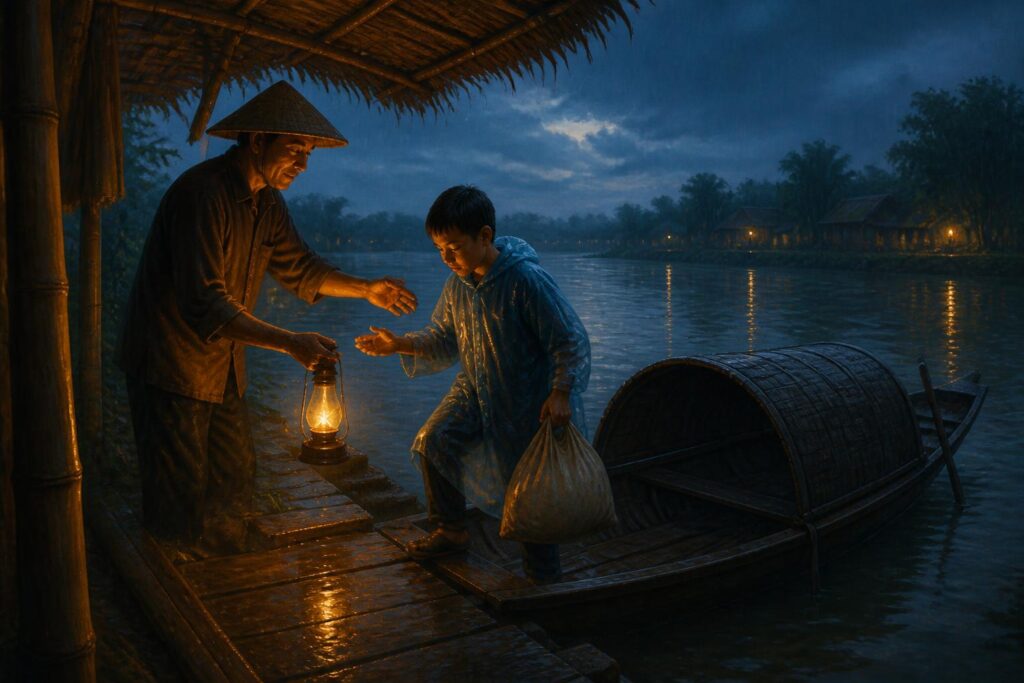
At the far end of Van Bai Village stood an old river landing. It was not on a major road, nor was it near the market or the village communal house. To get there, people had to follow a winding dirt path bordered by spear grass and clumps of wild pineapple. During the flood season, the path was often muddy up to the ankles. On scorching days, red dust covered the hems of travelers’ trousers like a stain that was not easily shaken off.
And yet, for a very long time, people still passed through that river landing. The ferryman was named Lam, a man over fifty who lived in a thatched hut beside the trunk of an old cotton tree. His ferry was not large, only big enough for a few people along with a bicycle or several light bundles of goods. Every day, he carried passengers to the opposite bank and accepted whatever fare people were willing to give. Some days, passengers paid in full. On other days, they offered only a bundle of vegetables, a few eggs, or a hurried word of thanks. There were also days when no one paid anything at all.
Lam had never driven anyone off the ferry because they had no money. He usually just said, “Once you reach the other bank, we’ll figure out the rest. Everyone’s journey in life sometimes requires borrowing a stretch of the road.”
The Lamp That Never Went Out at the River Landing
What made Van Bai Landing different from other ferry landings was not Lam’s ferry, but an oil lamp that was always lit when dusk fell. The lamp hung beneath a bamboo shelter, its weak light illuminating only a few steps of earth around the landing. On foggy nights, the lamp looked like a tiny flame drifting through a hazy white veil.
People in the village had once asked why Lam went to the expense of keeping the lamp lit. The landing was deserted, and after the Hour of the Rooster hardly anyone crossed anymore. If someone needed to cross the river, they could call out loudly. Besides, although lamp oil was not expensive, for someone who lived on sporadic ferry trips, it was still an expense that had to be considered.
Lam would only smile. “Some people can’t call out.”
No one understood what he meant. Only much later did everyone learn that many years earlier, Lam’s younger brother had disappeared on a rainy night. At the time, the two brothers were still young. Their family was poor, their father had died early, and their mother was ill. His younger brother, Minh, was an energetic boy who often ran across to the other bank to play with the children in the fishing hamlet. One evening, Minh did not return. Rain poured down suddenly, the river rose high, and the village’s only boat had been pulled up onto the bank.
Lam grabbed a torch and ran along the landing, calling for his brother all night. He called until his voice was hoarse, but the rain swallowed every sound. The next morning, people found Minh on a sandbar quite far from the landing. The boy had been rescued by a fisherman while clinging to a drifting bamboo branch. If not for the light from the fisherman’s boat, perhaps no one would have seen Minh amid the dark waters.
From that day on, Lam always kept a lamp at the landing. Not to remember a fear, but so that those who lost their way would still know where someone was waiting.
The Passenger Who Carried No Money
One night at the end of the rainy season, just as Lam was about to close the hut, he heard footsteps running along the dirt path. The footsteps came and went, mingled with hurried breathing and the sound of branches being pushed aside. He took the lamp and stepped outside. Beneath the flickering glow, a boy of about twelve appeared. His shirt was soaked through, his hair stuck to his forehead, and both hands clutched a small cloth bag.
“Uncle, are you still taking the ferry?”
“I am. Do you need to cross the river?”
The boy nodded, but did not step onto the ferry right away. He looked toward the path behind him as if afraid someone might catch up with him.
“What’s your name?” Lam asked.
“Tung.”
“Where do you live?”
Tung was silent for a moment, then replied, “Across the river. My mother is home alone. I have to get back.”
Lam asked no more questions. He simply retied the lamp’s cord at the bow of the ferry and told the boy to sit down. The river was running swiftly that night, its surface black and glistening with rain. Lam pushed the pole slowly, watching every whirlpool. Tung sat huddled at the stern, still holding the cloth bag tightly against his chest.
In midstream, the boy suddenly asked, “Do you know where Mrs. Hao’s house is in Con Hamlet?”
“I do. The house with the areca palms in front, right?”
“Yes. My mother has had a fever for several days. I went to my aunt’s house to ask for medicine, but she was away. People said there was a kind ferryman on this side of the landing who might help.”
Lam looked at the boy. He understood why Tung had run through the rain and why the cloth bag might contain medicine or something else important. He did not ask where the boy had obtained the medicine, nor why he had no adult accompanying him. When the ferry reached the bank, he helped Tung ashore and said, “Let me take you all the way home.”
“But I don’t have any money to pay the fare.”
“I know.”
“I’ll bring the money tomorrow.”
“What if you’re busy caring for your mother tomorrow?”
Tung lowered his head.
“Then don’t bring it,” Lam said. “Just remember the way to this landing. In the future, if you meet someone who needs help and you are able to help them, carry them across a stretch of the way.”
The Debt Not Recorded in the Ledger
That night, Lam took Tung all the way to the small house at the end of Con Hamlet. The boy’s mother lay on a bamboo bed, her body burning hot. In the cloth bag were several packets of medicine given by a herbalist at the head of the village after hearing Tung’s story. Lam lit the stove, boiled water, and went to call the village midwife. Near dawn, the mother’s fever subsided.
The next morning, Lam returned to the ferry landing as usual. No one in the village knew what had happened the night before except the midwife. She retold it to a few people in the hamlet, and the story quickly spread. Some praised Lam for his kindness. Some said he was foolish to take a child so far in the middle of a stormy night. Others suspected that Tung had stolen someone’s medicine and made up a story to cross the river for free.
Lam heard it all but offered no explanation. He still lit the lamp every evening, still let those who lacked money board the ferry, and still recorded the trips and unpaid debts in his old ledger. Many lines in the fare column were left blank. Whenever anyone asked, he always said he would fill them in later.
In truth, Lam knew that some debts should not be recorded as numbers. Someone who crosses the river at the right moment may arrive in time to be beside a loved one. A bundle of vegetables may help someone get through the evening meal. A direction given may prevent someone from becoming lost in the night. If everything were measured in money, kindness would become an exchange that was far too narrow.
But Lam did not think he was special either. Other people had helped him when he was young. His younger brother had once been rescued from the dark current. He understood that what he gave today might have originated from a hand that had reached out to him many years before. Kindness rarely begins and ends with one person. It usually passes through many generations, many homes, and many encounters no one clearly remembers.
The Day the Waters Rose
Three years later, a great flood swept into Van Bai Village. Rain that continued for many days caused the river to rise almost to the edge of the landing. Trees leaned and swayed, and the low-lying houses were surrounded by water. The villagers gradually moved to the higher ground behind the communal house. Lam’s ferry was used to transport the elderly, children, and families who had not yet managed to leave.
By afternoon, Lam heard that an old woman living alone in a house near the reed marsh had still not been evacuated. The water had reached the threshold, but she stubbornly refused to leave because her buffalo was still trapped in the pen. Everyone tried to persuade her, but no one dared row there because the current was too strong.
Lam pulled the ferry out. He had only pushed the pole a short distance when he saw a small boat approaching from the opposite bank. At the front of the boat stood a young man, rowing firmly and swiftly. When he drew near, he called out, “Uncle Lam, let me go with you.”
Lam looked closely and recognized Tung. The boy from years ago had grown tall, his face darkened by the sun, an old raincoat draped over his shoulders.
“The river is very dangerous,” Lam said.
“I know. But you once told me that if I met someone who needed help and I was able to help, I should carry them across a stretch of the way.”
The two of them rowed together. It took nearly an hour to reach the house by the reed marsh. They brought the old woman aboard the ferry, while the buffalo had to be untied and led to swim behind them. On the way back, the current swept away one of the oars. The ferry struck a tree trunk, tearing a hole in its side. Lam and Tung had to use an old plank to temporarily block the breach and keep the boat from sinking.
When they reached the higher ground, Tung took the old woman to the shelter, then turned to inspect the ferry. Lam told him to go home and rest, but Tung shook his head.
“Let me repair it with you.”
“You still have to look after your mother.”
“People have already taken my mother up to the communal house. She told me to stay and help you.”
In the pale evening light, the oil lamp by the landing was still burning even as the wind repeatedly swept across it. Lam looked at the lamp, then at Tung, who was busily nailing the plank to the side of the ferry. He suddenly realized that some things one thought had been given away long ago were, in fact, quietly returning—not in their original form, but in a broader one.
What Remains After a Ferry Crossing
After the flood, Van Bai Landing was repaired. The villagers contributed bamboo to rebuild the shelter and planks to make Lam a sturdier ferry. Tung asked to help him row whenever he was free. Later, he left the village to learn a trade, but whenever he returned, he still stopped by the landing, replaced the oil in the lamp, and checked the mooring rope.
Lam grew older. The hands that had pushed the pole through countless seasons of rising water began to tremble, and his eyes could no longer see clearly in the fog. One early-winter evening, he handed Tung the small key to the hut.
“I can’t row forever,” Lam said.
Tung lowered his head. “I know.”
“This landing doesn’t need the best person. It only needs someone who won’t leave when someone is standing alone in the dark.”
From that day on, Tung took Lam’s place watching over the landing. He still collected fares from those who could pay and let those in difficulty cross without paying. The old ledger remained on the wooden table, but the fare column was filled in less and less often. Some people told Tung he should run the business more seriously. He only replied that one ferry trip could sustain the ferryman, but a ferry landing that knew how to open its doors at the right moment could preserve the faith of an entire region.
Many years passed, and the hut beside the landing was rebuilt in brick. The old cotton tree still stood there, its roots winding across the surface of the earth. The path to the landing was paved with stone and was no longer as muddy as before. Only the lamp remained as it had been in the old days. Its light was not much stronger, but it had never gone out.
The villagers sometimes told their children about Lam, the ferryman who asked for nothing in return. But Tung often corrected them. He said Lam was not a man who gave without receiving anything. He had received a great deal; it simply had not come in the form of money. It was a boy who grew up knowing how to return, a mother rescued on a rainy night, an old woman who managed to leave her house in the middle of a flood, and a lamp that continued to shine after the man who lit it was no longer strong.
Perhaps kindness is like a ferry crossing. It carries one person from this bank to the other, then quietly returns to bring the next person across. The person who was helped may not clearly remember which hand kept them from falling, but if they understand the meaning of that act, they will know how to reach out when their turn comes. In this way, kindness does not become trapped in a private exchange. It travels farther than the person who offered it, crossing even the river of time.
And on the darkest nights, sometimes people do not need a truly bright lamp. They only need a light that has been kept burning, bright enough to know that ahead there is still a shore, where someone has not yet closed the door.

ARTICLES IN THE SAME CATEGORY
The Well That Does Not Keep Water for Itself
The Library at the End of the Alley and the People Learning How to Open Doors for One Another
After an Argument, What Needs to Be Repaired First?
The Box That Holds the Rainy Season
The Watchmaker and the Forgotten Moments
Tam Cam Part 2: The Vengeful Spirits of the Palace
ARTICLES IN THE SAME GENRE
Stepmother and Stepchild