

 Tiếng Việt
 日本語
日本語 한국어
한국어 中文 (中国)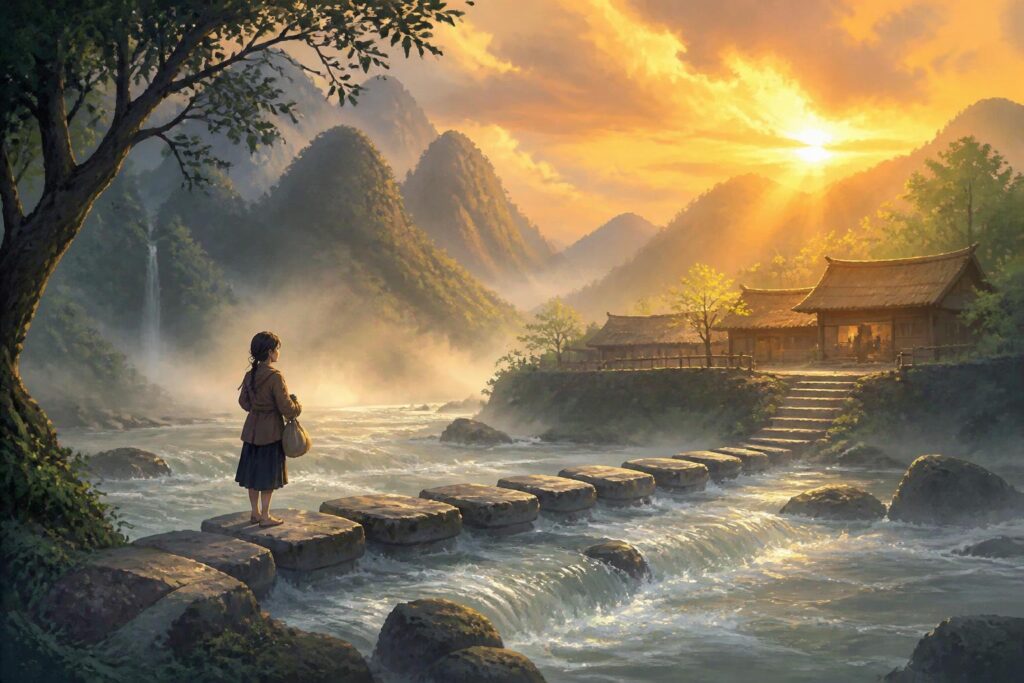
Once upon a time, beyond the green mountain ranges that were shrouded in mist all year round, there was a small village beside a river that frequently changed its course. The villagers called that river the Silent River, not because its waters flowed gently, but because no one had ever heard it say anything. Whenever the rainy season came, the river rose, carrying away branches, thatched roofs, and sometimes even the things people thought they had held tightly in their hearts.
In the village lived a girl named May. She lived with her mother in a palm-thatched house at the end of a dirt road. From a young age, May had quick feet and a clear singing voice. She often went up the hill to pick rose myrtle berries, down to the riverbank to wash clothes, and then sat on the front porch listening to her mother tell stories. But in the year May turned seventeen, a caravan passed through the village. The merchants told of a city beyond the mountains, where there were stone-paved roads, brightly lit markets, and houses so tall that people standing below had to crane their necks to see the roofs.
May listened to these words with shining eyes. She thought her life could not remain confined to the banks of the Silent River. She wanted to go far away, to see places that had never appeared in her mother’s stories. Her mother did not stop her. She only wrapped a brown scarf for her daughter, placed a bag of seeds in her hand, and said: “If there comes a time when you do not know where you are going, plant a seed in the ground. When the tree grows, it will remind you of the place that once nourished you.”
May left the village on a cloudy morning. She traveled with the caravan along winding trails, through a forest where the tree trunks were so large that three people holding hands could barely encircle them. She did not look back, because she was afraid that if she caught sight of her mother’s roof, she would not have the courage to continue.
The city truly was more dazzling than anything May had ever imagined. She found work in a weaving shop, spinning thread during the day and learning bookkeeping in the evenings. Several years passed, and May became skilled and diligent. She had a small room in an attic, a trunk containing a few beautiful dresses, and acquaintances who always praised her independence. She also sent money back to the village, but never wrote letters. Whenever she thought of her mother, she told herself that once she was wealthier, she would return with truly grand gifts.
Then, one winter, news from her homeland reached the city. The messenger said that May’s mother had grown weak, that the wind had torn away part of the palm-thatched roof, and that the Silent River had risen, causing the road to the village to nearly disappear. May immediately packed her belongings. She brought along the old scarf her mother had wrapped for her long ago, but the bag of seeds was gone. During her years in the city, she had moved several times. Perhaps the bag of seeds lay somewhere in a trunk that had been left behind; perhaps it had fallen along the road without her noticing.
May traveled back toward the mountains. The city behind her quickly sank into the mist. On the third day, she met an old man sitting beside a tree whose trunk had been burned halfway through. He was using a dry branch to draw winding lines on the ground.
“Do you know the way back to the village by the Silent River?” May asked.
The old man looked up. “I do. But that path is not always there.”
“How can a path be there sometimes and not at other times?”
“Because the bridge leading there only appears before someone who truly wants to return.”
May thought the old man was joking. She thanked him and continued on her way. But when night fell, the path suddenly divided into three routes. One led up toward a cliff, another turned into a dense forest, and the last followed a reed-covered marsh. May chose the middle path because she could hear flowing water. She walked on and on, until, when the moon rose, there was only a deep ravine before her. Below, the black river churned violently. There was no bridge, nor any sign of human footprints.
That night, May slept beneath a tree. In her dream, she saw her mother standing on the front porch, holding a chipped porcelain bowl. Her mother did not reproach her, but only asked: “Did you come back because you missed me, or because you were afraid you would no longer have time to see me?”
May awoke before dawn. The question followed her throughout the journey. She realized that she had missed her mother many times, but had always found a reason to delay. She wanted to return as a successful person, not as the girl who had left without having had the chance to say goodbye. She wanted to bring gifts home to cover over the years of silence. Perhaps what she feared most was not that her mother was angry, but that her mother had grown used to no longer waiting for her.
The Path Not Meant for Those Who Only Know How to Look Forward
The next morning, May returned to the crossroads. This time she did not choose the path marked by the sound of water, nor did she choose the easiest route. She closed her eyes, remembered her mother’s words about the seeds, and then stepped onto a path covered in decaying leaves. The path was narrow and dark. Many times vines wrapped around her feet and made her fall. At times she heard people calling from behind her, sounding exactly like her friends in the city, telling her to turn back because there was nothing ahead but mud.
May kept walking. She did not know whether the calls were real or the product of her imagination. She only knew that if she turned back, she would continue living by promises of “one day.”
Near noon, she came upon a boy sitting and crying beside a bamboo thicket. He was clutching an empty basket and said that he had lost his family’s goat. May intended to continue, for she was anxious to get home. But then she remembered all the times her mother had spent an entire market day searching for the wooden bracelet May had dropped. She put down her luggage and followed the goat’s hoofprints in the dirt with the boy.
They found it just as the sun was about to set. The goat was trapped in a hollow in the rocks, its leg tightly tangled in forest vines. May had to use her small knife to cut through each vine before she could free it. The boy thanked her and then showed her a trail leading to the riverbank. Before they parted, he picked up a dried fruit and placed it in her hand.
“The seed is inside,” he said. “My grandmother says every tree remembers the person who planted it.”
May looked at the fruit in her palm. She did not know whether it contained the kind of seed her mother had once given her, but for the first time in many years, she felt that she was holding a truly clear reminder.
At the end of the path, she once again stood before the deep ravine. The Silent River still surged violently. May sat down, using the brown scarf to wipe away her sweat and tears. She spoke aloud, though she did not know whether she was speaking to her mother, to the river, or to herself:
“I don’t have any grand gifts. I didn’t become the person I once promised I would be. I only want to go home and say that I have missed you very much. I’m sorry I made you wait so long.”
As soon as the final words dissolved into the wind, the water ahead suddenly gleamed beneath the evening light. From the opposite bank, gray stone slabs slowly rose one after another, joining together to form a low bridge. The bridge had no railings and no supporting pillars; it simply lay still upon the water, as though it had been there for a very long time but had just been called by someone.
May stepped onto the first stone slab. Each footstep made the bridge tremble slightly. She did not look down at the water. In the middle of the bridge, she heard many familiar sounds: her mother’s voice calling from beside the kitchen fire, her own laughter when she was little, the wooden door opening on rainy afternoons. Those sounds did not pull her back. They only reminded her that she had once had a place to return to.
What Was Waiting on the Other Side of the River
When May set foot on the opposite bank, the bridge disappeared. Ahead was a dirt road leading straight to the village. Her mother’s house was still there, though one corner of the roof had been temporarily tied down with bamboo poles. On the porch, a silver-haired woman was sitting and sorting beans. She was thinner than May remembered, but her eyes were still as gentle as they had been on the day May left.
May stood outside the gate for a long time. She did not know how to begin. Finally, her mother looked up, saw her, and set down the basket of beans.
“You’re home?”
That one simple sentence was enough to make May burst into tears. She knelt at her mother’s feet and told her everything she had kept hidden: the letters she had never written, the times she had wanted to return but waited for tomorrow instead, the shame of not yet being as wealthy as she had hoped, and the fact that she had lost the bag of seeds.
After listening, her mother reached out and stroked her daughter’s hair. “If the seeds are lost, we can plant others. When someone who has gone far loses their way, they simply need to find the road home. I never needed you to bring anything back.”
In the days that followed, May stayed to repair the roof, care for her mother, and help the villagers clear the canal that had been buried under earth and stones after the flood season. She told everyone about the city, but no longer spoke in a boastful voice. She also told them about the bridge that appeared only when someone truly wanted to return. Some believed her, and some laughed, but no one ever found the bridge where May had crossed.
One early spring morning, May planted the dried fruit the boy had given her in front of the house. Her mother said it might not grow because the seed was old. May still watered it every day. Several weeks later, a green sprout emerged from the soil. It grew slowly, but its trunk was sturdy. Many years later, the tree spread its shade across the front porch, becoming a place where the village children sat and listened to May tell stories.
May never knew whether the bridge had been created by magic, by the river’s compassion, or by the courage in her own heart. She understood only one thing: some paths do not appear because we travel quickly, nor do they open because of grand gifts. They appear when we stop running from what we love and dare to admit that we have been lost.
From then on, whenever someone in the village wanted to leave, May did not advise them to stay. She simply gave them a seed and said: “Go if your heart wants to go. But when you need to return, don’t wait until you have become a perfect person. A home usually opens its door to those who are honest, not to those who have never made a mistake.”
And on nights when the Silent River rose, people sometimes saw, beneath the moonlight, several gray stone slabs emerge in the middle of the current before silently sinking again. No one knew where that bridge led. Only those who truly wanted to return could see it.

ARTICLES IN THE SAME CATEGORY
The Lamp by the Desolate Ferry Landing and the Man Who Asked for Nothing in Return
The Well That Does Not Keep Water for Itself
The Library at the End of the Alley and the People Learning How to Open Doors for One Another
After an Argument, What Needs to Be Repaired First?
The Box That Holds the Rainy Season
The Watchmaker and the Forgotten Moments
ARTICLES IN THE SAME GENRE
Stepmother and Stepchild