

 Tiếng Việt
 日本語
日本語 한국어
한국어 中文 (中国)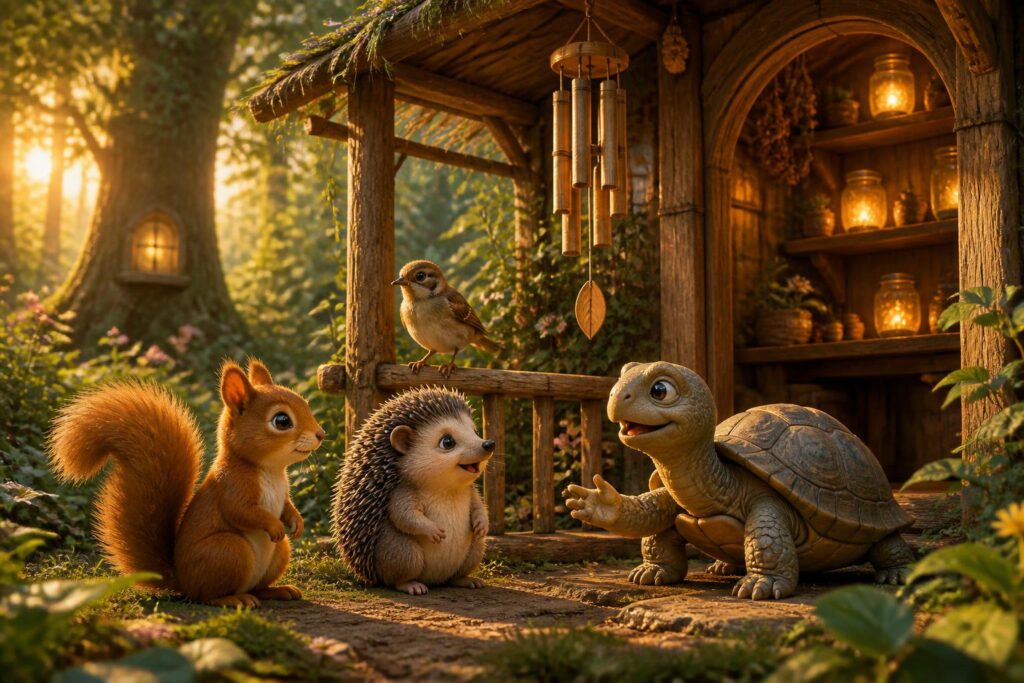
At the edge of the Green Forest, where tall tree trunks reached up to welcome the sunlight and a small stream wound its way through the grasses, stood a wooden house that had been uninhabited for a long time. The house was not large. Its roof was covered in soft moss, its windows were trimmed in green, and a wind chime made of slender bamboo tubes hung in front of the porch. Whenever the wind blew through, the chime rang out with crystal-clear sounds, sometimes as soft as a whisper, sometimes as cheerful as laughter.
The animals in the forest called it the House of Sounds. No one knew who had built the house, nor did anyone know why unusual sounds came there. They only passed along the tale that if a sound was forgotten or had no one to listen to it, it would follow the wind and take temporary shelter beneath the old roof.
Little Brown Squirrel often passed by the house on the way to gather acorns. Brown Squirrel had bright eyes, a soft tail, and a habit that Mother often reminded him about: he spoke very quickly and listened very little. When Hedgehog told a story, Squirrel would interrupt. When Sparrow was singing, Squirrel would immediately say that he had heard that song many times. Sometimes, before Gray Turtle had even finished a sentence, Squirrel had already guessed what he meant and run off to do something else.
Brown Squirrel did not mean to make his friends sad. He simply thought that because he was quick, he would understand everything more quickly, too. But as time went by, his friends invited him to play less and less. Hedgehog would often fall silent when he saw Squirrel coming. Sparrow would fly to another branch. Gray Turtle continued walking at his steady pace, but he no longer told Squirrel about the things he observed along the streambank.
The Forgotten Sound
One afternoon, after busily chasing a pinecone rolling down a slope, Brown Squirrel arrived in front of the wooden house. The sky was full of clouds that day. The wind blew strongly through the forest, making the branches sway. The wind chime on the porch rang out rapidly, but amid the familiar tinkling sounds, Squirrel heard something very small.
It was a sigh.
Squirrel looked around. No one was beneath the porch. He pressed his ear to the wooden door. From inside came many overlapping sounds: the gentle drip of water, the rustling of dry leaves, the soft beating of wings, and even sobs that sounded as if they had been held back for a very long time.
“Who’s in there?” Squirrel asked.
The door opened by itself. Inside, the house was dark but not frightening. On the wooden shelves stood many glass jars. Each jar held a small, flickering light. Some jars gave off laughter, some rang with singing, and some contained the sound of footsteps, calls to one another across the meadow, and a mother soothing her child to sleep.
In the corner of the room, a yellow light was trembling.
“I am an apology that has not been spoken,” the light answered softly. “I have been here for many days.”
Squirrel was surprised. “Why don’t you return to the person who said you?”
“Because that person keeps thinking it is fine not to say anything. They wait for the other person to understand on their own, while the other person waits for a sincere apology.”
Squirrel looked at the other jars. A pale blue light introduced itself as a question that no one had answered. An orange light was a forgotten thank-you. Near the window was the clear sound of a word of encouragement, but it was fading because it had been waiting too long to be given to anyone.
Brown Squirrel suddenly felt a heavy weight in his heart. He thought of Hedgehog, Sparrow, and Gray Turtle. Perhaps there were also words in the forest that had not yet reached their destination. Perhaps Squirrel himself had forgotten quite a few of his friends’ stories.
The Wind Chime’s Lesson
Just then, an old Wind came blowing in from the porch. He had a deep, slow voice, like bamboo rubbing against bamboo in the night.
“Sounds are not made only with the mouth,” said Wind. “A nod, an attentive gaze, or the patience to sit beside someone is also a way of listening. When a person feels that they are being heard, their words are no longer lonely.”
Brown Squirrel lowered his head. “But what should I do to help these sounds return?”
“Begin by listening to an entire story. Do not rush to guess, and do not rush to answer for someone else. Once you understand what your friends want to say, you will know which sound needs to be brought back to the right place.”
The next morning, Brown Squirrel got up earlier than usual. He did not run straight to the meadow but went to Hedgehog’s house instead. Hedgehog was sitting outside, struggling to repair a basket for holding berries.
“Hedgehog, did you want to tell me something yesterday?” Squirrel asked.
Hedgehog looked at Squirrel in surprise. “I wanted to ask you to make a larger basket with me. But every time I started to speak, you had already run away.”
Squirrel sat down beside Hedgehog. This time, he did not interrupt. Squirrel listened as Hedgehog told him about the soft grasses, how to weave them so the basket would not come undone, and his wish to gather lots of berries to share with the other animals in the forest. When Hedgehog finished speaking, Squirrel finally smiled.
“I’m sorry I didn’t listen to you. If you agree, I’d like to make it with you.”
As soon as the apology was spoken, a joyful tinkling sound rang out from the far end of the forest. The yellow light in the wooden house had flown out of its jar and returned to Hedgehog. Hedgehog could not see the light, but he felt lighter inside. The two of them sat weaving the basket until noon.
After that, Squirrel went to find Sparrow. Sparrow was practicing a new melody on a low branch. Squirrel sat beneath the tree and listened quietly to the entire song. When Sparrow stopped singing, Squirrel spoke:
“Your song makes me imagine a sunny morning shining on the surface of the stream. Could you sing it one more time?”
Sparrow happily nodded. From somewhere, a clear sound soared into the sky. It was the forgotten word of encouragement. It landed gently on the branch, making the leaves tremble as if they were applauding.
Finally, Brown Squirrel went to Gray Turtle. Turtle was observing some small footprints around the streambank. In the past, Squirrel had often thought that Turtle did everything too slowly. But that day, Squirrel patiently sat down.
“What are you looking for?” Squirrel asked.
Gray Turtle pointed to the soft mud. “Last night, a little frog got lost. I’m following his footprints to take him back to the pond.”
Squirrel was about to say that it would take all day, but then he remembered what Wind had said. He did not rush to judge. Squirrel examined the footprints carefully, listened to Turtle’s explanation, and followed the little path with his friend. In the afternoon, they found the little frog sheltering beneath a large leaf. Turtle took the frog back to the pond, and Squirrel realized that there were some things only someone who knew how to slow down could see.
The House with the Lights On
From that day on, Brown Squirrel changed little by little. He was still quick and lively, still fond of running around and telling stories, but before speaking, he often asked himself, “Has my friend finished speaking?” When a friend was sad, Squirrel did not hastily say that everything would be all right. He sat beside them, listened, and offered advice only when they wanted it.
The animals in the forest gradually noticed the change. Hedgehog invited Squirrel to make baskets again. Sparrow often sang new melodies for Squirrel. Gray Turtle shared interesting tracks and traces from along the streambank. It was not because Squirrel had become perfect, but because he had learned to make room for other people’s voices.
The wooden house at the edge of the forest also grew brighter. The glass jars gradually emptied as the sounds found the places where they belonged. On the porch, the wind chime rang gently. Each tinkling note seemed to remind everyone that words only truly have meaning when they are offered with sincerity and received with an open heart.
One evening, the animals brought lanterns to the house together. Hedgehog brought the new basket, Sparrow sang a song, Gray Turtle told the story of the little frog, and Brown Squirrel sat listening in the middle of the circle. No one tried to speak louder than anyone else. No one hurried to interrupt. Laughter, singing, and storytelling blended together, warm as a small fire.
From then on, whenever an animal in the forest felt that their words had been forgotten, they would come to the House of Sounds. There was always an empty chair, a wide-open door, and a wind chime ready to ring. Brown Squirrel often reminded his friends that sometimes the most precious gift we can give another person is not a particularly clever thing to say, but a few quiet minutes to let them finish speaking from the heart.
Brown Squirrel’s story offers children a simple lesson: listening does not mean that we must always agree, nor does it mean that we can always find an answer right away. Listening means letting the person before us know that their feelings and story deserve respect. When we learn to listen patiently, we understand our friends better, find it easier to mend misunderstandings, and create a space where everyone feels that they belong.

ARTICLES IN THE SAME CATEGORY
The Promise of the Flying Leaf
The Raindrop Keeps Its Promise to the Little Bean Plant
The Little Bell Beneath the Banyan Tree
The Little Girl Who Sewed a Coat for the Wind
The Boy Who Kept a Raindrop in a Seashell
The Seed That Knew How to Listen
ARTICLES IN THE SAME GENRE
Tam Cam Part 2: The Vengeful Spirits of the Palace
Tam and Cam: The Palace Intrigue and the Original Ending – Part 1
The world is never short of those who judge others by their material possessions; however, the most concerning poverty of all is the lack of wisdom and self-cultivation.
Stay Away from Foolishness: Seven Forms of Self-Deception and the Path to Awakening
Letting Go of Attachment to Overcome Anxiety: When What Exhausts Us Is Not Life Itself, but the Way We Hold On to It
Drinking Tea or Living Life: When People Get Lost in Material Glamour and Forget Themselves