

 Tiếng Việt
 日本語
日本語 한국어
한국어 中文 (中国)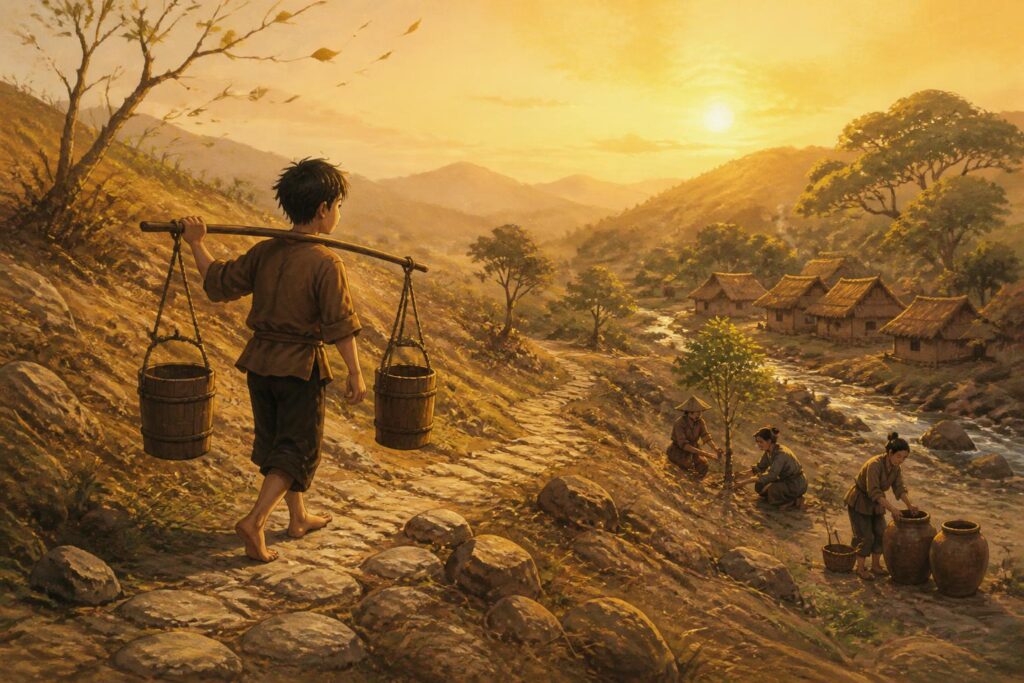
Once, on the far side of a mountain range swept by wind all year round, there was a village called Sunlit Patch. The village lay between two barren hills. The earth was cracked and dry, and its only stream usually ran dry before summer had passed. The villagers were accustomed to saving every dipperful of water. Each household had an earthenware jar beneath the eaves, but often the jar held only a thin layer of water, barely enough to wet the palms of their hands.
In the middle of the village stood an ancient stone well. The water in the well never dried up completely, but the spring was so small that every family had to queue before dawn. On dry days, arguments often rang out around the well. The strong pushed ahead, while the weak quietly waited behind. Everyone feared that if they gave up one dipperful of water, they themselves would be thirsty the next day.
In the village, a boy named Lam lived with his grandmother. Lam was not as strong as the other young men. One of his legs had been disabled since childhood, so he walked slowly and found heavy work difficult. In return, Lam had keen eyes and a heart that always noticed the things others usually overlooked. He knew which homes had sick people, which had small children, and which had run out of firewood for boiling water. Every morning, Lam usually rose earlier than his grandmother, carried a small bucket to the well, and returned before the sun rose above the hill to the east.
One day, after many days without rain, the village head announced that the spring in the well had weakened considerably. Starting the next day, each household would be allowed to draw only one small jar of water. Families with many children would have to divide every sip among themselves. When Lam’s grandmother heard the news, she sighed:
“We must keep our share, my child. No one can take care of everyone.”
Lam nodded, but in his mind he saw old Mrs. Net at the far end of the village. She lived alone in a thatched-roof house. Her eyesight had grown dim, and her hands trembled so badly that she could not draw a bucket herself. For the past several days, she had only dared to go to the well when no one was around, but by the time she arrived, the water had usually all been distributed.
The next morning, Lam took two old wooden buckets, tied them to a carrying pole, and practiced walking. The weight of the pole made his shoulder ache, while his disabled foot repeatedly slipped on the gravelly ground. After walking a short distance, Lam had to sit down and catch his breath. Seeing him, his grandmother hurried out to help.
“What are you trying to do?”
“I want to fetch water for Mrs. Net.”
“Our own household has hardly anything to spare.”
“I’ll only take a little less for us. If she has one bucket a day, she probably won’t have to go thirsty.”
His grandmother remained silent for a long while. At last, she removed the brown scarf from her head and wrapped it around Lam’s shoulder so that the carrying pole would not rub against his skin. She did not say that she agreed, nor did she stop him. She only told him to walk slowly and not push himself too hard.
The Road Across the Hill
From the village well to Mrs. Net’s house was only a short distance, but the route crossed Windy Hill. There were no large trees there, only low grasses clinging to the soil. The wind blew year-round, sometimes as gently as a sigh, and sometimes so fiercely that it could knock down a person carrying a heavy load.
On the first day, Lam spilled nearly all the water. As he stepped down the hillside, a sudden gust struck from the side and sharply tilted the bucket on his right. Water spilled onto the ground, seeped into the cracks, and vanished. Lam sank to the ground, staring at the small puddle before him, and felt his throat grow parched.
A few people passed by. A young man laughed:
“You can barely walk steadily, and you’re pretending you can carry water. You can hardly take care of yourself—who do you think you can help?”
Lam did not answer. He picked up the bucket and returned to the well for more water. By the time he reached Mrs. Net’s house, only a little more than half remained in the bucket. The old woman raised both hands to receive it and thanked him over and over. Lam watched her drink it in small sips and suddenly felt that the distance he had just traveled was no longer as long as it had seemed at first.
In the days that followed, Lam continued carrying water. He learned to tie the ropes more tightly, place a layer of cloth beneath the bottoms of the buckets, and set his feet on the least slippery stones. He also realized that Windy Hill had its own pattern. Each morning, the wind usually blew from west to east. Toward noon, it changed direction and grew stronger. So Lam chose to leave very early, while the ground was still cool and the wind had not yet risen.
The villagers began to notice what he was doing. Some said Lam was wasting his effort because sooner or later Mrs. Net would not survive the dry season anyway. Others thought he only wanted to be praised. Lam heard them but did not defend himself. He thought that if a good deed had to wait until everyone understood it before it could begin, perhaps no good deed would ever be done.
The Jar Beneath the Fig Tree
A week later, Lam realized that Mrs. Net lacked more than drinking water. Her house had no large jar for storing water, and every time he brought some, she had to ladle it into small bowls. In hot weather, the water would quickly run out before the next day.
Lam went to the only potter in the village and asked for a jar with a cracked rim. The potter was busy repairing intact jars for families who could afford them, so he waved Lam away:
“How much water can a cracked jar hold? Take it home and it will only clutter your house.”
Lam asked for the jar anyway. He mixed clay with cooking ash to seal the crack, then left it in the sun for many days. The jar was no longer beautiful, but after testing it, Lam found that it still held most of the water. He placed it beneath the fig tree in front of Mrs. Net’s house, where it stayed in the shade from morning until afternoon.
From that day on, Lam no longer had to carry water every day. He could bring a little more at a time and leave it for her to use gradually. The effort made his shoulder ache, but his grandmother quietly set aside some of her own water for him. When Lam found out, he shook his head:
“Don’t take less for yourself, Grandmother. If you grow weak, I won’t be able to walk either.”
His grandmother looked at him and smiled sadly:
“Kindness also needs to be cared for, just like a young tree. If you only give and never conserve your strength, you will collapse before you have time to help anyone else.”
Her words made Lam think for a long time. From then on, he no longer tried to do everything alone. He asked the children in the village to gather flat stones to pave the slippery section of the road. He showed several stronger people how to tie the buckets so the wind would not spill the water. He invited the mothers to collect old jars, repair them, and place them in shady spots.
At first, no one wanted to participate. Everyone had a reason to refuse. Some were busy, some were afraid of losing their household’s share of water, and others thought the effort would not change anything. But then a little girl named Nhai brought a rope braided from palm leaves. A farmer contributed several planks to build a small bridge over a rocky ditch. The potter from before also quietly brought over an intact jar, saying that he had made an extra one.
No one mentioned that Lam had started it all. They simply worked together, little by little.
The Spring Beneath the Ground
By the end of the dry season, the village well was almost empty. That morning, even though they had queued early, many families still could not collect enough water. The village head sent people to search for another place to dig a well, but the soil around the village was hard and dry. The adults argued, the children cried from thirst, and the wind on the hill blew clouds of dust everywhere.
Lam remembered signs he had noticed while crossing Windy Hill. On the northern side of the hill was a strip of pale green grass, even though everything around it had turned yellow. Beneath a large rock, the soil was always damper than elsewhere. Lam had thought many times about telling everyone, but he was afraid he might be wrong.
At last, Lam led the village head there. They tried digging. At first, they found only dry soil and gravel. As they dug deeper, the shovel struck a layer of soft earth. By afternoon, a thin trickle of water seeped from the ground. It was not enough to be called a stream, but it flowed steadily, slowly, and crystal clear.
The villagers rejoiced. They took turns widening the hollow in the ground, setting stones around the spring, and building a small channel to lead the water toward the lowland. The work continued for many days. When the spring had grown large enough, they did not divide the water according to wealth, nor according to who had arrived first. The village head established a rule: drinking water would be given priority, followed by water for livestock and crops. Each household would appoint one person to take turns watching over the spring, so that no one took more than their share.
Mrs. Net was the first person to draw water from the new spring. She lifted the bowl with both hands, took a sip, and then offered it to Lam. He shook his head and told her to keep drinking. She smiled:
“This water does not belong to me alone. You must drink too.”
Lam accepted the bowl. The cool water flowed down his throat, carrying the taste of earth and stone. He suddenly understood that the spring had not appeared simply because one person found it. It had been there for a long time, but only when everyone learned to search together and preserve it together did the water become a source of life for the whole village.
The Lesson Left Behind After the Dry Season
Many years later, Windy Hill was no longer as barren as before. The villagers planted rows of low trees around the slopes, built stone fences to hold the soil in place, and set rain jars beneath their roofs. The dry season still came, but it no longer forced everyone to crowd around a single well.
Lam grew up and became the caretaker of the village spring. He still walked more slowly than others, but he was no longer ashamed of it. He knew that a person did not have to be the strongest to begin a change. Sometimes, all that mattered was seeing the hardship of the person beside you and being willing to take the first step.
The story of the water carriers crossing Windy Hill was retold to the children of the village every dry season. The storyteller would often remind them that kindness did not always produce results immediately. There would be days when the water spilled onto the ground, words of ridicule that made us lose heart, and deeds that seemed too small to make a difference. But if one person patiently kept that flame alive and then passed it on to others, kindness could spread like a quiet spring beneath the ground.
And just like the spring in the story, the human heart often contains clear, pure parts that we ourselves have not yet recognized. As long as someone begins to dig down with care, perseverance, and faith, what seemed to have dried up may sometimes still find its way back toward life.

ARTICLES IN THE SAME CATEGORY
The Lamp by the Riverside Landing
The Empty Chair Beside the Veranda
The Stone Path Through the Flood Season
The Map of Things Left Unsaid
The Empty Chair Beside the Veranda
The Lamplighter and the Road Without Darkness
ARTICLES IN THE SAME GENRE
Stepmother and Stepchild