

 Tiếng Việt
 日本語
日本語 한국어
한국어 中文 (中国)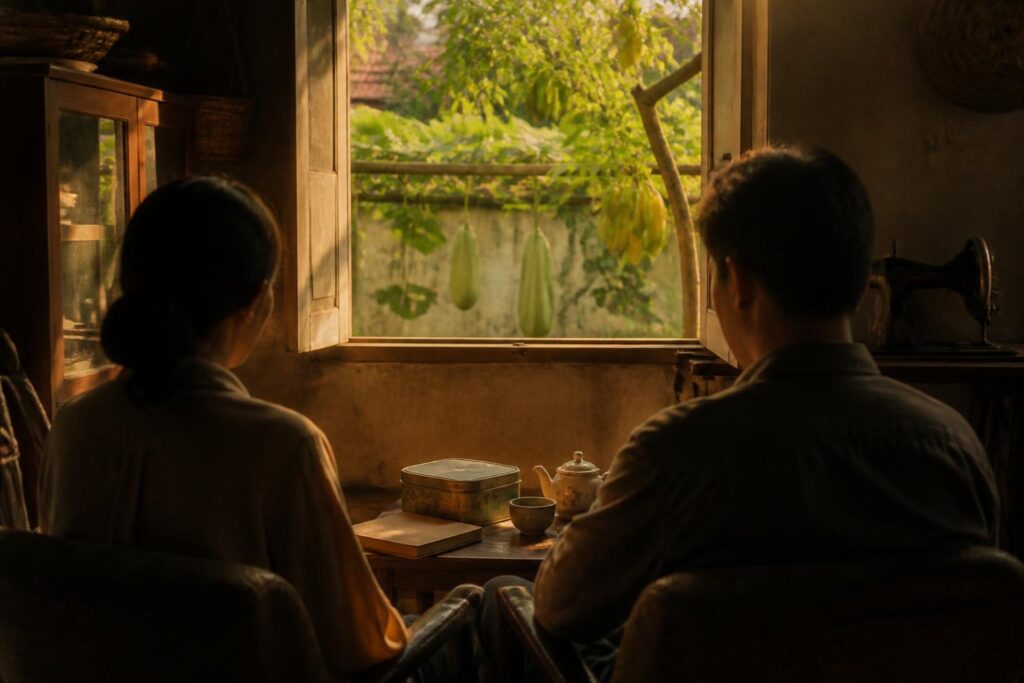
Some rooms are not spacious, yet they are large enough to hold an entire lifetime. The room at the end of the hallway in Mrs. Lam’s house was such a place. It contained only a wooden bed, a low wardrobe, an old sewing table, and a window overlooking the backyard. Through that window, one could see the star-fruit tree, the loofah trellis, and the moss-covered brick wall. Every afternoon, the sunlight slanted down into the garden in thin golden streaks, touching the tiled floor before quietly fading away.
Mrs. Lam had lived in that room for more than thirty years. After her husband died, she did not make many renovations. She covered the peeling paint with a small picture, propped up the unsteady table leg with a piece of cardboard, and continued washing and rehanging the faded curtain every rainy season. She often said that a house did not need to be new; it only needed to still have someone who remembered the way home.
Her two children, Quan and Thao, had not come home together for many years. Quan worked in a city several hundred kilometers from their hometown, busy with meetings, business trips, and an apartment that stayed brightly lit until late at night. Thao was married and lived in another province, where she ran a small shop and had two school-age children. Both still called their mother and sent gifts on necessary occasions, but their conversations usually revolved around medicine, electricity bills, the leaking roof, or when they would come home.
They had once been very close. When they were children, Quan was always the one who led his younger sister across the bamboo bridge at the end of the hamlet. Thao kept his finest marbles for him and was willing to take the blame when the two of them broke their mother’s flower vase. The distance between them began with something minor, but it lasted so long that it eventually became a wall.
That year, Mrs. Lam suffered severe back pain. Quan wanted to bring their mother to the city so he could care for her more easily. Thao objected, believing that their mother was accustomed to her house, her neighbors, and the backyard, and that moving away would make her sad. The siblings argued over the phone. Quan said Thao only wanted to keep the house because she was thinking about dividing the property. Thao angrily replied that Quan only remembered their mother when he could arrange everything with money.
Neither of them said everything they were truly afraid of. Quan was afraid that their mother would suffer while he was far away, afraid that one day he would receive a call too late. Thao was afraid that if their mother left the house, she would lose the part of her remaining life that she understood best. Those fears were concealed beneath harsh voices, then turned into hurt. From then on, they contacted each other only when they needed to communicate something specific.
Mrs. Lam knew what had happened but blamed no one. She still mentioned one child in front of the other in the most ordinary phrases. “Quan must be very busy these days.” Or: “Is Thao’s shop getting many customers?” When she heard her children speak about each other with irritation, she would usually remain silent, turning instead to pick vegetables or fold clothes. She understood that some advice, the more one offered it, only made people build the barriers between them even higher.
One winter, Mrs. Lam fell in the backyard. The neighbors found her and took her to the hospital, but this time her health did not recover as it had before. Quan returned that very night. Thao also brought her children to their maternal grandparents’ home. The siblings met in the hospital corridor, standing a few steps apart and asking about their mother in brief sentences. They did not mention the argument from years earlier, but the silence between them seemed to say everything in its place.
Mrs. Lam died not long afterward. The funeral ended, and the relatives gradually left. The house became strangely larger. There was no longer the sound of their mother’s slippers moving from room to room, nor the sound of the gate opening whenever a neighbor came to visit. Quan and Thao stayed behind to sort through her belongings because neither was brave enough to entrust the task to someone else.
Things That Had No Value but Could Not Be Thrown Away
On the first morning, they divided up the task of cleaning the living room. Quan gathered old books and newspapers into a cardboard box. Thao wiped dust from the picture frames. They worked beside each other, polite to the point of seeming like strangers. Whenever their hands touched the same object, one of them would pull back first.
By afternoon, they entered the room at the end of the hallway. On the sewing table there was still a blue tin box. Quan opened the lid. Inside were needles and thread, a few buttons, a roll of elastic, and small pieces of fabric neatly cut. At the bottom of the box was an old envelope, with Quan’s name written on the outside in their mother’s handwriting.
Quan thought it contained documents and handed it to Thao. She did not take it, only telling him to open it himself. Inside were several sheets of paper recording the amounts Mrs. Lam had sent Quan during the first years after he began working. One payment was for tuition, another for buying a used computer, and another was recorded very simply: “Send to my son to buy a warm coat.”
Quan stared at the lines for a long time. He remembered once thinking that those payments were something their mother could afford to handle. He had never asked how she had saved the money, much less known that during some months she had taken on extra sewing work at night to have enough to send him. He set the envelope down, his voice growing hoarse. “I didn’t know Mother had worked so hard.”
Thao did not answer immediately. She opened the sewing table’s drawer and took out a small notebook with a brown cover. In it was a list of the days Mrs. Lam went to the doctor, the names of her medicines, neighbors’ phone numbers, and a few notes about sending things to her two children. On one of the last pages, she had written: “Thao likes sour soup. Quan often has stomachaches; remember to remind him not to drink coffee before breakfast.”
Thao ran her hand over the page. She had often thought that their mother relied only on her, that everything in the house fell on her shoulders while Quan was far away. But the notebook showed her that their mother had still kept watch over Quan every day; her way of caring was simply quiet and never displayed. She also suddenly realized that she had used her exhaustion to judge him instead of saying that she needed him to share the burden.
In the bottom drawer of the wardrobe, they found an envelope with no name on it. Inside was only a single sheet of paper. Their mother’s handwriting was shakier than usual: “If both of you are reading this, then I must no longer be here. I have left you nothing of value. This house, too, is not as important as the fact that the two of you can still sit beside each other. If there is anything left unsaid, say it while there is still time. Family members are not always right, but they are often the people who most want to be understood.”
What Had Been Forgotten in an Argument
Thao turned toward the window. Outside in the garden, the young star fruits swayed in the wind. Quan sat down on the low chair, his hands clasped together. After a long while, he said that back then he had not truly wanted to take their mother away merely for his own convenience. He was afraid that his work would turn him into a son who did nothing but send money and make phone calls. Bringing their mother to the city was the way he thought he could make up for it.
Thao said that she had objected because their mother had once said she did not want to leave the house. But beneath that, she was afraid that if Quan took their mother away, everyone would think she had been unable to care for her. She was afraid that all the years she had spent by their mother’s side would become meaningless simply because of a decision made by her older brother, who lived far away. At that point, she began to cry—not because of the house or the matter of dividing the property, but because it had been so long since she had had a chance to speak honestly.
Quan did not rush to comfort her. He simply sat and listened. When Thao finished, he admitted that he had been unfair to accuse his sister of being greedy. Thao also apologized for saying that he was someone who only knew how to use money to solve everything. They both understood that an apology could not erase the years of coldness, but at least it opened a door they had once thought was locked.
They did not immediately decide whether to sell or keep the house. Instead, the siblings cleaned up the room at the end of the hallway together. Quan repaired the sewing table, replaced the window hinges, and called someone to fix the leaking veranda roof. Thao washed the curtains and replanted several clumps of flowers along the path. The tasks were small, but they gradually helped the two of them rediscover the rhythm of working together that they had shared as children.
On the last day before Quan returned to the city, the two of them sat by the window drinking tea. Thao asked whether he could come back the following month to repair the fence together. Quan said he could, then asked whether she could send him the recipe for the sour soup their mother used to make over the weekend. The conversation shifted to small, everyday matters: Thao’s older child was about to take an exam, Quan’s car needed servicing, and the star-fruit tree might bear a particularly large crop that year.
No miracle took place. The old misunderstandings did not disappear after a single afternoon. But once people begin speaking with honesty instead of pride, the distance can start to narrow. They do not need to agree with every choice the other makes. They only need to remember that behind an objection there may sometimes be worry, and behind a reproach there may be a desire to be cared for.
The Window Remains Open
A few months later, the room at the end of the hallway remained just as it had been. Quan did not want to turn it into an office, and Thao did not want to sell the sewing table. The siblings agreed to return there from time to time, each bringing along something that needed to be done. Once, they repaired the veranda roof together. Another time, Quan brought his nieces and nephews to pick star fruit, while Thao cooked the soup their mother used to make.
The house was still old, the wall was still covered in moss, and the curtain was still faded. But the room was no longer merely a place that preserved the belongings of someone who had died. It became a place where two living people learned how to see each other again. Through the window, the backyard changed with every season. The loofah trellis was replaced, the star-fruit tree grew larger, while the patch of sunlight on the tiled floor each afternoon remained as gentle as before.
In family life, some separations begin with something very small and then continue because no one wants to be the first to give in. People often wait for the other person to understand what is in their heart, while they themselves do not say it clearly. By the time the distance has grown large enough, even a simple inquiry about the other person can become difficult.
Mrs. Lam’s room reminded Quan and Thao that family ties do not remain strong automatically simply because people share the same roof. They need to be cared for through honest conversations, through the ability to listen without immediately passing judgment, and through the courage to admit fault when one has hurt someone else. We may not be able to change what has happened, but we can always choose how to move forward.
And sometimes, the first step is simply to sit down beside a window, call a family member by name in a calm voice, and say something one has held back for too long: “I still want to understand you.” Or: “I still want us to be a family.”

ARTICLES IN THE SAME CATEGORY
The Clock Repairer and the Forgotten Hours and Minutes
The Scent of Rain on the Old Tile Roof
The Water Carrier Across Windy Hill
The Lamp by the Riverside Landing
The Empty Chair Beside the Veranda
The Stone Path Through the Flood Season
ARTICLES IN THE SAME GENRE
The Seedling Who Knew How to Listen and the Forest That Awoke
Brown Squirrel’s Raincoat
The Wind Chime Finds Its Chime Again
Stepmother and Stepchild