

 Tiếng Việt
 日本語
 한국어
 中文 (中国)
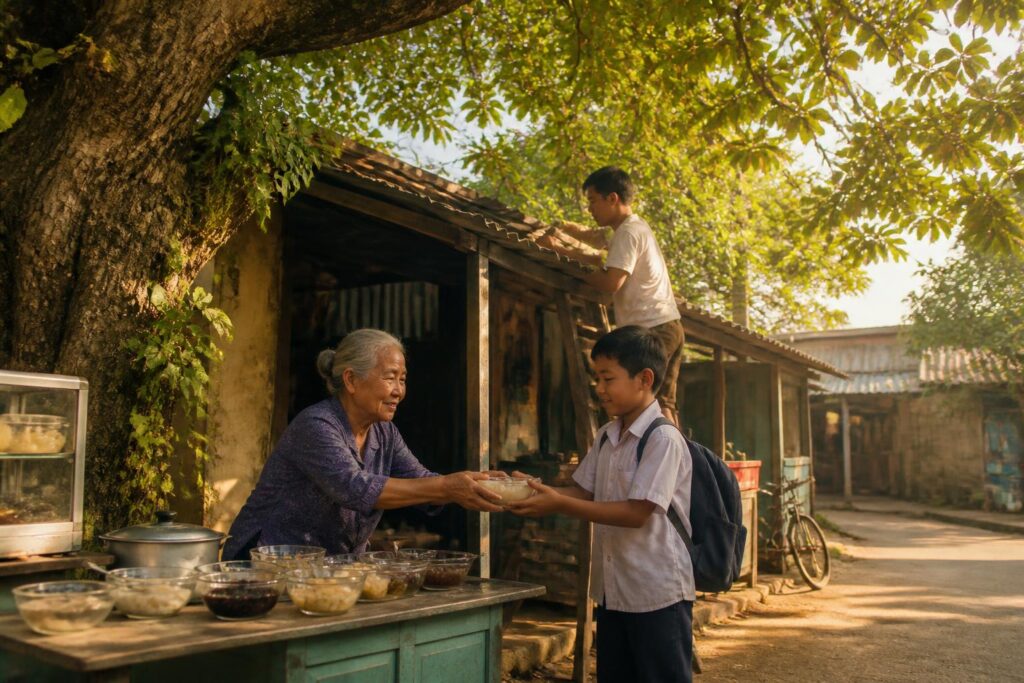
At the bottom of the slope leading to the riverside pier stood a small sweet soup stall nestled beneath an old tropical almond tree. The stall consisted of nothing more than a low corrugated-metal roof, a few faded plastic chairs, and a glass cabinet holding jars of sugar, mung beans, and lotus seeds. People in the neighborhood called it Mrs. Lanh’s sweet soup stall. She had been selling sweet soup for more than twenty years, from when more than half her hair was still black until the only hair left on her head was a thin gray bun.
Her stall was not famous for any particularly special dessert. Black bean sweet soup, corn sweet soup, taro sweet soup, and, occasionally, lotus seed sweet soup were much like those sold by other vendors in the market. What people remembered about the stall was her unusual habit. If she saw a child standing in front of the glass cabinet, staring for a long time, she would usually ladle out a small bowl and say that it was sweet soup from a jar whose rim had cracked, so it could not be sold. If she met an older person who had forgotten to bring money, she would simply smile, mark a dot in an old notebook, and say they could pay whenever it was convenient.
That notebook was thick, its cover curled up at the corners. But no one knew how many debts were recorded in it, because Mrs. Lanh had never asked anyone to pay. Some people returned a few days later to settle up. Some moved away, went to work somewhere distant, and disappeared completely. Whenever her daughter asked why her mother kept letting people buy on credit, she would usually reply: “One bowl of sweet soup won’t make us poor. But sometimes, it helps someone feel that the day hasn’t been so bad after all.”
The Forgotten Wallet
One late afternoon at the end of the rainy season, when nearly all the customers had left, Mrs. Lanh noticed a brown wallet lying beneath a chair. She picked it up and opened it to look for identification. Inside were several cards, a little cash, and a photograph of a young woman holding a baby. There was no address, only a slip of paper with a name and a phone number blurred by ink.
She asked the delivery boy at the end of the lane to try calling the number, but no one could be reached at the other end. By evening, she took the wallet inside and placed it on top of the cabinet. She thought that the next morning she would ask around the neighborhood whether anyone knew its owner. But that night, a young man came running up in a panic. He asked whether anyone had found a wallet, his voice broken because he had been running while making phone calls.
The man’s name was Minh. He said he had come from the neighboring district to look for work, and had stopped at the stall to buy a bowl of sweet soup before accidentally leaving his wallet behind. There was not much money in it, but it was the money he had set aside to pay his mother’s medical bills. The photograph in the wallet was of his daughter, while the cards were the only documents he had after months of temporary work.
Mrs. Lanh handed the wallet to Minh. He opened it to check, then stood beside the low table for a long time, his hands tightly clenched. He took the money from the wallet and placed it on the table to pay for the bowl of sweet soup from that afternoon. Mrs. Lanh pushed it back and refused to accept it. Minh insisted on leaving some money, so she ladled an extra box of sweet soup for him to take home, saying that he had a long journey ahead and should have something to eat.
Before leaving, Minh asked whether she could give him her phone number. She smiled. “There’s no need. Whenever you happen to pass by, just stop in for some sweet soup.”
The Debt That Was Not in the Notebook
A few months later, trouble came to Mrs. Lanh’s sweet soup stall. The wind tore away a large section of the corrugated-metal roof, and rainwater poured in, damaging the glass cabinet and many jars of ingredients. She did not have the money to repair it immediately. Her daughter called from the city and wanted her mother to stop selling, but Mrs. Lanh refused. The stall had been part of her life for far too long. Besides, she still owed people money for rice and beans, and if she stopped working, she did not know how she would pay them.
That day, while she was picking through the wet beans, a small truck stopped in front of the stall. Minh stepped down with two workers. He had found a steady job at a repair workshop nearby. After losing his wallet, he had returned several times but never managed to meet her. When he learned that the stall was leaking, he asked the workshop owner to lend him a truck and brought people to help.
Mrs. Lanh asked in surprise why he was doing this. As he removed the old sheet of roofing, Minh said, “I’m only repaying one bowl of sweet soup.”
That bowl of sweet soup had been worth only a few thousand dong, while repairing the stall’s roof cost far more than that. But Minh was not talking about money. He told her that after paying his mother’s medical bills, he had taken his daughter back to the countryside to live with her maternal grandparents. Whenever he passed the stall, he still remembered what Mrs. Lanh had said: a bowl of sweet soup could help someone feel that a day had not been so bad.
During the time he spent in the city looking for work, there were days when Minh had no money for lunch. Once, he sat outside the gate of a machine shop, planning to turn back because he thought they would never hire him. Just then, he saw a worker share half a bánh mì with a young shoe shiner. The sight reminded him of the sweet soup stall beneath the tropical almond tree. He stayed and waited, and in the end was accepted as an apprentice.
“You may not remember,” Minh said, “but when you returned the wallet, I realized that I could still meet kind people. After that, whenever I wanted to give up, I thought that if I could get back on my feet, then someday I should help someone else get back on theirs.”
Kindness Is Not a Transaction
The story of the repaired stall quickly spread through the neighborhood. One person brought several sheets of roofing, another brought a box of nails, and others helped Mrs. Lanh clean up. A teacher who lived nearby gave her an old glass cabinet. The delivery boy from years ago, now grown up, also stopped by to replace a light bulb. No one told anyone else what to do; each person simply contributed a little, as if they were continuing something that had begun a very long time ago.
Mrs. Lanh sat beneath the tropical almond tree, watching everyone repair the stall, and did not know how to thank them. Her daughter told her to write down each person’s name on a list so she could repay them later. Mrs. Lanh shook her head. “If you keep recording debts, everything becomes buying and selling. Some things, once received, only need to be passed on.”
That was also what set her apart from many people. She did not see kindness as a deposit made to wait for a return. She gave a bowl of sweet soup because, at that moment, in front of her was a hungry child, a tired worker, or an elderly person embarrassed by having forgotten to bring money. She did what she could within her means, and then let the deed continue on its own path.
Of course, kindness was not always repaid. Some people ate on credit and never came back. Some even complained that the sweet soup was too thin or that she charged too much. At such times she was still sad, but she did not close the notebook or stop letting children eat on credit because of it. She understood that helping others did not mean placing blind trust in everyone. She still exercised judgment and kept enough capital to buy ingredients; she simply refused to let a few disappointments turn her into a cold person.
What Remains After a Bowl of Sweet Soup
Many years passed, and the sweet soup stall beneath the tropical almond tree remained as small as ever. Mrs. Lanh no longer had the strength to prepare everything herself, so her daughter often came home to help on weekends. Minh occasionally brought her a sack of good beans, and every time she scolded him for buying too much. He now had a family of his own, and his daughter had grown up knowing the whole story of the forgotten wallet.
One afternoon, the girl came to the stall with her father. She ordered a bowl of lotus seed sweet soup, then sat quietly watching Mrs. Lanh ladle sweet soup for a boy wearing an old school uniform. The boy had no money and was simply standing shyly beside the tropical almond tree because of the fragrant smell. Mrs. Lanh handed him the bowl, repeating her familiar words: “This came from a jar whose rim cracked, so it can’t be sold.”
The girl asked her father why the woman had to say that. Minh replied, “Because if she says she’s giving it to him, the person receiving it might feel embarrassed. But if she says it’s something that can’t be sold, he’ll feel more at ease.”
The girl was silent for a moment, then took the money from her pocket and placed it on the table. She ordered another bowl of sweet soup and asked Mrs. Lanh to give it to the next customer waiting. Mrs. Lanh looked at her, then at Minh. No one said anything, but beneath the shade of the tropical almond tree, a small circle of kindness seemed to have just been extended a little farther.
People often think of a debt as something that requires a person to return and repay it. But some debts do not need to be repaid to the right person, in the exact amount, or at the right time. A word of encouragement, a meal, or one moment of preserving someone’s faith can pass through many years, from one person to another, before returning in an entirely different form.
Mrs. Lanh’s sweet soup stall did not accomplish anything grand. It could not change an entire town, nor could it suddenly make everyone kinder. But there, many people once had an afternoon that felt a little lighter. A child was a little less hungry, a worker felt a little less humiliated, and someone in despair learned that there were still people in the world willing to reach out a hand.
And sometimes, that is enough. Because genuine kindness does not disappear after it is given. It simply quietly finds another path to return.

ARTICLES IN THE SAME CATEGORY
A Kind Person Is Not Someone Who Is Always There, but Someone Who Knows When to Stay
An Ordinary Family Meal and the Things That Keep a Family Together
A Proper Apology Can Reopen a Closed Door
The Things No One Applauds Still Make a Decent Life
A Meal with Someone Waiting: The Art of Keeping a Home Close
When Old Things Teach Us How to Slow Down
ARTICLES IN THE SAME GENRE
The Seedling Who Knew How to Listen and the Forest That Awoke
Brown Squirrel’s Raincoat
The Wind Chime Finds Its Chime Again
Stepmother and Stepchild