

 Tiếng Việt
 日本語
 한국어
 中文 (中国)
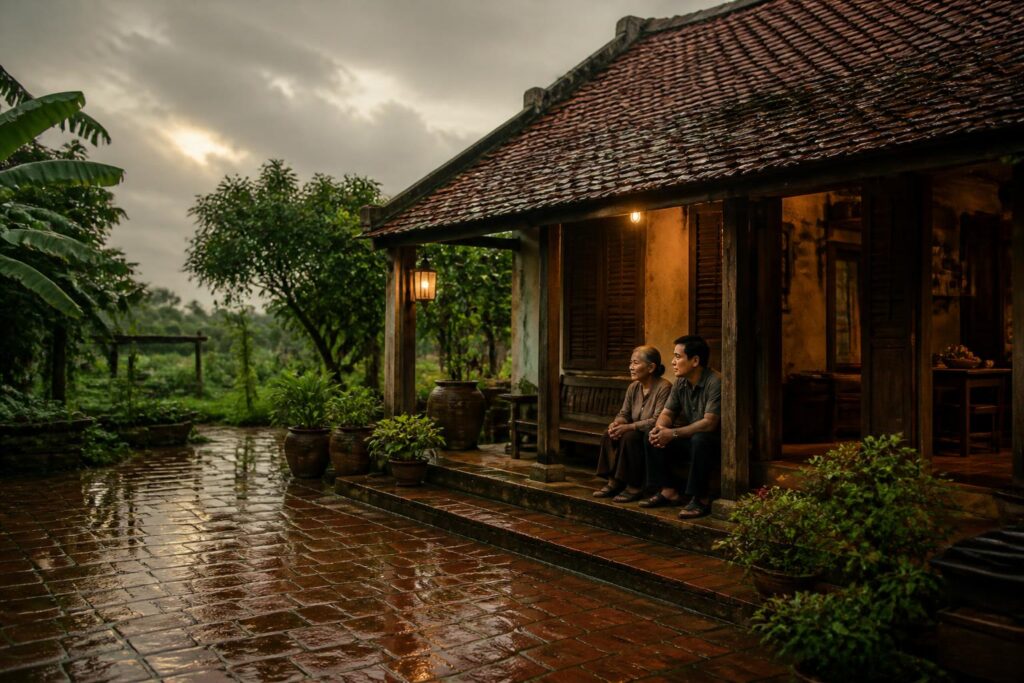
There are afternoons when a sudden rain is all it takes to carry us back to a place deep in our memories. Not by foot, but through the scent of wet earth, the sound of water falling on a tiled roof, and the warmth that once lingered beside the doorstep. These things often appear when we least expect them, in the middle of a crowded street or inside an unfamiliar room, quietly reminding us that behind every departure, there is still a place that once called us by a familiar name.
For Minh, that place was the small house at the end of the village road. There was nothing particularly remarkable about it from the outside. The tiled roof had darkened with age, the limewashed walls were mottled, and the areca palms in front of the house leaned with the changing seasons. After many years of living in the city, Minh once thought that house was simply a part of the past that did not need to be mentioned often. Yet, one day at the end of June, as rain fell heavily on the trees lining the road, he suddenly realized that some things only follow us more quietly the harder we try to set them down.
The House Preserved in the Smallest Things
When he was little, Minh often woke to the sound of his mother sweeping the yard. The rustling of the bamboo broom stretched from the veranda to the gate, steady like a clock that never needed winding. His grandmother would sit by the window, picking vegetables in a rattan basket with a worn handle. His father left for work early, always placing his cloth cap on the nail beside the door before he went. No one thought those habits were important while they were happening. They were simply the rhythm of everyday life, so ordinary that they were easy to overlook.
But memory does not preserve everything in the way people consciously choose. It often stores the smallest fragments in a hidden corner, only to open it unexpectedly many years later. Minh might have forgotten which shirt he wore on his first day of school, but he still clearly remembered the scent of hot rice mingled with kitchen smoke on winter mornings. He did not remember all the stories his grandmother had told him, but he remembered her hand resting on his forehead whenever he had a fever. He could no longer picture the exact color of the old door, but he remembered the hinges creaking softly whenever his mother returned from the market.
That house was preserved by more than bricks and tiles. It was held together by nameless sounds, scents, and gestures. A basin placed beneath the eaves to catch the rain. A towel hanging over the back of a chair. A scratch on the tabletop from the times Minh played with a fruit knife. Every mark was a whispered sentence, saying that people had lived here, loved one another here, and passed together through days that had seemed to hold nothing particularly noteworthy.
Distance Changes the Way We See Home
Minh left his hometown after graduating. The city opened before him with tall buildings, lights that never went out, and opportunities he believed he had to seize. During the first few years, he called home quite often. Later, the calls became less frequent because of work, appointments, and the feeling that everything back home remained unchanged and could wait for him whenever he was ready.
People often postpone what is familiar. We think our parents will always be there, an old room will always have its door open, and a family meal can happen any weekend. We are quick to reserve our urgency for work, paperwork, trips, and people we have just met, while messages checking on our family are pushed to the bottom of the list. It is not necessarily because we love them less, but because we trust too much in the lasting nature of what is familiar.
It was only when his mother called to say that the tiles at the back of the house had started leaking after a heavy storm that Minh decided to return. His mother spoke very calmly, as though it were merely a small repair that needed to be made. But there was a hesitation in her voice that made him understand the house was much older than the image he had continued to carry in his mind.
The trip home took longer than he had expected. Through the glass window, the city gradually receded, giving way to fields coming into season. Minh watched trails of water run down the vehicle window and wondered when he had last truly looked closely at the road home. The question had no clear answer. It only made him feel a hollow space opening inside him, one that the busy years had covered over.
Returning Does Not Begin at the Gate
When Minh stepped through the old gate, he realized the house was smaller than it had been in his memory. The areca palms were still there, but shorter; the yard was narrower; the veranda seemed to have retreated. His mother was sitting by the threshold, running her fingers over each of his father’s old shirt buttons. She smiled, scolded him for losing weight, and immediately asked whether he had eaten. Those questions, which never changed, suddenly made Minh’s eyes sting.
During dinner, his mother talked about very small things. The neighbor’s cat had given birth to another litter. The guava tree behind the house had borne less fruit this year. Someone in the neighborhood had just repaired the road leading to the water landing. Minh listened and realized how many small changes in this place he had missed. No major event had taken place, yet time had still passed day by day, quietly lowering the roof, thinning his mother’s hands, and changing the familiar people around him.
The next morning, Minh climbed onto the roof with a local craftsman. The old tiles were lifted, revealing green moss and layers of dust that had lain beneath them for years. One tile was cracked, and inside it was a faded paper airplane. Minh recognized it as something he had once folded and hidden on the roof during a mischievous midday. He had completely forgotten it, while the house seemed to have quietly held on to it.
The paper airplane could no longer fly. Its folds had softened, and its edges were torn by rain and sun. Minh held it in his hand for a long time. He suddenly understood that returning did not mean finding the lost days intact. No one could turn time backward. To return was to see the changes that had taken place, accept them, and learn to love a place that was no longer exactly like the one in his memory.
The Things We Often Understand Only After Going Far Away
In the past, Minh had thought that growing up meant being able to step out of one’s home on one’s own. Later, he understood that growing up also meant looking back at the place one had left with gratitude and responsibility. Leaving may be necessary to broaden one’s world, but leaving does not mean severing every thread that connects us to the past.
A house cannot keep people from leaving forever. Nor can parents remain frozen at one age in their children’s memories. Those who once carried us in their arms will eventually need us to help them across the threshold. Those who once prepared meals for us will one day wait for a brief call just to know that we are safe. This change of roles happens so gradually that we can easily fail to notice it, but it is a natural part of life.
Minh began to repair his old room. He did not turn it into an elegant space, nor did he try to preserve everything like a museum. He replaced the flickering light bulb, fixed the window, wiped the dust from the bookshelf, and placed a long bench on the veranda. His mother told him he did not need to do so much, but Minh only smiled. He knew he was not merely repairing a room. He was repairing the way he was present in his family.
From then on, Minh called home every Sunday evening. Sometimes the conversation lasted only a few minutes. His mother would say that it had rained, his father would mention the guava tree, and Minh would talk about a rushed lunch in the city. The stories had no climax, but together they formed a bridge. People do not always need grand words to preserve family bonds. Sometimes, asking a question at the right moment and listening long enough is already a way of returning.
The Scent of Rain and the Lesson of Being Present
Several months later, Minh returned to his hometown on a rainy day. The rain falling on the newly repaired tiled roof made a different sound than before, firmer and more even. He sat beneath the veranda and watched his mother bring the clothes she had just hung out to dry inside the house. She still complained that the rain had come at the wrong time, and still asked whether he had brought enough warm clothes. Minh realized that those words were not meaningless repetition. They were his mother’s way of showing care, a simple language he had heard all his life but had only now truly begun to understand.
The scent of rain on the old tiled roof did not take Minh back to an intact past. It brought him back to the present, where his mother was still sitting by the veranda, where the house still needed to be cared for, and where he still had the chance to say the things he had once tended to save for later. Memory, if seen in the right way, is not a room for us to hide in whenever we are tired. Memory is a mirror that helps us recognize what we have received and what we can still give in return.
Everyone has a place like that in life. It may be a house in the countryside, a first rented room, a grandmother’s kitchen, a small alley, or a stone bench where one once sat waiting for a loved one. Such places do not necessarily have to be beautiful by other people’s standards. They are precious because there, we were once seen, called by name, forgiven for our clumsiness, and loved before we even knew how to return that love.
So, if one day the scent of rain suddenly carries a wave of longing, do not be quick to push it away. It may be a reminder that we should call someone, return to visit a home, or simply set aside a quiet moment to remember the people who made us who we are. Life still requires journeys far away, but a person only truly knows where they are going when they still remember where they can return.
And sometimes, the road home does not begin with a journey. It begins at the moment we stop taking the familiar for granted.

ARTICLES IN THE SAME CATEGORY
The Girl Who Gathered Light at the End of the Slope
The Lighthouse Keeper and the Road That Was Not on the Map
The Man Who Mended Forgotten Umbrellas
The Empty Chair in the Evening Rice Shop
The Empty Seat Beneath the Station Eaves
The Postman on the Nameless Slope
ARTICLES IN THE SAME GENRE
The Girl and the Wind Chime
The Wind Chime That Kept Promises
The Lamp Beneath the Station Eaves
Little Hedgehog and the Moonlight Garden
The Seedling Who Knew How to Listen and the Forest That Awoke
Brown Squirrel’s Raincoat