
Collection Of Story · 8 November, 2026
The Keeper of the Last Bell in the Village

At the end of the dirt road leading out to the fields, there was a small village nestled beside a river that flowed slowly all year round. The villagers called the place Van Khe Village, not because it had any particularly special stream, but because whenever evening fell, the bell from the ancient communal house would ring out across a great distance, passing over the bamboo hedges, the fields, and the low rooftops like a gentle reminder that another day was drawing to a close.
That bell had been there for so long that no one remembered exactly when it had first appeared. The older people said that when they were children, the bell had already rung every morning. Children listened for it to know when it was time to go to school, farmers working in the fields listened for it to know when to return as darkness approached, and people living far from home said each time they came back, they recognized the village before they could even see the bamboo gate. To them, the bell was more than a sound. It was a sign of presence, a part of a shared memory that no household could keep for itself.
The man who looked after and repaired the bell was Mr. Lam, a quiet man who lived in a small house behind the communal house. He had once been a blacksmith, and his calloused hands still had iron-colored stains beneath his fingernails even though he had left the forge many years earlier. After suffering a back injury, he no longer had the strength for heavy work. He began caring for the communal house instead, sweeping the courtyard, oiling the hinges of the gate, and observing the bell every day.
A Sound Everyone Knew but Few Noticed
Mr. Lam understood the bell better than anyone else in the village. He knew which days its ring sounded slightly dull because the hanging rope was damp, which days the sound was shorter because dust had gathered on the bell, and which days the wooden striker had worn down so much that it needed replacing. Every month, he climbed up to the bell tower to inspect every joint. The work was not difficult, but it required patience. A small crack in the wooden beam could make the bell vibrate unevenly. A single rotten rope could put the person striking the bell in danger.
Yet hardly anyone ever asked him how he did those things. The villagers simply heard the bell ring and continued with their work. Its regularity made everyone assume it would always be there, like the trees along the road or the stone steps in front of the communal house. Familiar things are often mentioned the least, not because they are unimportant, but because people easily mistake what matters for something that will never disappear.
Mr. Lam was not saddened by this. He once told his granddaughter, An, that a good deed did not necessarily have to be seen. If people only did good things while waiting to be thanked, they would quickly grow tired. But if they understood that what they did helped someone else’s day pass more peacefully, that was enough.
An was an energetic child who often followed him up to the bell tower, even though he repeatedly told her to walk slowly. She loved looking at the village from above. From there, the rooftops stood side by side like brown stones, the river curved around the fields, and the village road looked so small that it seemed one could walk its entire length in just a few steps. An once asked why he did not let someone else take care of the bell in his place. Mr. Lam replied that anyone could do it, but to preserve a sound for a long time, one first had to learn how to listen.
The Day the Bell Fell Silent
One rainy season, the river rose after many days of unrelenting rain. The wind blew hard enough to shake the tiled roof of the communal house, and several large branches broke and fell into the courtyard. Mr. Lam went to inspect the bell tower early one morning and realized that the crossbeam had become waterlogged. One end of the rope suspending the bell was also nearly worn through. He immediately informed the village chief, but everyone was busy reinforcing the earthen embankment, moving belongings to higher ground, and caring for families living near the riverbank.
That afternoon, a sudden storm broke out. Just as Mr. Lam stepped onto the bell tower, a sharp crack rang out. The beam shook violently, and the bell tilted to one side. He only had time to grab hold of a wooden post to keep from falling. The rope snapped, and the bell struck the side of the tower, producing a heavy sound before falling silent.
That night, the entire village did not hear the familiar bell. At first, no one thought much of it. The heavy rain drowned out every other sound, and people closed their doors, checked their roofs, and waited for the water to recede. But the next morning, the silence became unmistakable. Those who went to the fields out of habit suddenly realized they did not know when to begin. The children arrived late at school because they assumed it was still early. An elderly woman living alone by the river wandered onto a flooded road because she had not heard the bell signaling the time when people usually returned.
No one suffered a serious accident, but the entire village realized that they had relied on one sound more than they had imagined. The bell had never commanded anyone or forced anyone to do anything in particular. It simply appeared at the right time, reminding everyone to turn their attention to a shared moment. When that sound disappeared, each person could still live according to their own rhythm, but the feeling of connection suddenly became fragile.
Mr. Lam sprained his wrist while trying to hold on to the bell. He rested at home, while the bell was temporarily placed on a wooden platform in the communal house courtyard. People came to look at it one after another. For the first time, they saw the scratches, the patches of discolored bronze, and the joints that no one had paid attention to before. A farmer noticed that the roof above had been leaking for a long time. The village teacher discovered that the safety instruction board for children had nearly peeled away completely. The children, meanwhile, were curious to know why the bell was so heavy.
When One Person Does Their Part, Many Begin to Do Theirs
Without waiting for Mr. Lam to recover fully, the villagers came together to repair the bell tower. Those who had bamboo contributed bamboo; those who had wood contributed wood. The construction workers reinforced the foundation of the communal house, several young people took charge of erecting the scaffolding, while the children gathered leaves and collected broken roof tiles. The work that had once belonged to one person gradually became a shared responsibility, not because Mr. Lam was no longer capable, but because everyone had understood that the village’s peace was often created by many small tasks that they had previously taken for granted.
An brought him food every day. She told him that everyone had agreed to take turns inspecting the bell tower, recording the places that needed repair, and making sure its maintenance was not neglected. Mr. Lam simply smiled when he heard this. He told An that the bell did not need a hero. It needed people willing to take responsibility for their own part.
After nearly a month, the bell tower was repaired. The new rope was braided more tightly, the beam was replaced with dry wood, and the communal house roof was retiled. The villagers organized a simple afternoon ceremony to return the bell to its former position. There was no stage and no lengthy praise. The village chief said only a few words of thanks to Mr. Lam and to everyone who had contributed. Then An was handed the first wooden striker.
The girl looked at her grandfather. Mr. Lam nodded. An gently struck the body of the bell.
The sound rang out slowly, deep and clear. It spread across the courtyard, touched the moss-covered walls, skimmed over the surface of the river, and traveled toward the fields. The villagers stood still and listened until the final resonance dissolved into the wind. No one applauded. Perhaps everyone understood that the moment did not need to be made any louder.
What Remained After the Resonance
From then on, the bell still rang every morning and every evening, but Van Khe Village had changed a little. People no longer regarded it as something that naturally had to be there. They formed a small group to care for the communal house, but the group was not responsible only for the bell. They also paid attention to the slippery road after rain, the loose wooden bridge, the homes of elderly people living alone, and the children who often walked to school along the stretch beside the river.
Mr. Lam continued his habit of climbing up to the bell tower. The only difference was that someone always went with him now. An grew older and no longer ran about on the stairs, but she still placed her hand on the wooden post during every inspection to feel its vibrations. She began to understand what he had once said: listening was not merely hearing a sound. Listening also meant noticing small signs before a problem became too serious, recognizing the silence of a neighbor, and realizing that someone needed a helping hand even though they had not yet found the words to ask.
The story of the keeper of the bell at the end of the village is not a story about an ancient object or a person with some extraordinary achievement. It reminds us of the value of quiet responsibilities. In every family, workplace, or community, there are always people who quietly keep everything running: the person who remembers their parents’ birthdays, the person who checks the door before going to bed, the person who repairs a leaking faucet, or the person who takes the initiative to ask how someone who is tired is doing. Without them, life might not collapse immediately, but it would gradually lose the warmth and order that make us feel safe.
More valuable still is the fact that when one person does their part well, they can inspire others to begin caring as well. Kindness does not always spread through grand actions. Sometimes it begins with drying a doorstep, fixing a fence, keeping a promise, or taking the time to listen. These things are so small that no one records them as achievements, but when repeated for long enough, they create a place that people want to return to.
Every afternoon, when the bell from Van Khe’s communal house rang out, Mr. Lam would often stand on his porch and look toward the fields. He did not need to know how many people were listening. As long as that sound continued to remind everyone that they were living together in one village, sharing one afternoon, and sharing responsibility for the peace around them, he felt that his work had meaning.
And perhaps, in every person’s life, there is always a bell like that. It may be a reminder from a loved one, a good habit, a memory, or a simple responsibility. When we take the trouble to preserve it, we are not only protecting a part of the past. We are also helping the present become steadier, so that the people walking beside us know that amid life’s many upheavals, there are still dependable things quietly ringing out.
Related articles

A Belated Apology Can Still Open the Door to Tomorrow
In many relationships, what drives people apart is not necessarily some major event. Sometimes it is simply a harsh word spoken in the heat of the moment, a broken promise treated lightly, a prolonged silence, or the habit of always assuming that the other person will understand without an explanation. Such things may pass unnoticed
Read more
The Scent of Rain on an Old Tiled Roof: When Memories Teach Us How to Return
There are afternoons when a sudden rain is all it takes to carry us back to a place deep in our memories. Not by foot, but through the scent of wet earth, the sound of water falling on a tiled roof, and the warmth that once lingered beside the doorstep. These things often appear when
Read more
The Girl Who Gathered Light at the End of the Slope
The Village Behind Three Hills Once upon a time, behind three hills that followed one after another, there was a small village called An Nhien. The villagers made their living by growing rice, weaving baskets, and making terracotta lamps. The village was not wealthy, but it had long been known to many people because the
Read more
The Lighthouse Keeper and the Road That Was Not on the Map
The Lamp at the Edge of the Forest At the end of a narrow valley, a dirt road ran along the mountainside. It did not lead to a large city, nor did it connect to any busy markets. It merely passed a few houses with old tiled roofs, a low stone bridge, and a forest
Read more
The Man Who Mended Forgotten Umbrellas
The Umbrella Repair Shop at the End of the Street At the end of the street stood a small shop tucked beneath a faded awning. The wooden sign out front bore only two words: “Umbrella Repair,” written so simply that passersby often did not bother to look twice. The shop had no gleaming glass display
Read more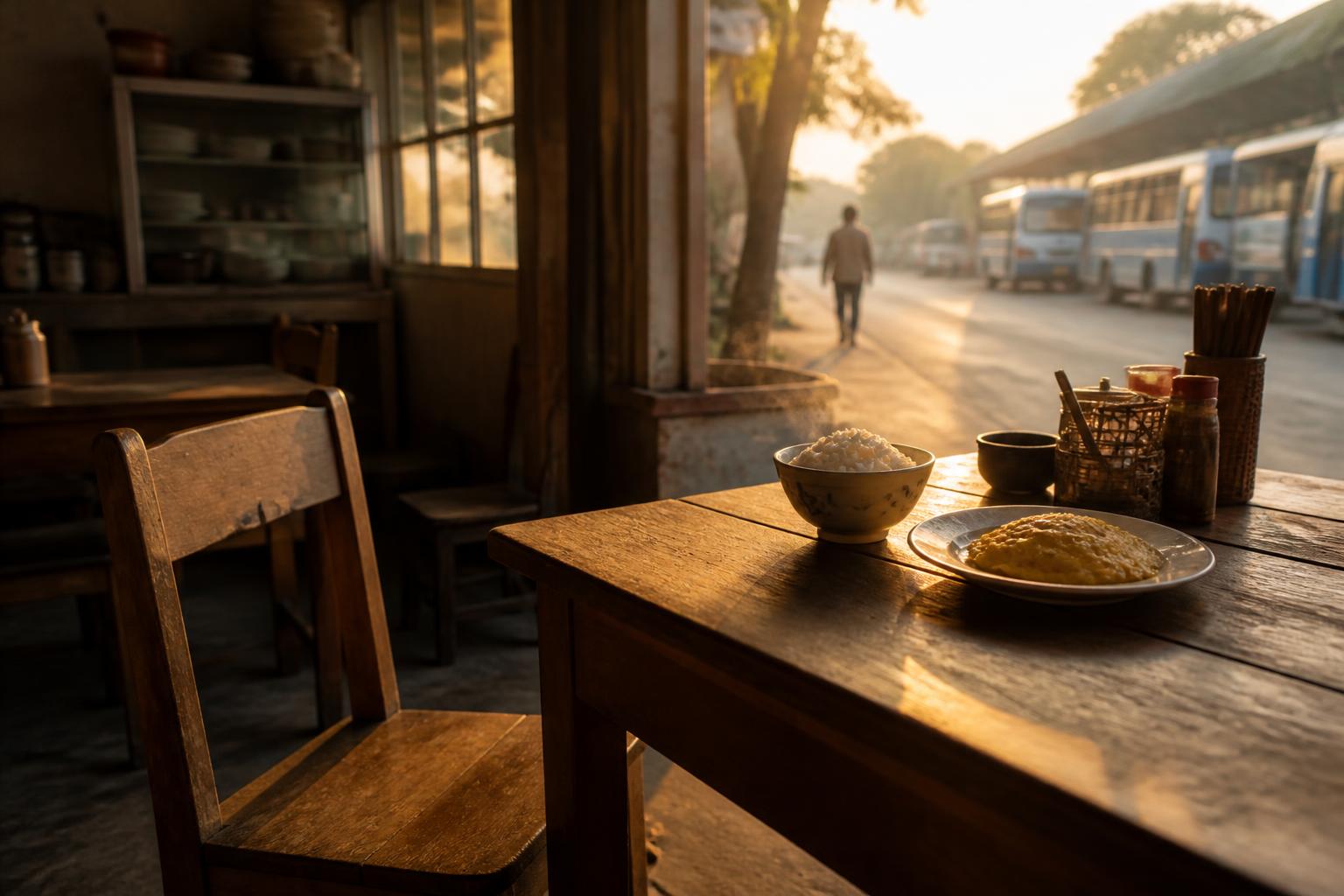
The Empty Chair in the Evening Rice Shop
At the end of the road leading to the old bus station stood a small rice shop called Bep Chieu. The shop had no large sign, only a faded wooden board and a few four-o’clock flowers in pots along the porch. People in the neighborhood often stopped by for a bowl of hot soup, a
Read more