

 Tiếng Việt
 日本語
日本語 한국어
한국어 中文 (中国)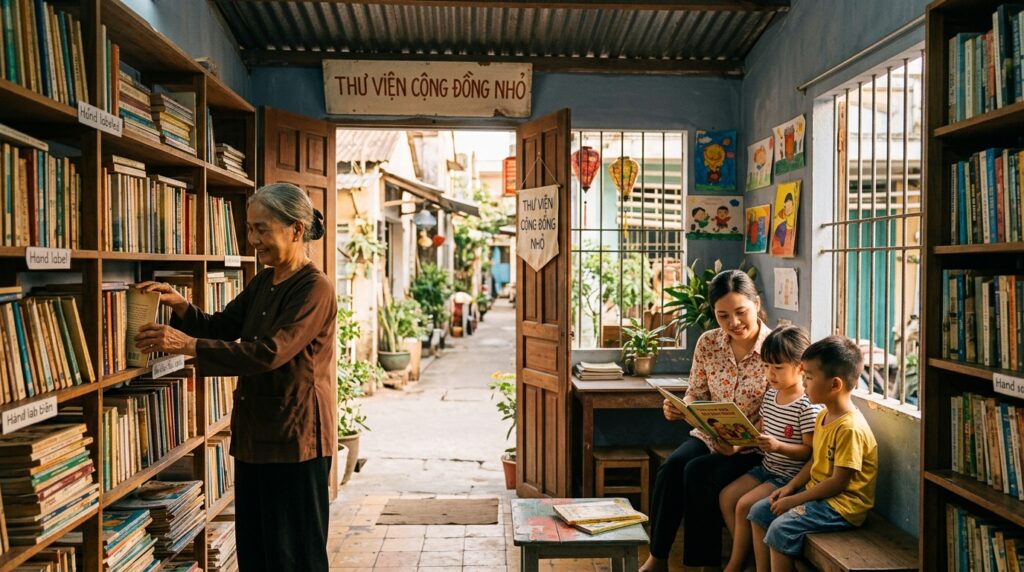
At the end of a winding alley stands a room with a corrugated metal roof and walls painted a faded yellow. There is no sign hanging over the door, nor any introductory words written beside it. People in the neighborhood call the place a library, though it has only a few wooden shelves, a long table, and books gathered from many families. Some have lost their covers, some have yellowed with age, and some still carry the scent of new paper. The only thing that makes the room special is not the number of books, but the fact that its door is always open to anyone who wants to step inside.
The person who keeps the library key is Mrs. Hanh, a woman in her sixties who once worked as a librarian at the local secondary school. After retiring, she did not want her days to pass by with nothing more than tending a few potted plants and watching television. She began bringing the old books from her house and arranging them in a vacant room belonging to the neighborhood association. At first, hardly anyone paid attention. Children passing by would only look inside before running off to play, while some adults even said that old books were good for nothing.
Mrs. Hanh did not argue. She wiped the shelves, repaired pages that had come loose from their bindings, placed a water jug by the window, and regularly opened the door every afternoon. She believed that some things could not be persuaded through words. For a place to become cherished, it first had to exist long enough for people to grow accustomed to its presence.
A Small Room Begins to Have Voices
The first person to visit the library regularly was Tung, a sixth-grade boy who lived with his mother in the house opposite. Tung was not an outstanding student. He read slowly, often made spelling mistakes, and usually avoided classes in which he had to speak in front of everyone. But he could sit for hours with books about machines, trains, and distant cities. Whenever he finished reading, he would use a pencil to draw bridges, railway tracks, and buildings on the back of old calendar pages.
Mrs. Hanh did not ask why Tung was doing poorly in school, nor did she tell him to read books considered more useful. She simply gave him a thick notebook and said that if he liked drawing, he should also write a few lines about what he had just read. Tung held the notebook for a long time before managing to write his first sentence. It was clumsy and lacked punctuation, but Mrs. Hanh still nodded approvingly as if he had just accomplished something important.
After Tung came Ms. Mai, a sales clerk who usually returned home late at night. She came to the library to borrow a cookbook, then happened to take along a guide to using smartphones. She had been using a phone for years but was still awkward when she wanted to save photos, make video calls to her daughter working in another province, or pay a bill online. She was reluctant to ask younger people because she was afraid they would criticize her for being slow to understand. So Mrs. Hanh asked Tung to show her step by step.
The first lesson was very awkward. Tung spoke too quickly, Ms. Mai kept pressing the wrong buttons, and Mrs. Hanh had to go look for a charger. Yet after more than an hour, Ms. Mai managed to call her daughter. The screen showed the face of a young woman in an unfamiliar rented room far away. Ms. Mai smiled, laughing as she wiped away her tears. Tung looked at Mrs. Hanh, seeming to understand for the first time that knowledge did not merely help people perform a task correctly; it could also shorten the distance between people who cared for one another.
No One Came Here Merely to Borrow a Book
The library gradually became a strange kind of place. People came for the books but often stayed for other stories. A motorcycle taxi driver would stop to read old newspapers while waiting for passengers. A third-grade girl sat coloring beside her grandmother. Two brothers who were usually always arguing debated whether the character in a story should tell the truth. An unemployed man found several books on repairing household appliances, then began repairing fans and rice cookers for his neighbors.
The room did not turn anyone into a perfect person. The children were still mischievous at times, adults still lost their tempers, and a few books were still returned late. Once, several pages of a valuable comic book were torn out. Mrs. Hanh was sad, but she did not close the library or make a list of suspects. She simply placed a small box beside the shelves containing slips of paper with reminders about how to take care of shared belongings.
The next afternoon, a boy named Khoi came to see her. He confessed that he had torn the book because he had hidden it in a bag that was too full. Khoi expected to be scolded, but Mrs. Hanh handed him a roll of paper tape and told him to help repair it. The two of them spent nearly an hour carefully aligning each edge of the paper. The tear was still there; it could not disappear completely. She told Khoi that repairing something did not always restore it to its original condition, but it showed that we were taking responsibility for what we had done.
From that day on, Khoi often arrived early to check the bookshelves. He did not immediately become an obedient child, but he began asking before taking things and returning whatever he borrowed. That small change did not come after a moral lecture. It came from an afternoon when he was given the chance to make amends instead of being labeled a troublemaker.
Knowledge Truly Lives Only When It Is Passed On
Many people think a library is a place to store books. To Mrs. Hanh, that was only the visible part. The more important part was the way books created encounters. A book about caring for plants led two families to share seeds. A story about courage helped a little girl tell her mother that she was afraid of changing schools. A career guidance book made several students realize that they did not necessarily have to choose the same path as their friends.
Mrs. Hanh never said that reading would immediately change a person’s life. She had seen many people read a great deal and remain stubborn, and she had also met people with few opportunities for education who lived with kindness and clear judgment. In her view, the value of reading did not lie in how much information we could remember, but in our ability to see an issue from more perspectives than before.
That was why the library organized a small discussion each month. There were no famous speakers, no stage, and no projector. Everyone simply sat in a circle, chose a story, and shared what they thought. Some months they talked about raising children. Some months they discussed the loneliness of the elderly. Some months the topic was simply how to keep promises to oneself.
During such gatherings, people who were quiet were not forced to speak. Those who talked a lot were also reminded to listen. This was more difficult than it seemed. In everyday life, everyone wanted their opinions to be recognized, but not everyone had enough patience to listen to another person express themselves slowly. The room at the end of the alley gradually taught everyone a simple yet rare skill: waiting for the person opposite them to finish speaking.
The Door Opens in Both Directions
One rainy season, the library’s corrugated roof began to leak. Water poured down directly onto the corner where the history books were kept. Mrs. Hanh intended to pay for the repairs herself, but before she could do so, the neighbors had already contributed their labor. One brought a tarp, another brought a ladder, someone called a repairman, and others dried the books. Tung drew a small sign reminding everyone not to place things against the walls, while Ms. Mai made a list of tasks to be done on rainy days.
When the roof was repaired, Mrs. Hanh realized that the library was no longer her own project. It had become part of the life of the entire alley. People did not merely come to receive something; they began bringing what they had: a few books, a skill, a free afternoon, a piece of advice, and sometimes simply their presence.
This raised a question worth considering: What is a community built from? Is it built from grand plans, beautiful slogans, or impressive structures? Those things may be necessary, but they are not enough. A community begins at the moment people stop seeing one another as strangers who merely happen to live near each other. It grows when one person is willing to teach what they know, and another is humble enough to say that they do not know.
The library at the end of the alley could not solve every difficulty. It could not instantly help someone find a good job, heal a long-standing sorrow, or make every family stop arguing. But it created a place where those problems could be named without being mocked. Sometimes, that was the first step toward change.
Mrs. Hanh still kept the old key in her shirt pocket. The key was scratched, and its head was slightly bent because it had once fallen into a drain and been found after a rainstorm. Every afternoon, she opened the door, turned on the ceiling fan, and pulled back the curtains to let the light pour in. Tung was older now; he no longer drew trains on calendars but had begun drawing bridge designs. Ms. Mai occasionally sent photos to her daughter from the phone she now knew how to use proficiently. Khoi still made mistakes sometimes, but he was often the first to suggest fixing them.
That room reminds us that a door is not used only to separate the inside from the outside. When opened at the right moment, it creates an invitation. An invitation to read a page of a book, learn a skill, tell a story, or simply sit beside one another without rushing. In an age when people can connect with so many places yet still feel lonely, small spaces that know how to welcome one another become more precious than ever.
Perhaps we do not have an empty room in which to establish a library. But each of us can begin with something similar: share a book, teach someone something we know, listen to a story that has not yet been fully told, or keep a shared place clean and welcoming. These actions are not loud, yet they quietly change the way people see one another.
And who knows, somewhere at the end of some alley, a door may be waiting to be opened. Not to welcome perfect people, but to welcome people who are still learning how to live together.

ARTICLES IN THE SAME CATEGORY
After an Argument, What Needs to Be Repaired First?
The Box That Holds the Rainy Season
The Watchmaker and the Forgotten Moments
Tam Cam Part 2: The Vengeful Spirits of the Palace
Tam and Cam: The Palace Intrigue and the Original Ending – Part 1
THE STORY OF SOWING SEEDS
ARTICLES IN THE SAME GENRE
Knowing What Is Right Is Still Not Enough: Why It Is Difficult for People to Change Their Habits
Familiarity Is Not the Truth: Recognizing Reasoning Traps in Everyday Life
Greenland and the Great Test of the World Order