

 Tiếng Việt
 日本語
 한국어
 中文 (中国)
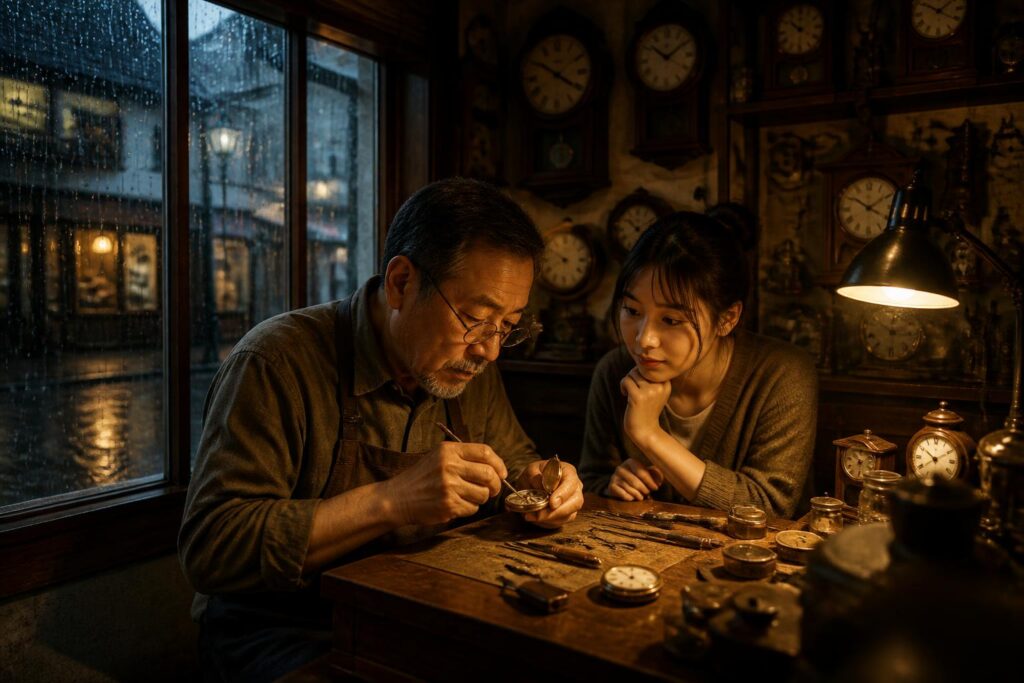
At the end of a narrow street stood a watch repair shop so cramped that even two people standing side by side felt crowded. The wooden sign above the door had faded with age; only a few words remained legible: “An Tam Watch Repair.” People in the neighborhood said that the shop’s owner, a man in his sixties named Lam, could bring back to life watches that seemed beyond saving. But what made his shop memorable was not his skillful hands, but a personal rule: on Saturday afternoons, he did not accept money from customers.
No one knew when the rule had begun. Some guessed he did it to attract customers; others thought it was an old-fashioned form of advertising. A few young people passing by even laughed when they heard about it, because in a city where everything had a price, it was hard to believe that someone could spend his effort without expecting anything in return.
Mr. Lam never explained. Every Saturday afternoon, he still pulled up the metal door, placed the desk lamp on the counter, and patiently waited for people carrying broken watches. If anyone wanted to pay him, he simply shook his head. If someone insisted on leaving money on the table, he gently pushed it back toward them and said, “If you feel you need to repay me, then next time, help someone else fix something in their life.”
The Watch That Lay Still in the Drawer
One Saturday afternoon at the beginning of the rainy season, a young woman named Mai came to the shop. She worked in an office not far away and often passed through the street, but she had never stepped inside. That day, while cleaning out her father’s old room, Mai found a pocket watch at the bottom of a drawer. Its glass was cracked, its chain was rusty, and its hands had stopped at 4:17.
Mai’s father had been gone for nearly two years. During that time, she had continued to avoid opening the cabinets that held his belongings. She thought it was simply because she was busy, but in truth, she was afraid that familiar objects would force her to face a void that had never been given a name.
The watch was the first thing she had picked up in a long time. Mai did not know whether it had any value. She only remembered that her father used to wear it on special days, especially when he took her to school in the morning or stood waiting outside the hospital when she had a fever. Back then, she always saw the watch sway gently with his footsteps.
Mai placed the watch on the counter. Mr. Lam did not ask whom it belonged to. He used a soft cloth to wipe the glass, opened the back, and looked for a long time at the mechanism covered in dust.
“Can it be repaired?” Mai asked.
“Let me take a look first. Some only have one faulty part; others break down because no one has remembered them for too long.”
The remark made Mai slightly uncomfortable. She thought he was blaming her. But the old watchmaker had already bent over the workbench, taken out a magnifying glass and a small set of tools. The tiny gears were removed and arranged neatly on a blue cloth. He worked slowly, without hurrying, as if caring for a frail creature.
The Payment That Could Not Be Placed on the Table
Mai sat on the wooden chair beside the door. Outside, the rain began to fall, each drop striking the awning in a steady rhythm. She looked at the watches hanging around the walls. Some ran fast, some ran slow, and some were completely silent. The shop resembled a room filled with many different streams of time, where every object preserved part of the story of the person who had once owned it.
Nearly an hour later, Mr. Lam replaced a small spring, oiled the mechanism, and put it back together. He wound the watch and placed it on the table. The second hand moved one step, stopped, and then continued moving. The ticking was faint and clear, like someone lightly knocking on a door that had been closed for a long time.
“How much do I owe you?” Mai asked.
“I don’t take money on Saturday afternoons.”
“But you spent the whole afternoon on it.”
“I repair watches every day. This afternoon is only different because I don’t collect payment.”
Mai took out her wallet and placed several bills on the counter. Mr. Lam pushed them back.
“If you want to thank me, then when you meet someone who needs help, don’t look the other way.”
Mai picked up the watch, feeling that it was heavier than when she had first brought it in. She did not know whether she was holding a repaired object or a part of her father’s life that had just been awakened. Before leaving, she asked:
“When did you start refusing money on Saturday afternoons?”
Mr. Lam looked out at the curtain of rain, one hand still resting on the small screwdriver.
“From the day I understood that some debts can never be settled, the more you try to repay them with money.”
The Old Watchmaker’s Story
Mr. Lam did not often tell his own story. Still, perhaps the rain had slowed the street that day, or perhaps the watch in Mai’s hand had reminded him of a distant time.
Many years earlier, when he was young, he had worked as a laborer in a machine shop. The work was steady, and the pay was not high, but it was enough to support his family. He had an older teacher who specialized in repairing time-measuring devices. The teacher taught him not only how to recognize a misaligned gear or a bent hand, but also to respect the objects that other people brought to him.
“People don’t bring time here,” his teacher once said. “They bring what they want to preserve.”
Later, the teacher retired. Before leaving, he gave Lam an old set of tools and told him that every week he should set aside one session to repair things for free for people who could not afford to pay. Lam had laughed, thinking it was a beautiful but difficult piece of advice to follow. At the time, he still had rent to pay, young children to raise, and all kinds of expenses to worry about.
Then one Saturday afternoon, his former teacher came to see him. He brought a broken wristwatch and said he wanted it repaired as a gift for his grandson before the boy left his hometown to study. Lam finished the repair but firmly refused to accept payment. His teacher protested for a long time, and in the end, he simply placed a bag of oranges on the table and left.
A few weeks later, Lam heard that his teacher had died. He had not made it in time to see him one last time. The teacher’s watch continued to run, but the words he had spoken years before remained inside Lam, becoming clearer with each passing day.
From then on, he began setting aside Saturday afternoons for free repairs. At first, only a few poor people brought in old watches. Later, there were students carrying their mothers’ alarm clocks, laborers bringing broken wedding watches, and elderly people who wanted to preserve gifts from loved ones. He never asked how much they could pay. He only asked what the watch had once meant to them.
What Was Repaired Was More Than the Mechanism
Mai returned to the shop on another Saturday afternoon. She brought a blue alarm clock, its outer casing scratched in many places. This time, a boy of about ten stood at the counter. He said the clock belonged to his mother. It had been broken for a long time, but she could not bear to throw it away.
Mai recognized the boy. He lived with his grandmother in the house at the end of the alley and often helped her sell sticky rice in the mornings. The day before, Mai had seen him struggling to gather paper bags that had been blown across the street by the wind. She had helped him collect them and learned that his mother worked far away and returned home only on rare occasions.
The boy had no money to repair the clock. Mai remembered Mr. Lam’s words and brought him here. She did not think what she was doing was anything significant. She simply realized that she could help someone walk through a door they had not dared to enter before.
Mr. Lam examined the clock and discovered that a plastic piece inside had broken. He did not have the exact replacement part, so he took one from another clock. As he worked, the boy sat quietly, his eyes following every movement.
“Why do you want to repair this one?” he asked.
“Because Mom said it was the first gift she was able to buy with her own salary.”
Mr. Lam nodded. He did not say that it was only an old clock. He understood that people who see the value in an object do not usually look at its outer shell.
When the clock began working again, the boy smiled. Mai saw something in that smile that resembled the ticking of her father’s watch: small and steady, but strong enough to fill a stretch of silence.
The Value of Passing It On
After that, Mai began changing a few of her habits. She no longer hurried to throw away old things before finding out what they meant to someone else. She made time to call her aunt, who had asked after her many times but whom she had always answered absentmindedly. She also repaired the wooden shelf of an elderly neighbor, even though the job took only one afternoon.
None of these things made Mai wealthier. Nor did they make her grief over her father disappear. But the grief gradually changed into something gentler. Whenever she heard the ticking of the pocket watch, she no longer remembered only the day her father left. She also remembered the mornings when he patiently waited for her to tie her shoelaces, the times he stood outside the school gate under the bright sun, and the way he always set his watch a few minutes fast so he would never be late.
Mai understood that some people leave our lives but continue to be present in the way we treat others. A kind act does not end with the person who receives it. It can move onward, through another hand, another reminder, another afternoon that seems ordinary.
At the end of the year, Mr. Lam hung another small sign in the shop. It had no prices, no opening hours, and no advertisement. It contained only one sentence: “If someone helps you today, help someone else tomorrow.”
Mai did not ask who had written the sentence. She knew Mr. Lam did not want to turn kindness into something to boast about. To him, repairing a watch meant simply returning the gears to their proper positions so that time could continue moving. But repairing a relationship, a sense of trust, or a sorrow required more patience. The principle, however, was no different: one had to use a gentle touch, pay attention, and not rush to conclude that something silent could never work again.
That Saturday afternoon, the shop was still open. Outside, the rain fell thinly, like a layer of silver dust. Mr. Lam bent over the watch on the table, while Mai sat beside him, wiping the pieces of glass that had been removed. Neither of them said much. Between them was only the sound of ticking following one beat after another, steadily passing through the small room.
And within that sound, a simple truth was repeated: we cannot turn back time, but we can always decide what we will do with the time we have left.

ARTICLES IN THE SAME CATEGORY
The Ferryman and the Seed That Never Bloomed
The Keeper of the Bell at the Old Ferry Landing
The Tea House That Opens After the City Falls Asleep
The Mailman at the End of the Hill and the Letters Without Addresses
The Watchmaker and the Room That Kept the Rainy Season
The Bridge Watchman Who Never Crossed the River
ARTICLES IN THE SAME GENRE
The Lamp Beneath the Station Eaves
The Things No One Applauds Still Make a Decent Life
When the Meal Slows Down, Family Grows Closer
Gratitude in Everyday Life: From an Emotion to a Sustainable Way of Living
Grateful for mother’s hands