

 Tiếng Việt
 日本語
 한국어
 中文 (中国)
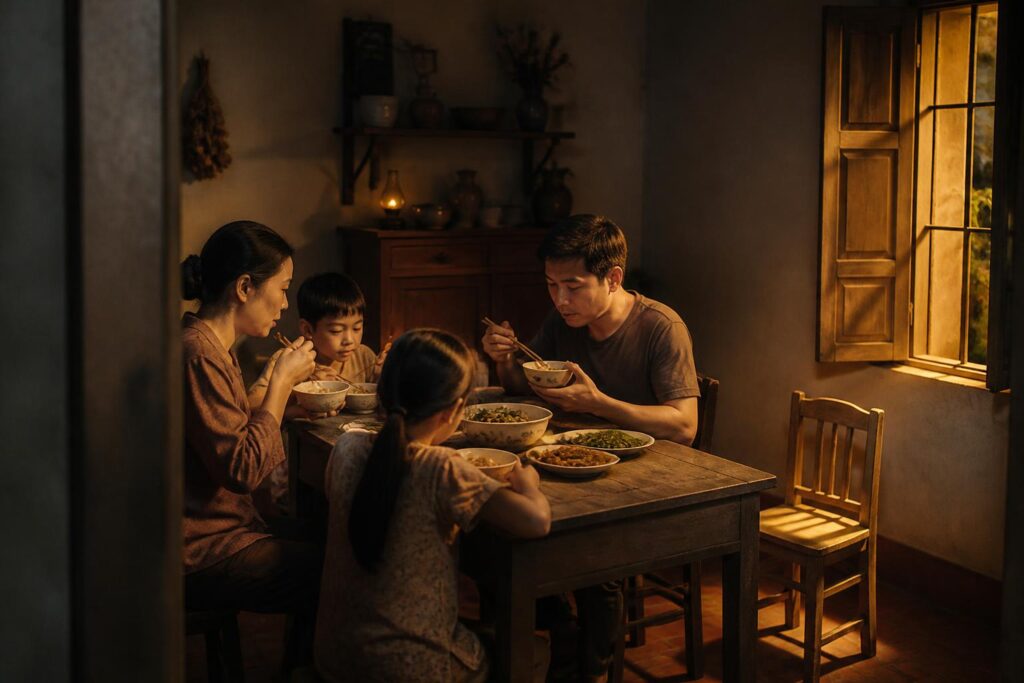
In many families, there is a chair that seems always to remain in the same place, even though the person who once sat there has gone away. The chair may be beside the window, at the head of the table, or in the place an older person often chose because it offered an easy view of the yard. It looks unremarkable, yet whenever a meal begins, someone’s eyes still unconsciously pause there. Absence makes no sound, and yet it is enough to make a room feel larger and a meal feel quieter.
The story of an empty chair does not necessarily have to be connected to a great loss. Sometimes it is the place of a child who has moved to the city, a father who often works far from home, a mother who has moved in with another child, or a family member who has grown accustomed to not returning on time. The empty chair reminds us that a family is shaped not only by the people who are present, but also by the bonds that quietly endure between those who are far apart.
The Empty Chair and the Things We Failed to Notice in Time
When he was young, Minh often thought his mother would always be in the kitchen. She knew exactly how much scallion to add to the soup, knew that the fish had to simmer until the sauce thickened, knew who in the family liked the crispy skin and who always pushed the herbs to the side. These things happened so regularly that Minh did not regard them as care. He saw the family meal as something natural, like the morning light or the sound of motorbikes outside the alley.
Then Minh left his hometown to study and work. During his first days in the city, he often called home in the evenings, but as he became busier, the calls grew less frequent. His mother still asked the familiar questions: What did you eat today? Was work tiring? Could you come home on the weekend? Minh answered quickly, sometimes speaking while looking at his computer screen. He did not mean to be cold. It was simply that on days when there were too many things to deal with, the love of family was often pushed to the bottom of the list because we believe it will not disappear.
One rainy season, his mother fell ill. It was not an entirely unexpected illness, since she had complained many times before about back pain and difficulty sleeping. But Minh was still startled when his older sister called to tell him. He booked a ticket home, repeatedly telling himself on the way that this time he would stay longer, take his mother to the doctor, fix the kitchen door that had been sticking, and sit and listen to her tell all the stories she had repeated over the years.
Yet by the time Minh arrived, his mother no longer had the strength to sit at the dining table for long. There were only four people at the meal that day, but everyone still set out five sets of bowls and chopsticks out of habit. His sister looked at the chair beside the window, then quietly put away the untouched portion of rice. Minh said nothing. He suddenly understood that the things he had thought he could do another day would not wait as long as he had imagined.
Families Are Often Held Together by Very Small Things
We easily imagine family affection through major occasions such as reunions, expensive gifts, or carefully planned trips. But in real life, families are often held together by things so small that they are rarely given a name. It is the extra bowl of rice served when someone comes home late, the raincoat placed ready by the door, the phone call asking whether someone has arrived home, or the portion of food set aside because they know the other person cannot eat spicy dishes.
These things make no great sound. No one applauds when someone remembers to buy the right medicine for their father, no one gives an award to the older sister who quietly pays the electricity bill, and no one records the number of times a mother wakes in the middle of the night to wait for her child to come home. Precisely because it is not displayed, care is easily mistaken for an obligation. When people receive it for too long, they may mistake another person’s devotion for something self-evident.
The empty chair helps us look back at that confusion. It raises a simple question that is not easy to answer: before someone leaves their familiar place, have we truly seen all that they do for the family? Have we ever thanked them for a meal, a reminder, or a time they waited by the door, or have we simply accepted everything and regarded it as the natural duty of a loved one?
Gratitude within a family does not need to begin with formal words. A timely thank-you can sometimes be worth more than a late gift. An unhurried phone call can make someone far away feel that they still belong to their old home. A meal eaten in its entirety, with no one looking at a screen while eating, is also a way of saying that each other’s presence matters.
Do Not Wait for the Empty Chair to Speak
Many people realize the value of someone only when the house suddenly lacks a familiar sound. There is no longer the shuffle of slippers across the tiled floor, the sound of the gate opening in the afternoon, a voice calling from the kitchen, or the reminders that once irritated us. At such times, memories often return through very small details. We remember a dish, a way of calling someone’s name, a habit that seemed trivial. What haunts us is not always a major event, but may be the words left unsaid and the appointments we allowed to pass.
No one can guarantee that they will always have enough time. That does not mean we must live anxiously or constantly fear separation. On the contrary, an awareness of life’s limits can help us treat the people beside us more kindly. When we know that an ordinary meal can become a precious memory, we are less likely to lose our temper over small things. When we understand that even a brief phone call can ease a loved one’s loneliness, we will be less likely to use busyness as an excuse for every silence.
Minh stayed in his hometown for another ten days. He took his mother to the doctor, changed the light bulb in the kitchen, and repaired the hinge that had been squeaking for months. In the evenings, he sat beside his mother by the window and listened to her talk about the neighbor who had recently planted a bougainvillea trellis, the cat that often ran into the yard, and the time his sister had accidentally made the soup too salty. The stories had no climax, but Minh no longer kept looking at the clock as he had before.
Before returning to the city, Minh suggested that the family take a picture beside the dining table. His mother smiled and said that a family photo had to include everyone. Minh looked at the empty chair, then pulled it closer. No one sat in it, but it still appeared in the picture as part of the house and part of the story. After that day, Minh called home every Sunday evening. Sometimes the call lasted only a few minutes. Sometimes the two of them had nothing to say except to ask whether the other had eaten. But that regularity meant the distance was no longer completely silent.
Keeping a Place for One Another in Life
In a family, keeping a place for one another does not mean merely leaving a chair empty at the dining table. It also means preserving time, patience, and the ability to listen even when we have heard the same story many times. Loved ones may change, the house may be renovated, and jobs and places of residence may shift, but the feeling of being waited for remains one of the things that makes people want to return.
Keeping a place for one another does not mean overlooking every hurt, either. Some families need to learn how to talk about disagreements, set boundaries, and heal things that have continued for many years. Gratitude does not force us to endure mistreatment, nor does it turn every conflict into something insignificant. Even so, when distance is necessary, we can still choose kindness and avoid letting angry words become the last thing left between two people.
A family meal is truly warm only when the people around the table feel that they are seen. Everyone does not have to be cheerful all the time, and the conversation does not have to be profound. Each person only needs the opportunity to speak, to be heard, and to remember that they are not merely a name appearing on someone else’s schedule. Lasting care often begins with noticing that someone has been quiet longer than usual, is eating less, or is no longer taking the initiative to share stories as they once did.
The empty chair in Minh’s story speaks not only of absence. It also speaks of the possibility of returning while there is still time, and of knowing how to cherish ordinary things before they become memories. Every family may have a chair like that, whether it is visible or exists only in memory. But while our loved ones are still present, that chair is not yet a final word. It can become a gentle reminder to put down our phones, sit a little longer at the meal, and say a sentence that should have been spoken long ago: thank you for always being here.

ARTICLES IN THE SAME CATEGORY
The Dry Well and the Keeper of the Rainy Season
The Clock That Stopped at the Small Station
The Unsent Letter and the Art of Closing an Old Season
The Keeper of Seeds by the Front Porch
The Seed Keeper by the Dry River
The Tin Box That Held on to the Scent of Rain
ARTICLES IN THE SAME GENRE
The Girl and the Wind Chime
The Wind Chime That Kept Promises
The Lamp Beneath the Station Eaves
Little Hedgehog and the Moonlight Garden
The Seedling Who Knew How to Listen and the Forest That Awoke
Brown Squirrel’s Raincoat