

 Tiếng Việt
 日本語
 한국어
 中文 (中国)
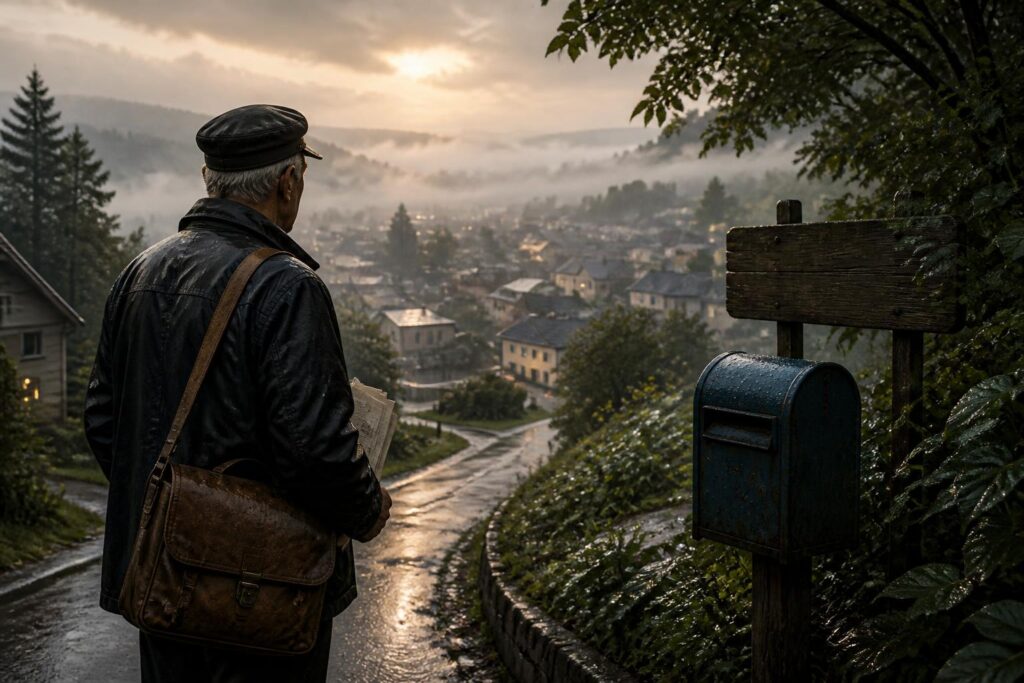
At the edge of the town, a winding slope led up to a low hill. The slope had no sign, did not appear on tourist maps, and no one remembered when it had begun. The townspeople simply called it Sau Cho Slope, because to get there one had to pass through the old market, turn by the moss-covered stone wall, and follow the row of Indian almond trees.
At the top of the slope stood a small house with a gray-tiled roof. In front of it was a blue mailbox with almost all of its paint peeled away. Every morning, Mr. Lam opened the door, swept the leaves, brewed a pot of strong tea, and took the letters from the mailbox, arranging them into separate piles. In the afternoon, he slung his brown canvas bag over his shoulder and set out on his journey.
He was the last postman on the nameless slope.
Letters Without Addresses
Strangely, the letters Mr. Lam delivered had no clear addresses. One envelope read only: “To Mother, the kitchen with a window looking out at the star fruit tree.” Another said: “To the friend who sat beside me on that bus ride years ago.” A different envelope bore, in careful handwriting, the words: “To the me who had not yet learned fear.”
If an outsider saw them, they would surely think Mr. Lam had chosen the wrong profession. Letters needed street names, house numbers, wards or communes, or at least a name specific enough to search for. But he never complained. He read the address, remained silent for a moment, and then placed the letter in his canvas bag. When someone asked whether he knew where those letters would end up, he only smiled:
“Of course I do. It’s just that the destination isn’t on any map.”
Mr. Lam was not an approachable man, but neither was he cold. He spoke little, remembered everything, and had a habit of listening all the way to the final sentence, even when the person speaking had forgotten what story they were telling. In town, everyone had seen him pass by with his slightly stooped figure, faded cloth hat, and shoes always caked with road dust.
No one knew when he had begun the work. Some said he had once been a postal employee and then retired. Others said he had once waited too long for a letter and later decided to carry letters for other people. Mr. Lam had never confirmed either story.
A Boy Named Tin
One afternoon at the end of the dry season, Tin came to the house at the top of the slope. The thirteen-year-old boy was stick-thin, with unevenly cut hair, and always wore a backpack with frayed straps. Tin lived with his grandmother at the far end of town. His mother worked in the city and came home only once every few months. His father had left before Tin even knew how to read.
Tin stood outside the gate for quite a while before knocking. Mr. Lam was wiping down the mailbox. Hearing the sound, he looked up but did not ask anything right away. Only when Tin stepped into the yard did he put the cloth down on the table.
“I want to send a letter,” Tin said.
“Do you have an address?”
Tin shook his head.
“Then who are you writing to?”
“My mother.”
“Where is your mother?”
“I don’t know exactly. I only know she works in a place with lots of glass windows, where she sees cars passing on the road every day.”
Mr. Lam looked at the boy. The description was not enough for an ordinary letter to find its recipient, but he did not say so. He pulled out a wooden chair for Tin to sit in, then handed him a sheet of white paper.
“Write down what you want to say first.”
Tin held the pen for a long time. He wrote, tore the page up, wrote again, and crumpled it. At last, he put the pen down:
“Mom, I don’t need you to send money home anymore. I just want you to know that the guava tree in front of the house has borne fruit. Grandma is still coughing a lot. I’ve learned to cook rice by myself, but sometimes it gets burned. I’m not angry with you. I’m just afraid that one day you’ll come home and I won’t remember your voice anymore.”
When he finished writing, Tin folded the letter into quarters. He had no envelope, so Mr. Lam gave him an old ivory-colored one. Tin carefully wrote on the front: “To Mother, the place with lots of glass windows.”
Mr. Lam accepted the letter and put it in his bag.
“When will my mother receive it?” Tin asked.
“When you’re ready for her to read it.”
Tin did not understand, but he did not ask anything else.
A Journey Through Places Not Found on Maps
The next morning, Mr. Lam left home earlier than usual. He went down the slope, passed through the old market, and then headed to the bus station. There, he met Mrs. Nam, who sold bougainvillea. She was over seventy and sent a letter every week to her husband, who had been dead for many years. She did not expect a reply. She only wanted to tell him that flower prices had risen, the lemon tree in front of the house had died, and there had been little rain that year.
Mr. Lam usually sat beside her for a few minutes. Then he carried the letter to the river south of town and placed it beneath an old Bengal almond tree. Mrs. Nam believed that the wind from the river would carry her words far away. Mr. Lam did not know whether that was true, but he had never lost a letter.
After leaving the riverbank, he went to the abandoned factory district, where a man named Khai often sent letters to his daughter, who lived overseas. Khai’s letters did not mention how much he missed her. He only told her about repairing his old motorbike, the neighbor who had grown a lush gourd trellis, and how he had learned to use a phone but still often pressed the wrong buttons. He did not send letters online because he was afraid important things would disappear too quickly.
In the afternoon, Mr. Lam climbed the hill to the west. There stood an empty wooden hut. He placed some letters in the crack beneath the door and tied the rest beneath a dry branch. They were letters from people who wanted to apologize but did not yet have the courage to say it to the living. They sent their letters to places with no recipients so they could be honest without having to wait for forgiveness.
Over the years, Mr. Lam had received letters from all kinds of people. One person wrote to an old friend because, long ago, they had allowed pride to sever a close bond. Another wrote to a child who had never had the chance to be born. Someone else wrote to himself on the first day he stepped out of an exhausting marriage. Those letters could not turn back time, but they helped their writers see clearly what they had kept inside for far too long.
The Returned Letter
Three days after sending the letter, Tin returned to the house at the top of the slope. He saw Mr. Lam sitting by the door, with the ivory-colored envelope in front of him. There was a new line of writing on it, not in Tin’s handwriting.
“The letter was returned,” he said.
Tin lowered his head. He had expected it, but his chest still felt unbearably heavy.
“My mother didn’t receive it?”
“Not necessarily.”
“But you said the letter was returned.”
“The letter coming back here doesn’t mean that what you said failed to arrive.”
Tin snatched up the envelope. Inside was no letter from his mother, only a small slip of paper. It read: “Your mother has changed workplaces. No one knows where the new one is.”
Tin sat in silence. He did not cry, but his hands clenched so tightly that they turned white. Mr. Lam did not try to comfort him. He poured the boy a cup of weak tea, even though he knew children usually disliked bitter flavors.
“If you can’t send it to your mother, write another letter to your grandmother,” he said.
“She’s right at home.”
“Some people are very close to us, and yet we still haven’t said everything we need to say.”
Tin took the sheet of paper home. That night, for the first time in many months, he sat beside his grandmother’s bed for more than ten minutes. She was coughing, and Tin quietly rubbed her back. He told her about the returned letter. When she finished listening, she did not blame his mother or tell him that he needed to try harder. She only said that, long ago, his mother had also written many letters to someone who never replied.
“To whom?” Tin asked.
His grandmother looked out into the yard.
“Your father.”
That night, she went on to explain that Tin’s father had not left because he hated his son. He had left town after an accident, carrying his shame and a fear that kept him from coming back. No one knew where he was. Tin’s mother had written to him for years, even though she did not know his address. Then one day, she stopped writing.
Tin did not know what he should be sad about. Perhaps it was that his father had left, that his mother had to work far away, or that the adults around him always kept important stories behind closed doors.
The Postman Has a Letter Too
A few weeks later, the town was hit by a heavy rainstorm. Water rushed down from the hill, carrying red soil and branches with it. A section of Sau Cho Slope collapsed, and the tiled roof of Mr. Lam’s house also began leaking above the kitchen.
Tin ran up to help him move the wooden boxes to a dry place. While dragging an old cardboard box, he dropped a pale blue envelope. It was different from the other letters. It had a clear address, but the recipient’s name had been blurred by ink.
Mr. Lam hurried over and picked up the envelope.
“Whose letter is that?” Tin asked.
Mr. Lam did not answer right away. He sat down on the low chair and stared at the envelope for a long time. Finally, he said:
“Mine.”
“Who did you send it to?”
“Someone who has died.”
“Then why do you still have it?”
“Because I haven’t been brave enough to send it.”
It was a letter Mr. Lam had written to his younger brother. Many years earlier, the two of them had quarreled over a small financial matter. His brother had gone to the city, then fallen seriously ill and died before they had a chance to reconcile. Mr. Lam wrote the letter on the very day he received the news, but put it away in a drawer. He had moved houses, changed professions, and traveled along countless roads, yet the letter had remained there.
Tin looked at him. For the first time, he realized that the postman did not always know how to deliver the most important things in his own life to where they needed to go.
“Do you want me to take it for you?” Tin asked.
Mr. Lam gave a thin, sad smile.
“No. Some letters have to be put down by the person who wrote them.”
That afternoon, when the rain stopped, Mr. Lam put on his coat, took the blue envelope, and walked down the slope alone. Tin followed behind but kept his distance. They reached the stone bridge spanning the small river. Mr. Lam stood in the middle of the bridge, watching the muddy water flow toward the fields. Then he placed the envelope in a tin box, tied a small stone to it, and dropped it into the river.
The box sank very quickly. Mr. Lam said nothing. Tin did not ask whether the letter would reach its destination.
The Slope with a Name
The rainy season that year lasted a long time. After the landslide, the townspeople worked together to repair the slope. They erected a wooden sign at the beginning of the road. It read: “The Letters Slope.” No one knew who had suggested the name. The sign was not attractive, and the lettering was uneven, but from then on the slope was no longer nameless.
Mr. Lam continued his old work. People kept bringing him envelopes without addresses. However, after the road was repaired, he began placing a small notebook beside the mailbox. Anyone who wanted to send a letter could record their name and the date it was sent. It was not for tracking, nor to prove anything. He simply wanted the writer to know that their words had once been received by a real person.
Tin sometimes went up the hill. He still had not found his mother, but he had learned to cook rice without burning too much of it. He also began writing letters to his grandmother, even though they lived in the same house. Each letter was only a few lines, usually about the guava tree bearing more fruit or about getting a good grade in literature class. His grandmother kept them all in an old cookie tin.
One morning, Tin asked Mr. Lam whether he could become a postman.
“First, you have to learn how to read the roads,” he replied.
“But what about places that aren’t on maps?”
Mr. Lam looked down at the town waking beneath the hill.
“Then you have to know how to listen. Some addresses are written in memories; some addresses are kept in longing. To find your way there, you can’t just look at the road.”
Later, many people in the town forgot who had put up the sign on the slope. They only remembered that a man there had once carried letters through unnamed places, helping others say what they feared or had postponed for far too long.
As for Mr. Lam, every afternoon he still returned to the small house with the gray-tiled roof, brewed a pot of tea, and opened the notebook beside the mailbox. When he came across a vague address, he was no longer surprised. He simply smiled, put the letter in his bag, and set out.
Because he understood that in this world, some messages do not need to find the right house. They only need to be passed on, so that the person who wrote them no longer has to carry them alone through years of silence.

ARTICLES IN THE SAME CATEGORY
The Lamp That Never Goes Out at the End of the Slope
The Ferry Landing Behind the Bamboo Grove and the Keeper of Promises
The Wooden Box That Held the Rainy Season
The Watch Repairman and the Day Without Chimes
The Clock That Stopped at the Last Station
The Dry Well and the Keeper of the Rainy Season
ARTICLES IN THE SAME GENRE