

 Tiếng Việt
 日本語
 한국어
 中文 (中国)
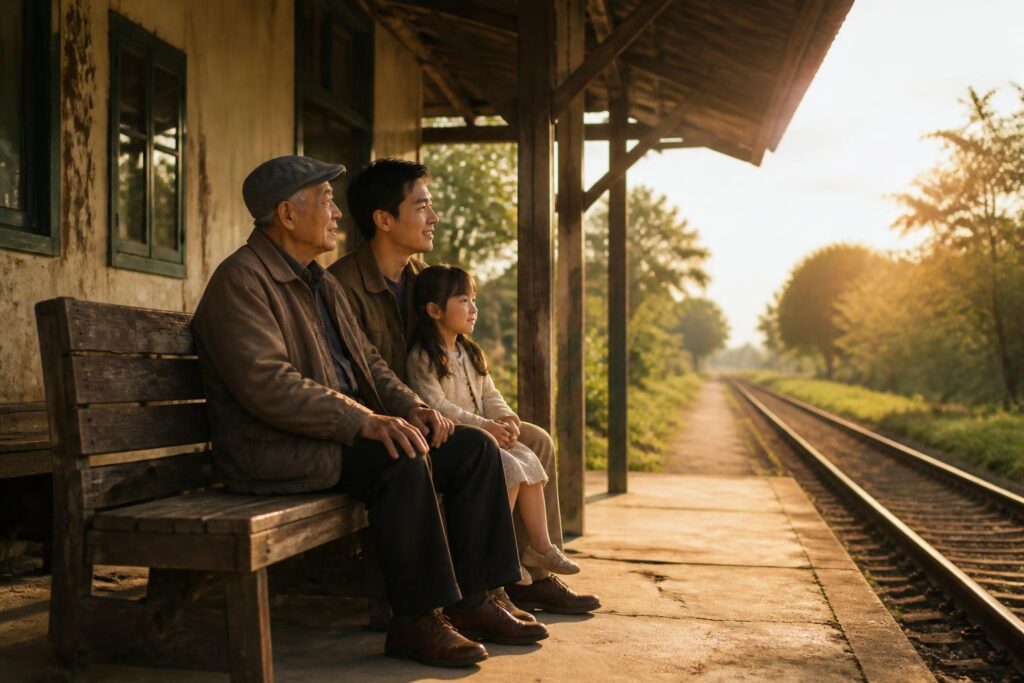
The district railway station stood at the end of a dusty road, where trains stopped for only a few minutes before continuing toward the sea or heading back up into the hills. The building was low, its tiled roof faded with age. In the dry season, the sunlight cast a harsh glare across the courtyard, while in the rainy season, water streamed down the steps. Beneath the eastern eaves stood a long wooden bench, its blue paint almost entirely peeled away. No one remembered when it had been placed there. The people at the station only knew that for many years, the bench had remained in the same spot, facing Track Two.
Every morning, Mr. Lam arrived at the station before the first train. He bought no tickets, met no one, and saw no one off. He simply sat at the left end of the bench, placed his cloth hat on his knees, and quietly watched the train cars pass. Whenever someone asked, he usually smiled and said, “I’m waiting for someone.” Then he fell silent, as though that answer were enough to explain everything.
The Man Waiting Beneath the Eaves
Mr. Lam had once worked as a watch repairman in the old market. His shop was so small that it could barely fit a wooden table, a glass cabinet, and a low chair for customers to sit on while they waited. People from the district came to him not only because of his skillful hands, but also because he had a habit of patiently listening to their stories. A stopped watch was sometimes not broken because of a damaged gear. Sometimes its owner simply wanted to preserve the memory connected to it a little longer.
His wife died young, leaving him a son named Minh. Minh grew up in the house behind the shop, surrounded by the steady ticking of watches. But the older he became, the more he wanted to leave that place. Minh disliked the afternoons when his father sat by the door, bending over tiny mechanisms. He thought his father had spent his entire life repairing time for other people, while not knowing what to do with his own.
At the age of twenty-two, Minh found a job in a city quite far from the district. On the night before he left, father and son sat down to dinner, but neither mentioned the train the next morning. Mr. Lam placed a piece of fish in his son’s bowl and asked an ordinary question about the new job. Minh answered briefly, then got up to wash the dishes. Late that night, he packed his things. Before leaving the house, Minh saw an old pocket watch on the table, its glass scratched. He knew it was a gift his father had intended to give him, but out of pride, he did not take it with him.
The next morning, Minh walked to the station while the sky was still hazy with mist. Mr. Lam followed some distance behind without calling his son back. At the platform, the two stood separated by a siding. Minh turned toward him, seeming as though he wanted to say something, but the train whistle sounded long and loud. He boarded the last carriage. Mr. Lam caught only a glimpse of his son’s hand resting against the window frame. When the train pulled away, he stood beneath the eaves for a long time, then sat down on the wooden bench.
Those Who Came and Went
From that day on, Mr. Lam became a familiar part of the station. The ticket clerk knew that he liked weak tea. The crossing guard occasionally brought him a newspaper. Regular passengers gradually came to recognize the man in the cloth hat who always sat at the end of the bench.
Many people sat on that bench, but no one occupied the place beside him for long. An old woman once sat there all afternoon because she had missed her connecting bus. A boy clutching a birdcage, crying as he explained that he was on his way to his aunt’s house. A young woman set a red suitcase down on the bench and ran off to look for her lost child. Each person carried a story, and when the train arrived, they left, leaving Mr. Lam with the empty space beside him.
Once, a young woman asked him, “Uncle, who have you been waiting for all this time?”
He looked at the tracks and replied, “My son.”
“Where did he go?”
“To find his own life.”
“Then do you think he’ll come back?”
Mr. Lam did not answer immediately. He took a small screwdriver from his shirt pocket and turned it over and over between his fingers. “I don’t know. But if he comes back, I want him to see that there is still a place for him to sit.”
The young woman lowered her gaze to the bench. A long crack had formed between the two wooden slats. She asked why he did not repair it. Mr. Lam smiled and said that the bench was like a person: some cracks did not need to be hidden to prove that one had never been hurt.
The Unsent Letter
In the early years, Minh still called home on holidays. Father and son exchanged brief words of concern. Mr. Lam asked whether work was keeping him busy, and Minh asked how the shop was doing. Both avoided mentioning that morning at the station, as though the old event would disappear on its own if they simply did not name it.
After that, the calls became less frequent. Minh moved to another city, started a family, and had a daughter. News reached Mr. Lam through acquaintances, a few photographs sent late, and snippets of conversation from people in the district. He knew that his son had a stable life, but he did not know what place, if any, he still held in it.
One evening, during a heavy rainstorm, the roof of the watch shop began to leak. Mr. Lam climbed a wooden ladder to place a basin beneath the broken tiles, then slipped and fell. The pain in his hip left him unable to stand. Fortunately, the owner of the neighboring rice shop heard the noise and called someone to take him to the local clinic.
A few days later, after returning home, he took a stack of blank paper from a drawer. He wrote Minh a letter. In it, he did not blame his son, nor did he say how long he had sat at the station. He only wrote that the shop had grown old, and that fewer people brought their watches in for repair than before. He wrote about the bench beneath the eaves and the strangers who had once sat beside him. At the end of the letter, he said: “If one day you want to come home, don’t worry about what you have to say. Just sit down.”
When he finished, he folded the letter but did not send it. He placed it in the box where he kept springs, the place where he stored things he did not yet know when he might need.
An Unexpected Return
One morning near the end of the rainy season, the station was more crowded than usual because the train from the city had been delayed. Mr. Lam was still sitting at the end of the bench, beside a young man holding a bouquet of paper flowers. The man said that he had just quit his job and did not know whether he should go home or keep moving forward. Mr. Lam listened, nodding from time to time. When the announcement said that the train was about to enter the station, the young man stood, thanked him, and ran toward the platform.
Just then, a girl of about eight appeared beneath the eaves. She wore a yellow raincoat and pulled a small suitcase decorated with clouds. Behind her was a woman, and behind the woman was a man with several strands of gray hair at his temples.
Mr. Lam recognized Minh before Minh had a chance to call out.
Father and son looked at each other. More than ten years had passed, changing Minh’s face. But the look in his eyes as he stood before his father was exactly the same as it had been that morning long ago: wanting to step closer while fearing that he would no longer be welcomed.
The girl tugged at her mother’s hand and whispered, “Who is he, Mom?”
Minh did not answer immediately. He looked at the wooden bench, then at his father, who was slowly getting to his feet.
“He’s your grandfather,” Minh said.
Mr. Lam smiled. He did not ask why his son had come home, nor why he had not called for so long. He simply held out his hand toward the girl. She looked at her father, saw him nod, and then walked over to take the old man’s calloused hand.
The train had left the station long ago, but no one was in a hurry to go. They sat on the old bench. Mr. Lam sat at the left end, the girl in the middle, and Minh at the right end. Minh’s wife stood nearby buying water from the counter. The four of them did not say much. They told one another small things: the girl liked to draw, Minh had changed careers, and the watch shop was still there, though its sign had faded.
After a while, Minh took the old pocket watch from his shirt pocket. The glass had been replaced, but the chain was still intact. He placed it in his father’s hand.
“I’ve carried it with me since the day I left,” Minh said. “But I’ve never been brave enough to open it.”
Mr. Lam held the watch and used his fingernail to release the latch. Inside, the hands had stopped at an indistinct hour. He gently turned the winding knob and heard the gears begin to move.
“It only needs winding,” he said.
Minh looked at his father. “Some things are like that too, aren’t they?”
Mr. Lam did not answer. He placed the watch in his son’s palm. Beyond the tracks, another train was approaching the station. The metal vibrated, followed by the sound of wind sweeping beneath the eaves.
A Seat Kept for Those Who Return
After that day, Minh did not move back to the district right away. He still had work, a family, and many things to arrange. But every month, he brought his wife and daughter to visit his father. Sometimes they stayed for two days; sometimes they only had time to share a meal before leaving. Their conversations were hesitant at first, but gradually became more natural.
Mr. Lam renovated the room behind the shop so that it could serve as a place for his granddaughter to sleep. He taught her how to distinguish the ticking sounds of different watches. She did not understand everything, but she liked sitting for hours at the repair table, handing him one small screwdriver after another.
The bench beneath the eaves was still there. The wood had been sanded smooth, and the crack had been reinforced from underneath but not erased. Mr. Lam still sat at the left end; the difference was that he no longer sat there waiting for one particular person. He sat to watch those who came and went, to greet familiar faces, and to hold on to the belief that every distance could be narrowed if someone was willing to stop and take a step closer.
Minh once asked why his father had never sent the letter.
Mr. Lam said, “Because at the time, I wrote too many things to you. When we met again, I realized I only needed to say one sentence.”
“What sentence?”
“There is still room for you at home.”
Minh lowered his head. Outside beneath the eaves, the afternoon train passed slowly, its windows reflecting the last streaks of sunlight. The wooden bench trembled lightly with the sound of the iron wheels, but it remained sturdy beneath the roof of the old station.
In life, some people leave because they want to find another path. Some stay because they do not yet know how to move forward. The distance between them is sometimes not measured in kilometers, but in unspoken words, unnamed wounds, and the pride that makes each side wait for the other to speak first. And yet, a seat kept open, a door left not quite closed, or a simple invitation can become a sign that family bonds have never completely disappeared.
The bench beneath the station eaves could not make the years of separation vanish. It could not bring back the mornings that had passed. But it reminded people that forgiveness did not necessarily have to begin with a long speech. Sometimes forgiveness was simply leaving a place open beside oneself in silence, then waiting until the person one loved found the courage to sit down.

ARTICLES IN THE SAME CATEGORY
The Empty Chair in the Evening Rice Shop
The Postman on the Nameless Slope
The Lamp That Never Goes Out at the End of the Slope
The Ferry Landing Behind the Bamboo Grove and the Keeper of Promises
The Wooden Box That Held the Rainy Season
The Watch Repairman and the Day Without Chimes
ARTICLES IN THE SAME GENRE
The Girl and the Wind Chime
The Wind Chime That Kept Promises
The Lamp Beneath the Station Eaves
Little Hedgehog and the Moonlight Garden
The Seedling Who Knew How to Listen and the Forest That Awoke
Brown Squirrel’s Raincoat