
Story Collections · 9 November, 2026
The Chair Beneath the Veranda and the One Who Came Back
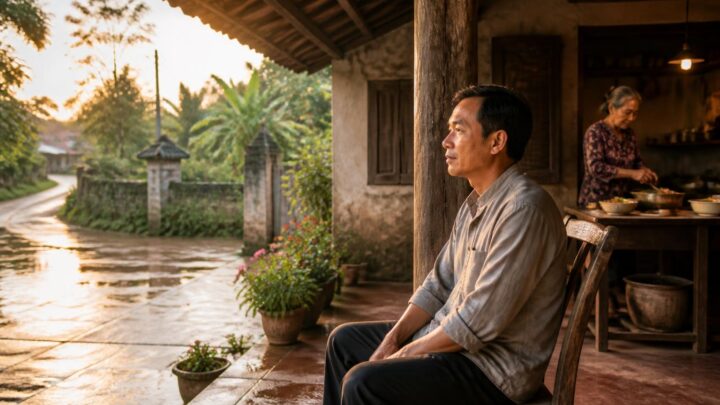
There are houses that do not keep people with doors, nor hold anyone back with reproaches. They simply stand there in silence, weathering sun and rain alongside a small yard, an old doorstep, and an object that seems meaningless. When people grow weary amid the vastness of life, it is precisely those ordinary things that become the first place they want to return to.
Minh’s house had a wooden chair beneath the veranda. The chair was low, its backrest polished smooth from years of use by the family, while its two front legs needed a thin piece of brick underneath to keep it from wobbling. Minh’s mother had said she would throw it away long ago, but every time she intended to take it to the backyard, she stopped. The chair remained, through one rainy season after another and one sunny season after another.
A Departure Without a Goodbye
Minh left his hometown on a cloudy morning. At the time, he had just finished high school and believed that life truly began only in places with brightly lit streets, abundant opportunities, and where no one knew him as the son of the grocery seller at the entrance to the alley. He packed a few sets of clothes into an old bag, took the small amount of money his mother had quietly placed at the bottom of a drawer, and left in a hurry.
His mother accompanied him all the way to the entrance of the alley. She did not cry. She only told him that if he ran short of money, he should say so; if he fell ill, he should come home; and if anything unpleasant happened out there, he should not keep it to himself. Minh heard those words then with the impatience of a young person. He only wanted to move forward, to prove that he could make everything for himself. Before getting on the vehicle, he turned to look back. His mother was standing beside the chair beneath the veranda, one hand resting on its back and the other shielding her eyes from the sunlight.
In the years that followed, Minh truly went farther than he had ever imagined. He worked in several cities, moved between a few companies, and grew accustomed to small rented rooms and hurried meals. He gained more friends, had a packed schedule, and there were days when he earned more money than his mother made selling goods in an entire month. But the busier he became, the shorter his calls home grew. At first, he called a few times a week; later, a few times a month. Then there were months when Minh only sent money without calling.
His mother never complained. She often said that the neighbors were still healthy, the calico cat had grown old, the star fruit tree in front of the house had produced little fruit that year, and that it was probably hot where he was. Those small matters drifted between the two ends of the telephone line like the sound of wind. Minh listened, replied with a few words, then hurried back to work. He did not realize that his mother did not really need to talk about the star fruit tree or the cat. She was simply looking for a reason to hear her son’s voice a little longer.
An Unexpected Return
Minh returned at the end of the rainy season, after trouble arose at work and the room he rented was no longer a place he wanted to enter every evening. No major event had happened. No one had driven him away, and there had been no dramatic breakup. It was simply that after months of living with the feeling that he was running without knowing where he was running to, Minh suddenly felt exhausted.
He did not tell his mother in advance. The bus arrived in his hometown close to noon. The road from the bus station to the house seemed narrower in his memory, but the trees on both sides still cast their shadows across the road. Minh pulled his suitcase through the gate. The wooden door was open. His mother was sitting beneath the veranda, her back slightly bent, picking vegetables in a blue plastic basket.
She looked up and watched him for a few seconds, then simply said:
“You’re back?”
Minh nodded. He had thought his mother would ask why he had returned, how work was going, and when he would leave again. But she asked nothing. She stood up, dusted her hands against the hem of her shirt, and went into the kitchen to warm up the pot of soup. The wooden chair was still there beneath the veranda, beside a ten-o’clock flower pot that had grown over its edge.
That afternoon, Minh sat on the chair. It was still wobbly as before. He bent down to look at the piece of brick propping up its leg and saw a streak of green moss on the brick’s surface. Suddenly, he remembered the evenings of his childhood, when his mother, after finishing work at the shop, would often sit there shelling beans or mending a torn shirt. Minh used to lie stretched out on the veranda floor, telling his mother rambling stories from school. She would listen while working, sometimes laugh, sometimes ask a very short question.
Back then, he thought his mother understood nothing about his dreams. Only later did Minh realize that it was not that she did not understand. She simply did not want to use her own worries to make her child’s dreams smaller.
Things Expressed Through Silence
Minh stayed home for more than a week. At first, he felt that time passed too slowly. In the mornings there were no urgent phone alerts, at noon there were no long meetings, and in the evenings there was only the sparse sound of vehicles on the road outside. He began helping his mother reorganize the shop, repair the storeroom door, and sweep leaves from the yard.
His mother still did not ask whether he planned to stay long. Nor did she say that he should find a new job or return to the city. Every morning, she put an extra pair of chopsticks on the table. If Minh slept late, she left his portion of rice in the pot and went to the market. Those actions were simple enough to be easily overlooked, but they gradually brought the house back to its old rhythm.
One day, Minh discovered that the chair beneath the veranda had been repaired. Its legs were no longer propped up by a piece of brick; instead, a new wooden bar had been nailed in place, quite sturdily. He asked his mother who had fixed it. While wiping a glass, she replied that Uncle Tu, the neighbor, had seen that the chair was about to break and had helped repair it.
“Why didn’t you throw it away and buy a new one?” Minh asked.
His mother looked at the chair and smiled faintly:
“Things develop a bond of their own after being used for a long time.”
Minh said nothing. He understood that she was not speaking only about the chair. In this house, many things were old but had never been considered useless. The dented pot was still used to cook food for the cat. The faded towel was still washed clean and folded neatly. The chipped ceramic cups still sat on the shelf because they had once been gifts from people who had not visited in a long time.
Where Minh had lived, anything broken was replaced immediately. People replaced their phones, their furniture, their rooms, and sometimes even their relationships simply because they were no longer convenient. After returning home, he realized that some things were not kept because of their practical value. They were kept because they had witnessed a part of a person’s life.
When the One Who Stayed Behind Also Needs to Be Heard
That night, it rained heavily. The electricity in the neighborhood flickered, then went out completely. Minh and his mother sat beneath the veranda, each holding a palm-leaf fan. Rain poured onto the corrugated metal roof, creating a dense, steady sound. It had been a long time since the two of them had sat beside each other without either one looking at a phone.
His mother said that after Minh left, she continued the habit of placing an extra bowl of rice on the table during the first few days. Later, she stopped doing so, but whenever she heard a vehicle stop in front of the gate, she still looked up. Minh sat silently. He wanted to apologize, but those two words suddenly seemed too small beside all the years his mother had spent waiting.
His mother continued, without reproach, saying that once she had had a fever but had not called him because she knew he was busy. She had asked a neighbor to buy medicine. Once, the veranda roof had leaked, so she climbed up to repair it herself and slipped, fortunately only bruising her knee. Once, business at the shop had been slow, and she had considered calling to ask whether Minh could come home for a few days, but in the end she decided not to.
Minh asked why she had not said anything.
She looked at the curtain of rain before them:
“I was afraid that while you were trying so hard, hearing about things at home would make you feel guilty.”
Those words made Minh lower his head. He had once thought his mother’s silence meant that she was at ease. It turned out that sometimes it was how someone loved another person so deeply that they accepted hiding their own vulnerability.
Minh told his mother about his months in the city. He said that he had suffered from insomnia, that he had sat alone in a brightly lit room without knowing whom to call. He told her about the times he had wanted to quit his job but was afraid others would think he had failed. For the first time in many years, he spoke of the things he had continued trying to hide beneath an appearance of calm.
His mother offered no advice. She simply reached out and placed her hand over the back of his. Her hand was thin, with prominent veins and a few calluses on the fingertips. Minh suddenly realized how many opportunities he had missed to sit beside his mother like this.
The Value of Having a Place to Return To
Minh did not immediately find an answer for the future. He did not know how long he would stay in his hometown, either. But he began to understand that returning did not necessarily mean giving up all his dreams. Sometimes, returning simply meant stopping long enough to hear what he needed, to see the people who had quietly stood behind him, and to rearrange the way he would move forward.
A few weeks later, Minh found a job he could do remotely. The income was lower than before, but the hours were more flexible. He helped his mother restock the shop, renovate the grocery stall, and create a simple ledger so she could keep track of the money more easily. In the afternoons, he often sat on the chair beneath the veranda, working on his computer. Whenever his eyes grew tired, he looked up at the road in front of the house.
His mother still often walked back and forth, sometimes watering the plants, sometimes arranging bottles of water on the shelves. The two of them did not always talk. There were afternoons when they sat beside each other for a very long time, each doing a different task. The silence then was no longer a distance between them. It became a form of intimacy, like sunlight resting quietly on the tiled floor or the smell of freshly cooked rice spreading from the kitchen.
The old chair still wobbled a little, even after being repaired. Minh said he would buy a newer, sturdier chair. His mother said to leave it be; she was used to sitting on it. He did not press the matter. He knew that perhaps he did not want to replace it either. The chair had been there when he was a child, on the morning he left, and on the afternoon he returned. It was not perfect, but it held a part of his memories that no new object could replace.
People often think of home as a place with walls, a door, and an address to return to. But sometimes, home is also the gaze that does not press you with questions, the meal warmed for you, the hand placed over yours in the middle of a rainy night, or the old chair left in the same place even though the person who sat in it had been absent for many years.
Minh no longer believed that he had to go very far to prove that he was grown-up. Nor did he think that staying was always the easier choice. What he understood after returning was that everyone needs a place where they do not have to succeed in order to be loved. In such a place, we can be tired, we can slow down, and we may not know what tomorrow will bring, yet the door will still be opened to welcome us in.
And sometimes, to find such a place, all we need to do is sit down on an old chair beneath the veranda, listen to a loved one moving about behind us, and realize that we were never truly left behind.
Related articles
The Box That Held the Scent of Rain
The day An returned to the village, the rain had just stopped. The dirt road leading into the small hamlet still glistened with water, and the two rows of grass along the roadside drooped as if they had just gone through a long conversation with the wind. The vehicle carrying her stopped in front of
Read more
A Belated Apology Can Still Open the Door to Tomorrow
In many relationships, what drives people apart is not necessarily some major event. Sometimes it is simply a harsh word spoken in the heat of the moment, a broken promise treated lightly, a prolonged silence, or the habit of always assuming that the other person will understand without an explanation. Such things may pass unnoticed
Read more
The Keeper of the Last Bell in the Village
At the end of the dirt road leading out to the fields, there was a small village nestled beside a river that flowed slowly all year round. The villagers called the place Van Khe Village, not because it had any particularly special stream, but because whenever evening fell, the bell from the ancient communal house
Read more
The Scent of Rain on an Old Tiled Roof: When Memories Teach Us How to Return
There are afternoons when a sudden rain is all it takes to carry us back to a place deep in our memories. Not by foot, but through the scent of wet earth, the sound of water falling on a tiled roof, and the warmth that once lingered beside the doorstep. These things often appear when
Read more
The Girl Who Gathered Light at the End of the Slope
The Village Behind Three Hills Once upon a time, behind three hills that followed one after another, there was a small village called An Nhien. The villagers made their living by growing rice, weaving baskets, and making terracotta lamps. The village was not wealthy, but it had long been known to many people because the
Read more
The Lighthouse Keeper and the Road That Was Not on the Map
The Lamp at the Edge of the Forest At the end of a narrow valley, a dirt road ran along the mountainside. It did not lead to a large city, nor did it connect to any busy markets. It merely passed a few houses with old tiled roofs, a low stone bridge, and a forest
Read more