
Story Collections · 9 November, 2026
The Box That Held the Scent of Rain
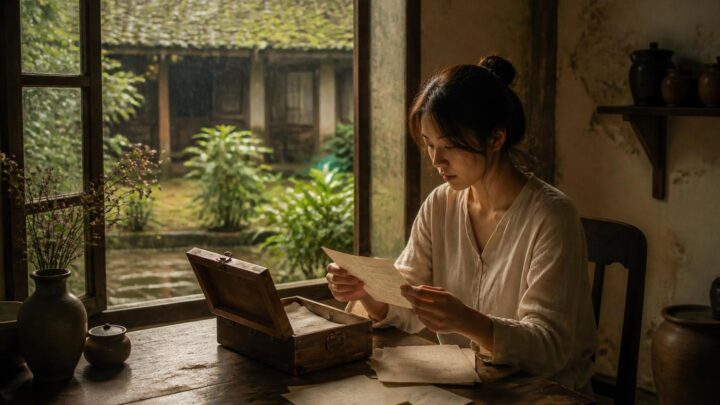
The day An returned to the village, the rain had just stopped. The dirt road leading into the small hamlet still glistened with water, and the two rows of grass along the roadside drooped as if they had just gone through a long conversation with the wind. The vehicle carrying her stopped in front of the weathered wooden gate. On the wall beside it, a climbing coral vine spread across the old bricks, blooming with a few pale pink flowers.
Her grandmother’s house was still there, low and deep, with a roof covered in green moss. Only her grandmother’s voice no longer rang out from the kitchen. She had died at the end of winter, while An was in a city more than a hundred kilometers from home. An had returned for the funeral and helped her mother put away a few things, but then she hurried back. Work, appointments, and the frantic pace of life had helped her temporarily forget the house that smelled of kitchen smoke.
This time, An had returned because her mother had asked her to inventory the belongings before the house was renovated. Her mother said the back part of the roof leaked, the windows were rotting, and many things could not remain unchanged forever. Listening to her, An felt a thin thread catch inside her heart. She knew the house needed repairs, but she was also afraid that every tile replaced would take away another piece of memory.
The Room Behind the Bookshelf
That afternoon, An began clearing out the front room. Chipped porcelain bowls were packed into cardboard boxes. An oil lamp that no longer worked was wrapped in an old newspaper. The pendulum clock still hung on the wall, its hands stopped at four seventeen, perhaps having ceased to run a very long time ago.
When she pulled the bookshelf away from the wall, An saw a small door completely hidden behind it. The door was so low that an adult had to duck to pass through. She did not remember that room existing. Perhaps she had seen it when she was little but had not been curious enough to ask. Or perhaps the bookshelf had covered it since before she was old enough to remember.
Inside the room were only a wooden table, a low chair, and several bamboo baskets. Light entered through a small window, turning the drifting dust into golden specks. On the table sat a wooden box about a handspan long, its lid slightly ajar. The box had no carvings, only an arc-shaped scratch and a tarnished brass latch.
An opened the lid. Inside were neatly folded pieces of paper, tied into bundles with blue thread. There was no money, jewelry, or important paperwork as she had expected. Each piece of paper contained only a short line written in her grandmother’s handwriting.
“March rain, the smell of fresh earth beside the bean patch.”
“Early-summer rain, the smell of little An’s wet hair.”
“Night rain, the smell of Father’s shirt hanging out to dry, still damp.”
“Rain after the day your mother and I quarreled, the smell of lime leaves in the braised fish.”
An read each line slowly. She laughed at the note about her wet hair, then instinctively raised a hand to touch her forehead. A memory appeared, indistinct but warm: an eight-year-old girl running around the yard, pulled inside by her grandmother to have her hair dried, while her grandmother scolded her for fear she would catch cold. At the time, An had found the scolding annoying. Now, in that dusty room, she finally understood that it was her grandmother’s way of saying she loved her.
The Rains That Were Put Away
There were more than a hundred pieces of paper in the box. Her grandmother had written them over many years, but not in chronological order. Some papers had yellowed, while others were newer, their ink still dark. A few lines contained only a handful of words: “Rain that smells of young mud.” “Rain on a corrugated-metal roof.” “Rain waiting for someone who has gone far away.”
An carried the box out to the veranda and placed it beside the teapot. Her mother was picking vegetables on the doorstep and stopped when she saw it.
“You found it?” her mother asked.
An looked up. “You know about this box?”
Her mother nodded, unsurprised. “Your grandmother called it the rain-scent box.”
“Could she really smell the scent of every single rain?”
“No one can smell every single rain. She just remembered what happened when it rained.”
Having said that, her mother bent down to pick up a wilted stalk of vegetable. An looked at her mother’s fingers and suddenly realized how remarkably much they resembled her grandmother’s hands. She had grown so used to that face that she had never noticed. The fine veins, the short-trimmed nails, the callus beside the thumb—all of it reminded her of the hands that had braided her hair before school.
“Why did Grandma write these things down?” An asked.
Her mother was silent for a moment. “Perhaps because she was afraid of forgetting. Or afraid that others would forget.”
An lowered her head and continued reading. One piece of paper said: “Rain on the day my daughter left home. The smell of wet earth, no smell of incense.” She knew that “daughter” meant her mother. Back then, her mother had been only nineteen. After an argument with An’s grandmother, she had left for the town. Her mother had once told the story as if it were something minor, saying only that she had gone away for a few days and then returned. But her grandmother’s words made An imagine a different afternoon: a mother standing on the veranda, listening to the rain and waiting for the sound of her daughter’s footsteps, not knowing whether she would come home that night.
An did not ask her mother about the note. Her mother did not explain. Between them was the sound of water dripping from the eaves into the earthenware jar.
What Gets Forgotten During Busy Days
The next day, An continued clearing out the room. At the bottom of the box, she discovered a secret compartment. Inside were smaller pieces of paper, each bearing the name of a family member. There were her mother’s name, her uncle’s name, and the names of neighbors who had passed away. An’s name appeared most often.
“An listened to the story and did not laugh at Grandma.”
“An knew to give the guava to her younger sibling.”
“An called on a rainy day, but could speak for only three minutes.”
The final piece of paper read: “An will come home when she hears the rain in her heart.”
She read the sentence several times. It did not sound like a prophecy. Her grandmother had never said mystical things, nor did she like to make others afraid. Perhaps she had simply written down a wish, or a simple belief that her granddaughter, always running off somewhere, would one day stop.
An remembered her grandmother’s phone calls. Her grandmother would often ask whether she had eaten, whether work was keeping her busy, and whether it was raining where she was. An usually answered hurriedly, sometimes typing on her keyboard while listening. Once, her grandmother told her that the guava tree in the garden behind the house had borne fruit. An had only said “yes” a few times before telling her she had to attend a meeting. Afterward, she forgot the story.
People do not usually lose something in a single day. We let it fade little by little, through the times we do not listen to the end of a story, the meals we postpone, and the calls we cut short. When we want to find it again, we discover that what was precious has been lying somewhere behind a great many things called necessary.
That afternoon, the rain came again. It fell on the old tiled roof, steady and deep. An sat in the kitchen with the box open in front of her. The smell of wet earth drifted in from the garden along with the scent of ginger frying in a pan. She took a blank piece of paper and sat for a long time without writing anything.
Her mother placed a plate of boiled sweet potatoes in front of her.
“Are you planning to keep the box?”
“Yes.”
“If you can keep it, then keep it. But don’t just keep it in a cabinet.”
An looked at her mother.
Her mother continued: “Your grandmother wrote these things down so that we would remember one another, not so that one person would keep them alone.”
Another Way of Coming Home
After the house was renovated, An asked her mother to leave the small room behind the bookshelf intact. She did not want to turn it into a cold exhibition room. She merely repainted the walls, replaced the broken window, and added a long table. The wooden box remained in the middle of the table, beside a stack of blank paper.
Her mother did not object. From time to time, she brought over a new piece of paper. She wrote more slowly than An’s grandmother, her handwriting slightly slanted, with frequent pauses between sentences. Her first note read: “Rain on the day An came home to repair the roof. The smell of fresh plaster and boiled sweet potatoes.”
An began writing too. She wrote about the morning she and her mother pulled weeds together, about a phone call with her uncle after years of barely speaking, and about the time a neighbor brought over a basket of lychees and sat on the veranda telling stories until evening. She did not try to make the lines special. Some days she wrote only: “Light rain. Mother napping. There is a yellow cat in the yard.”
She realized that memories did not necessarily have to be tied to major events. A head of hair being dried, a bowl of soup placed at just the right moment, the sound of slippers dragging along the hallway, or the smell of clothes hung out to dry but not yet dry could all become places where people found one another after many years. What makes a moment memorable is not always intensity, but sometimes simply that we were present and truly saw it.
A few months later, An moved part of her work home. She still traveled to the city regularly and still had days when she worked until evening, but she no longer regarded coming home as a task to complete. She learned to call her mother when there was nothing important to say. The two of them could remain silent on the phone, listening to each other breathe, and then ask what the weather was like on the other side.
One evening at the beginning of summer, rain suddenly poured down. An was locking the door when she heard water rushing over the roof. She went back into the small room and took out a piece of paper.
She wrote: “Early-summer rain. The smell of fallen areca flowers, the smell of Mother’s clothes, and a house that knows how to wait for someone to come home.”
When she finished, An did not fold the paper right away. She sat by the window, watching streams of water slide through the garden. In the sound of the rain, she imagined she could hear her grandmother’s voice from a distant afternoon: Don’t run so fast, dear, or you won’t have time to watch the road.
For the first time, An understood that coming home was not merely stepping through an old gate. Coming home meant learning again how to listen to the things once hidden by the noise of life. It meant realizing that family was not a place that always stood still waiting for us, but people who also changed, grew tired, and needed to be asked how they were before it was too late.
She placed the piece of paper in the box and closed the lid. Outside on the veranda, the rain continued to fall. In the newly renovated house, nothing strange happened. There was only a woman sitting beside the window, knowing she was in the right place, on an evening when the scent of rain suddenly became very clear.
Related articles
The Chair Beneath the Veranda and the One Who Came Back
There are houses that do not keep people with doors, nor hold anyone back with reproaches. They simply stand there in silence, weathering sun and rain alongside a small yard, an old doorstep, and an object that seems meaningless. When people grow weary amid the vastness of life, it is precisely those ordinary things that
Read more
A Belated Apology Can Still Open the Door to Tomorrow
In many relationships, what drives people apart is not necessarily some major event. Sometimes it is simply a harsh word spoken in the heat of the moment, a broken promise treated lightly, a prolonged silence, or the habit of always assuming that the other person will understand without an explanation. Such things may pass unnoticed
Read more
The Keeper of the Last Bell in the Village
At the end of the dirt road leading out to the fields, there was a small village nestled beside a river that flowed slowly all year round. The villagers called the place Van Khe Village, not because it had any particularly special stream, but because whenever evening fell, the bell from the ancient communal house
Read more
The Scent of Rain on an Old Tiled Roof: When Memories Teach Us How to Return
There are afternoons when a sudden rain is all it takes to carry us back to a place deep in our memories. Not by foot, but through the scent of wet earth, the sound of water falling on a tiled roof, and the warmth that once lingered beside the doorstep. These things often appear when
Read more
The Girl Who Gathered Light at the End of the Slope
The Village Behind Three Hills Once upon a time, behind three hills that followed one after another, there was a small village called An Nhien. The villagers made their living by growing rice, weaving baskets, and making terracotta lamps. The village was not wealthy, but it had long been known to many people because the
Read more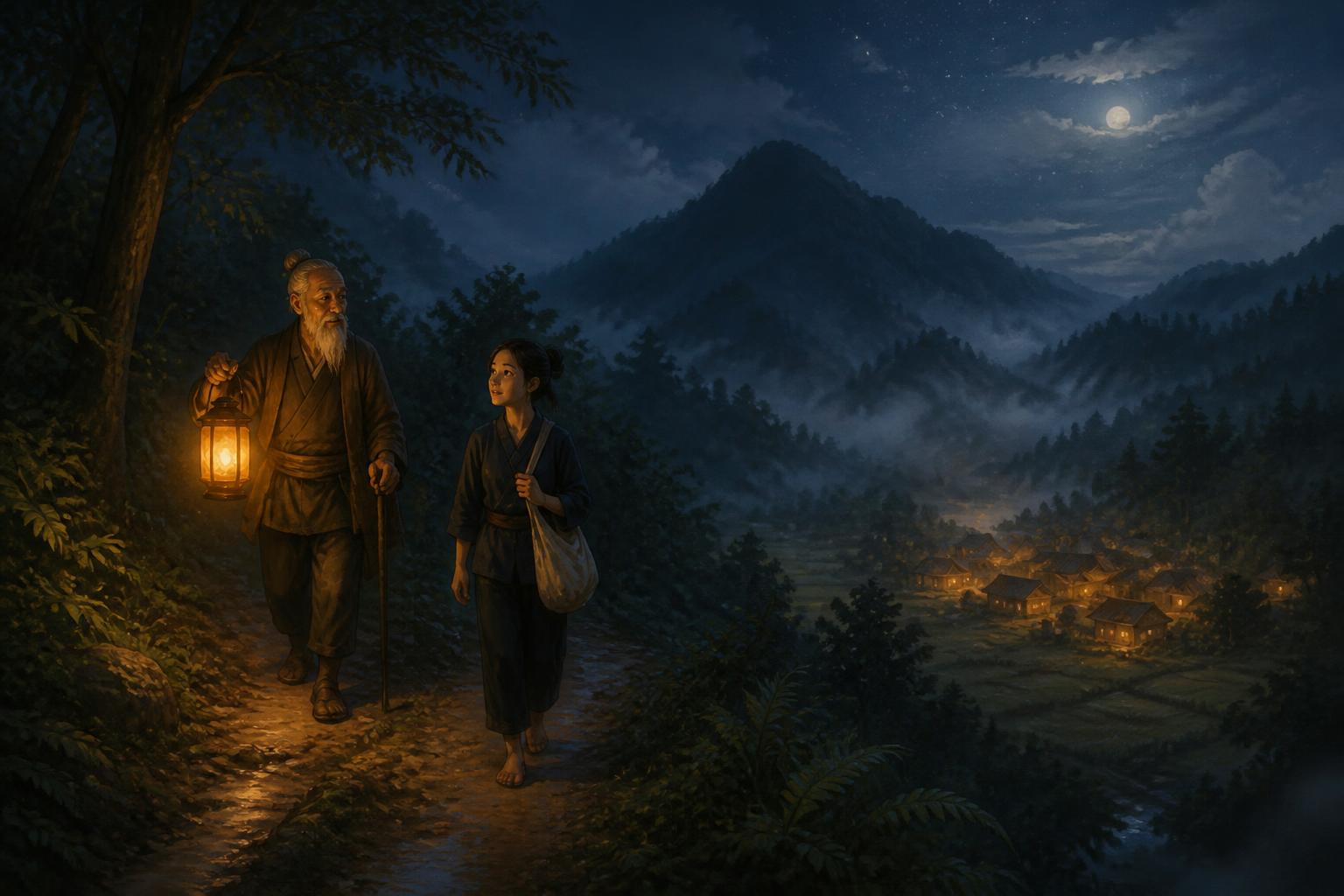
The Lighthouse Keeper and the Road That Was Not on the Map
The Lamp at the Edge of the Forest At the end of a narrow valley, a dirt road ran along the mountainside. It did not lead to a large city, nor did it connect to any busy markets. It merely passed a few houses with old tiled roofs, a low stone bridge, and a forest
Read more