
Story Collections · 15 November, 2026
The Clock That Did Not Tell Time
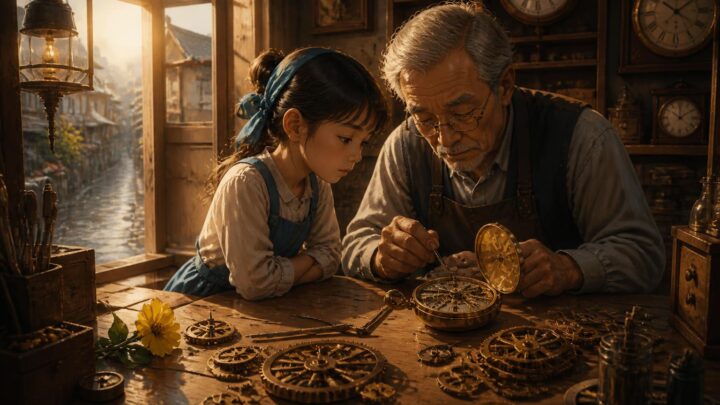
At the end of a narrow street, where old rooftops leaned to reflect their shadows in a ditch thick with duckweed, there was a small shop called Moc Clock Shop. The wooden sign had faded with age, and the letters on it were almost impossible to read, but everyone in town still knew the place. They came to repair clocks whose hands had stopped, replace worn-out mainsprings, or simply sit and listen to the steady ticking that filled the room with the scent of old wood.
The shop’s owner was an old man named Lam. He had bright eyes, slender hands, and an extraordinary patience. People said he could hear a clock running out of rhythm among a hundred different ticking sounds. Yet although he could repair nearly every kind of clock, Mr. Lam had never worn one on his wrist.
Every morning, he opened the shop while dew still clung to the flowers along the road. Every evening, he closed it after the last light in the street had gone out. He did not need a clock to know the time. He simply listened to the crowing of roosters, the bamboo broom of the street sweeper, the bicycle bell of the boy delivering bread, and the slowing footsteps of people returning home.
The Clock in the Drawer
One day at the beginning of the rainy season, while tidying an old wooden cabinet, Mr. Lam found a pocket watch lying deep inside a drawer. It was small and round, with a tarnished brass case. A crack ran across the glass from twelve down to six, while the two hands had stopped at an uncertain moment.
Mr. Lam wiped away the dust, opened the back, and saw an unusual mechanism. The gears inside were not made of metal but seemed to have been carved from dark brown wood. Each tooth bore a tiny engraving: a rice bowl, a lamp, a hand clasping another hand, a flower, and a drop of water.
The old man tried winding it. The watch immediately began to tick, but the sound was uneven. Each time the second hand moved forward one step, a very faint sound echoed through the room. Sometimes it was the laughter of a child, sometimes a sigh, sometimes the sound of rain falling on tiled roofs. After a few minutes, the hands stopped at six.
Just then, a little girl entered the shop. Her name was Mai, and she was about twelve years old. She often sold bunches of wildflowers at the street corner. Her hair was always tied with a strip of blue cloth, and although her shoes were old, they were always clean. Mai had come to ask Mr. Lam to repair her mother’s alarm clock.
Mai’s mother worked at the bakery on the other side of town. She had to wake before dawn to knead the dough, so the alarm clock was the most important object in their house. But for the past few days, it had stopped ringing. Mai was afraid her mother would oversleep and lose her job, so she had brought it to the shop.
While Mr. Lam examined the clock, Mai noticed the pocket watch on the table.
“I’ve never seen one like that,” the girl said.
Mr. Lam closed the back.
“Neither have I. It was just found this morning.”
Mai bent down to examine the cracked glass. She realized that the two hands had stopped at a position resembling six o’clock, but she did not know whether it was morning or evening.
“Which six o’clock is this, Grandpa?”
Mr. Lam shook his head.
“Perhaps it is the six o’clock that someone missed.”
The Missed Hours
Mai’s mother’s alarm clock had only a small gear that was stuck. Mr. Lam fixed it in a moment. When Mai tried to pay him, he accepted only a bunch of yellow wildflowers.
The next day, Mai came back. She said that her mother had stayed up late the night before to mend her child’s shirt. That morning, the clock had rung on time, but her mother was still tired. Mai asked whether Mr. Lam could repair a clock so that people could have more time to rest.
The old man smiled and said that no clock had ever been able to do that. But he placed the pocket watch on the table and wound it. The second hand began to move. This time, the ticking was accompanied by the sound of thread being pulled, a needle touching fabric, and a very soft yawn.
Mai was astonished. She understood that the watch did not merely measure time. It was recording the moments that people often failed to notice.
That afternoon, a wealthy man named Phuc came to the shop. He wanted to have the large clock hanging in his living room repaired. The clock was elaborately carved, with a brass pendulum and a gleaming face. Mr. Phuc complained that it was running one minute slower than the clock in his car.
Mr. Lam inspected it and said that the clock was not broken. It only needed to be wound.
“Not even one minute can be lost,” Mr. Phuc snapped. “I have many important things to do.”
While the clockmaker worked, Mr. Phuc kept looking toward the door. He did not notice his little daughter standing outside on the porch. She was holding a pastry, looking first at her father and then at the empty chair beside him.
The pocket watch on the table suddenly rang out. The second hand moved quickly, then stopped at the engraving of a hand clasping another hand. At the same time, Mai heard the voice of a child calling for her father from very far away.
The little girl walked over to Mr. Phuc.
“Dad, can you eat some pastry with me?”
Mr. Phuc frowned and told his daughter to go home first. He still had to meet a business partner. The girl lowered her head, placed the pastry on the table, and quietly walked out.
Mr. Lam watched her go but said nothing. When the large clock had been repaired, Mr. Phuc paid and left the shop. After taking only a few steps, he suddenly stopped. He turned back and looked at the pastry still lying on the table.
For the first time in many years, he realized that he could not remember when his daughter had last invited him to eat pastry with her.
He returned, picked up the pastry, and went to look for his daughter. People in the street said that he had missed a business appointment that day, but had managed to sit with his daughter beneath the tree in front of their house. The girl divided the pastry into two unequal pieces and gave the larger one to her father. Mr. Phuc did not correct the uneven division. He ate the smaller piece and found it more delicious than any feast.
The Man Who Wanted to Buy Back Time
News of the strange watch quickly spread throughout the town. People began coming to Mr. Lam’s shop not only to repair clocks but also to ask what they had missed.
Some heard the sound of a door closing in a house where no one had returned for a long time. Some heard their mothers calling them from a distant morning long ago. An old woman heard the sound of a spoon touching a bowl of porridge and suddenly remembered how her late husband had patiently blown on every spoonful to cool it for her during the days she was ill. A little boy heard his friend laughing, then remembered that he had not gone over to play for months simply because he had been absorbed in new forms of entertainment.
The watch did not judge anyone. It only let them hear again the moments they had once considered too small to matter.
But some people were not satisfied. A merchant named Khai came one evening. He had heard the story and believed that the watch could help him recover opportunities he had lost. Khai brought a heavy bag of money, placed it on the table, and offered to buy it.
Mr. Lam refused.
“I’ll pay double.”
“It’s not for sale.”
“Ten times as much.”
“This watch does not belong to the person with the most money.”
Khai grew furious. He thought Mr. Lam was only pretending to be mysterious in order to raise the price. That night, Khai secretly returned to the shop. He pried open a window, took the pocket watch, and ran home.
Khai wound it as hard as he could. The hands spun wildly. Hundreds of sounds flooded the room: people calling, doors opening, crying, laughter, footsteps moving away. Khai heard every time he had promised to return but failed to do so, every time he had refused to help a relative for fear of losing something, every time he had seen someone in trouble and turned away.
The sounds grew denser and denser. Khai covered his ears, but he could not stop them. The watch trembled in his hand, hot as a coal. Terrified, he threw it onto the floor. The glass cracked along another line, and the hands stopped at the engraving of a drop of water.
Khai ran to his younger brother’s house. They had not spoken for many years because of an old debt. He stood outside the door for a long time before daring to knock. His brother opened the door, and the two of them looked at each other in silence. Khai did not mention money. He only said that he had let too many days pass without knowing how to hold on to the things worth keeping.
The next morning, Khai brought the watch back. Mr. Lam did not ask about the previous night. He simply replaced the glass and placed the watch in the drawer.
“I thought it would help everyone return to the past,” Mai said.
“No one can return to the past,” Mr. Lam replied. “But sometimes, simply realizing what they have missed means people still have time to do something differently.”
The Final Moment
The rainy season that year lasted a long time. The ditch at the end of the street swelled with water, and nearly all of Mai’s wildflowers were submerged. The girl sadly planned to give up selling flowers, but Mr. Lam told her that plants had their own seasons. Some flowers did not bloom to be kept, but bloomed to remind people that one day, they could still begin again.
On a clear morning after many days of rain, Mr. Lam did not open the shop. Mai called for him repeatedly and finally found him resting on the small bed behind the counter. He had grown much weaker. On the table, the pocket watch lay beside a yellow flower.
He handed it to Mai.
“I have repaired many clocks, but this one does not need repairing. It only runs when someone knows how to listen.”
Mai took it. The two hands were pointing exactly at six. The ticking sounded slowly, mingling with the birds calling to one another outside the porch and the bamboo broom sweeping across the street.
Mr. Lam closed his eyes to rest. Mai sat beside him without saying anything. She understood that sometimes presence mattered more than any words of comfort. She poured him a glass of water, pulled the blanket up to his shoulders, and opened the window to let the room welcome the breeze.
By afternoon, Mr. Lam woke up. He told Mai to keep the clock shop, not because she already knew how to repair mechanisms, but because she knew how to see the things other people often overlooked.
In the years that followed, Moc Clock Shop remained open at the end of the street. Mai grew up, learning how to replace mainsprings, clean glass faces, and listen to the sound of mechanisms running. She never sold the pocket watch. Nor did she use it to force people to remember things they wanted to forget.
Everyone who entered the shop was treated alike. The wealthy could bring an expensive clock, while the poor needed only to bring a word of thanks. Some came to repair a clock, some came looking for an old object, and some simply sat quietly for a few minutes to listen to the calm ticking amid a hurried day.
Later, a small wooden box appeared on the counter in the shop. Inside were scraps of paper for customers to write down one kind thing they wanted to do before the day ended. Some wrote that they would call their mother. Some wrote that they would apologize to a friend. Some wrote that they would sit and eat with their children without looking at their phones. The scraps bore no names, but every evening Mai read them once before closing the shop.
The pocket watch continued to run, although it never showed the correct time. When someone knew enough to stop and listen, the hands moved one step farther. When someone managed to offer a hand, a word of concern, or a warm meal in time, the ticking became clearer again.
And if one afternoon you happen to walk past the street where old rooftops reflect their shadows in a ditch thick with duckweed, you may hear the sound of a clock coming from a small shop. It does not remind you that time is passing. It simply asks, gently, what you will choose to keep from the hours and moments you have now.
Related articles
The Clock That Would Not Run and the Forgotten Letter
At the end of a small street stood a watch-repair shop that had been there so long that many people no longer remembered when it had opened. The wooden sign above the porch had faded, two letters in the shop’s name worn away by sun and rain, while the glass door was always covered with
Read more
The Garden Behind the Old Wall
When An returned, the small alley was still as narrow as she remembered. Low awnings followed one another along both sides of the street, providing just enough shade from the afternoon sun. The smell of freshly cooked rice drifted from some kitchen, mingling with the scent of damp earth after the rain, and she felt
Read more
The Scent of Rain on an Old Coat
That afternoon, An reached the entrance to the alley just as the rain began to fall. The drops were small, sparse, and cold, clinging to the car window in long streaks that blurred the road ahead. The low hibiscus hedge was still there, as was the star-fruit tree leaning toward the neighbor’s house and the
Read more
The Empty Chair Beside the Porch
The Chair No One Had the Heart to Put Away At the end of a small alley stood a tile-roofed house whose tiles had faded with age. In front of the house, beneath an old starfruit tree, there was always a low wooden chair. The chair was not beautiful, nor was there anything particularly special
Read more
The Compass of the Lost Traveler
At the edge of a town nestled among the hills, there was a small shop that specialized in making and repairing compasses. The shop had no large sign; it only hung a tarnished bronze bell beneath the front porch. Whenever someone stepped inside, the bell rang out clearly, as though the room had just remembered
Read more
The House with Three Windows and the Clockmaker
At the end of the slope leading down to the river wharf, there was a clock repair shop so small that passersby often overlooked it. The wooden sign hanging above the door had faded with time; only the two words “Peace of Mind” could still be made out clearly. The shop’s owner was Mr. Lam,
Read more