

 Tiếng Việt
 日本語
日本語 한국어
한국어 中文 (中国)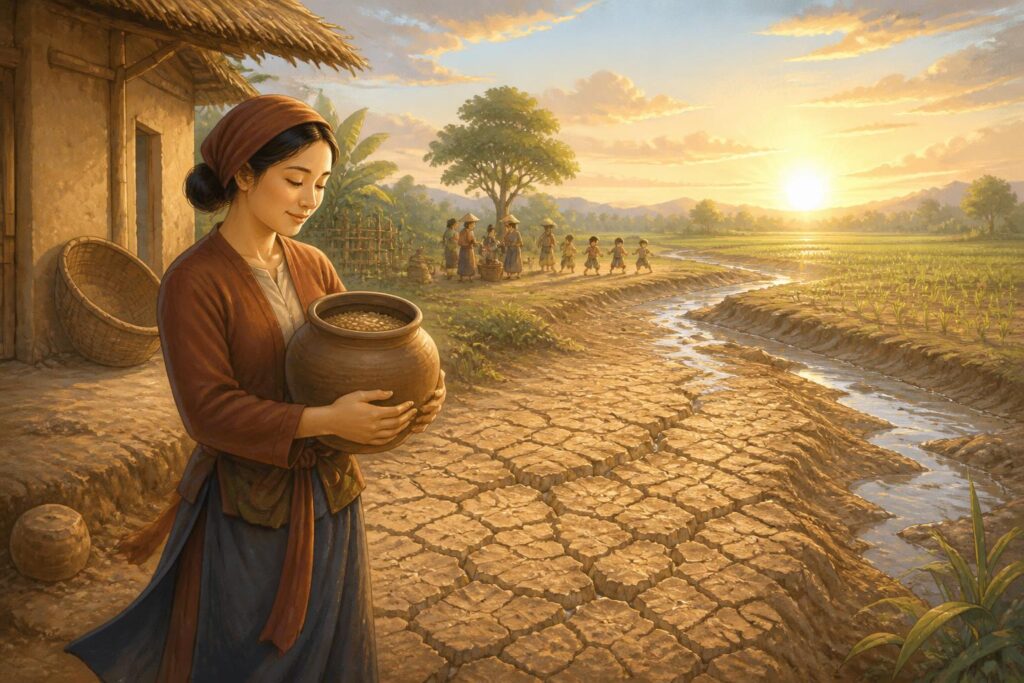
The Prolonged Dry Season
Long ago, in a land lying between two low ranges of hills, there was a river that flowed gently year-round through rice fields. The villagers called it the Mơ River, because its water was so clear that one could see the pebbles lying on the riverbed, while in the early mornings, the surface was often covered by a thin layer of mist like a dream that had not yet faded. Thanks to the river, the fields grew green and fertile, the orchards bore abundant fruit, and the village children grew up alongside the gentle murmur of water on the banks.
But then a dry season arrived and stayed longer than any before it. Rain did not appear on the hilltops. Clouds crossed the sky and then vanished before they could release a single drop of water. The Mơ River gradually narrowed, exposing white gravel bars and the withered stems of aquatic plants. By the end of the season, only a small stream of water remained in the riverbed, winding between cracked mud.
The villagers began to grow afraid. They drew up water bucket by bucket, sharing each bundle of vegetables and each measure of rice. Families with more grain shut their storage rooms more carefully. The poor went to the foot of the mountain to dig for wild roots. Everyone understood that if the drought continued, there would not be enough seeds left to sow the next crop.
The Woman Beside the Earthen House
At the edge of the village lived a woman named An. Her husband had died many years earlier, and An lived with her son in an earthen house with a palm-leaf roof. They were poor, but behind the house was a small garden that she tended with great care. In it, An grew beans, millet, pumpkins, glutinous rice, and many kinds of vegetables that the villagers had cultivated for generations.
Whenever she harvested, instead of taking everything to market, An always set aside the strongest seeds to dry and then stored them in earthen jars. Each jar was sealed with beeswax and placed on a high wooden shelf, away from the moisture rising from the floor. An’s son once asked why his mother did not sell those seeds to buy more rice. An only smiled and said that seeds were not merely food for tomorrow. They were also a promise that tomorrow could still begin.
During the difficult days, some villagers thought An was being overly cautious. They said that someone who did not even have enough rice to eat had no reason to keep seeds. Some even came to ask to borrow them, but when An said that the seeds would only be opened during planting season, they walked away displeased. An did not blame anyone. She knew that hunger could make people see only today, while tomorrow became a luxury too distant to consider.
The Stolen Jar
One night, as hot wind blew across the thatched roof, An heard a noise behind the house. She awoke, took an oil lamp, and went out into the garden. In the weak light, she saw someone holding a jar of millet seeds. The person fled in panic, but tripped over a tree root, causing the jar to fall to the ground. The lid broke, and the small millet seeds rolled all over the dry earth.
An recognized the thief as Lâm, a man in the village whose wife was ill and who had two young children. Lâm lowered his head and did not dare look at her. He said he had only intended to take a few seeds to exchange for rice, because his household had run out of food entirely. An did not scold him. She and Lâm gathered the seeds that were still clean, and then she took a small bag of rice from the house and gave it to him.
Lâm was surprised and asked why she was still helping him after he had stolen from her. An replied that if she merely managed to keep the jar while leaving a family in the village desperate, then the jar would have no meaning either. However, she warned Lâm that the seeds must not be exchanged for a single meal. If he truly needed help, he could ask for it, but he had to work with everyone to find a way to protect the next harvest.
The story spread throughout the village. Some blamed Lâm, while others sympathized with his circumstances, but what made them think more deeply was the way An treated the person who had taken her belongings. She did not condone theft, yet neither did she allow anger to obscure the reason behind that action.
The Seeds Belonged to No Single Person
A few days later, the village head came to see An. He said that the village’s seed store was nearly empty, while the seeds in her house were probably enough to sow many fields. He proposed that An hand them all over for the village to manage. In return, when the harvest returned, each family would give her a portion of the seeds they harvested.
After listening, An agreed halfway. She said she was willing to distribute the seeds among every household, but did not want to hand them all over to one person or one storehouse. If the storehouse burned, was infested by termites, or was seized by someone, the entire village would lose everything. The seeds needed to be distributed among many places and cared for by many people together. She proposed that each family receive a portion, keep part of it, and remember its origins so that no one would later think of it as private property.
At first, many people found the idea unfamiliar. They had always thought that anything valuable should be gathered in one place to make it easier to protect. But An pointed out that a single fire could destroy an entire storehouse, whereas handfuls of seeds kept beneath many roofs would have a chance of surviving. In the end, the village head agreed. The jars were opened one by one. Rice, millet, bean, and pumpkin seeds were divided into small portions.
An also taught everyone to choose low-lying ground for digging pits to collect rainwater, to cover the fields with straw to retain moisture, and to test varieties of plants that could withstand drought. No one in the village knew for certain whether these methods would succeed. They only knew that sitting and waiting for the river to fill again would not give them a single additional grain of rice.
The First Field
The villagers began working together. The children gathered stones from the fields. The adults dug channels to lead water from small springs beneath the foothills. Families who still had the strength took turns helping households with sick members. Lâm, the man who had once stolen the jar, took on the heaviest task: repairing the earthen embankments around the seeded area. Whenever anyone mentioned the old incident, he simply kept working in silence.
The first seeds were sown one morning when the sun was not harsh. The soil was still dry, but beneath the surface layer there was some moisture thanks to the water pits dug earlier. No one dared to hope too much. Every day they passed through the field, looking at the empty rows of earth and wondering whether they were striving in vain.
Then one morning, An’s son discovered tiny green shoots poking out of the ground. They were so slender that a single careless step could break them, yet they still reached upward in the pale light of dawn. The news spread quickly. The villagers came and stood around the field, and no one spoke loudly. They feared that noise might disturb the fragile shoots.
For many weeks that followed, the entire village cared for the field as they would care for something fragile but precious. Some rows dried out, some were damaged by pests, and in some places the seeds sprouted unevenly. An did not hide these failures. She told everyone to mark each row and remember which places held water well and which varieties tolerated drought better. To her, every plant that failed to survive still left behind a lesson for the next crop.
The Return of the Rain
By the end of the season, dark clouds finally gathered over the hills. The first rain fell sparsely, then grew denser into a white curtain of water. The villagers stepped outside their homes and tilted their faces toward the rain. The Mơ River could not immediately return to what it had once been, but the earthen channels had held water, and the small field had provided a harvest sufficient to carry them through the most difficult months.
When the new season began, each family returned a portion of the seeds as promised. But they did not take everything back to their own homes. One portion went into the communal storehouse, another was kept in small jars in many households, and a third was set aside for poor families or those facing hardship. From then on, no one in the village called those seeds An’s. They called them the seeds of tomorrow.
Lâm often visited the garden at the edge of the village. He built An a small shelter for drying seeds, and then taught his children how to select the strongest ones. When people asked why he did so, Lâm replied that being forgiven once would have meaning only if one knew how to turn it into responsibility.
What Remained After the Story
Many years passed. The Mơ River was sometimes full and sometimes dry, but the villagers no longer left their lives entirely to chance. They built water reservoirs, took turns tending the field embankments, and maintained the habit of setting aside seeds after every harvest. The children who grew up heard stories of the woman who had stored jars in an earthen house, not as a wealthy person, but as someone who understood that the most valuable things are often not found in the amount of property we keep for ourselves.
An’s story reminds us that hope does not always appear in a grand form. Sometimes hope is merely a few small seeds resting in the palm of one’s hand, a decision not to spend everything one has, an act of sharing carried out at the right moment, or the choice to work together on something that may not succeed.
Keeping seeds does not mean fearing the future. On the contrary, it is a way of preparing for the future with clear awareness. Sharing seeds does not mean losing one’s own share. It is a way for something good to take root in more places. When one person worries only about saving their own house, they may survive for a day. When an entire community knows how to protect a shared source of life, they have a chance of making it through a long dry season.
And perhaps the deepest lesson lies here: no one knows exactly what tomorrow will bring, but each person can decide what they will leave for tomorrow. A handful of seeds stored with faith can become a field. An act of kindness offered in a difficult time can become strength. And a community that knows how to hold hands, even if it begins beside a dry river, can still find a way to survive amid days when it seems that no harvest remains.

ARTICLES IN THE SAME CATEGORY
The Room Waiting for Sunlight
The Bellmaker and the Silent Monsoon
The Lamplighter at the End of the Slope
The Well That Could Hear the Truth
The Bridge That Appears Only When One Knows How to Return
The Lamp by the Desolate Ferry Landing and the Man Who Asked for Nothing in Return
ARTICLES IN THE SAME GENRE
Tam Cam Part 2: The Vengeful Spirits of the Palace
Tam and Cam: The Palace Intrigue and the Original Ending – Part 1
The world is never short of those who judge others by their material possessions; however, the most concerning poverty of all is the lack of wisdom and self-cultivation.
Stay Away from Foolishness: Seven Forms of Self-Deception and the Path to Awakening
Letting Go of Attachment to Overcome Anxiety: When What Exhausts Us Is Not Life Itself, but the Way We Hold On to It
Drinking Tea or Living Life: When People Get Lost in Material Glamour and Forget Themselves