

 Tiếng Việt
 日本語
日本語 한국어
한국어 中文 (中国)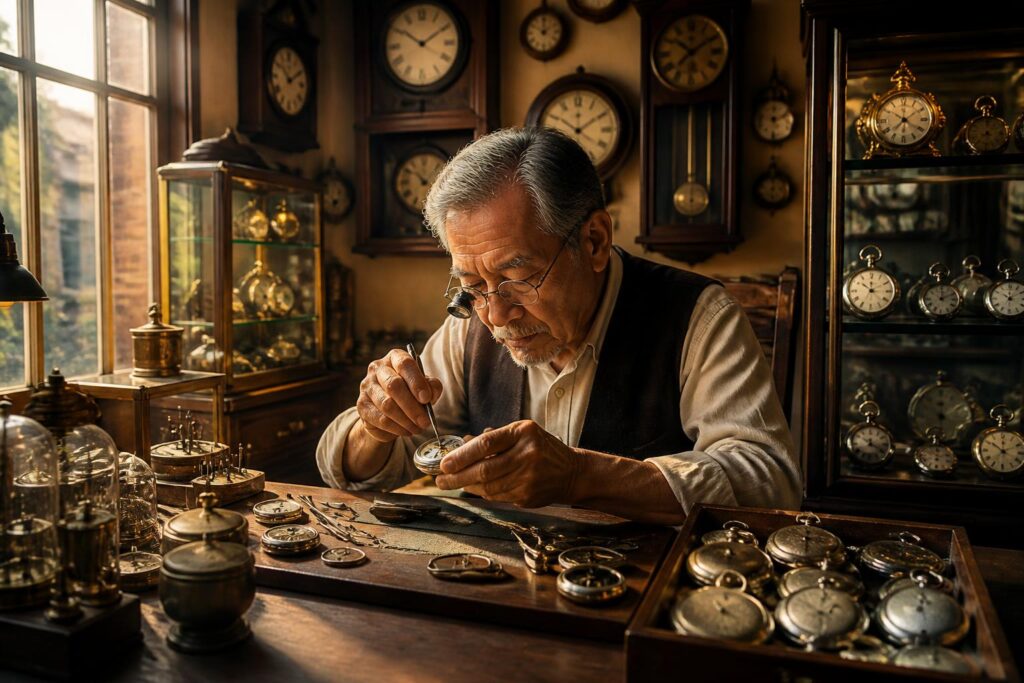
At the end of the street stood a shop so narrow that even two people standing side by side had to slightly turn their shoulders. The wooden sign had faded with age, leaving only a few legible letters: “Clock Repair.” Inside, dozens of clocks hung on the walls, sat in glass cabinets, or rested quietly on pieces of soft cloth. Some ran fast, some ran slow, and some had been silent for a very long time, but the repairer still cared for them as though each object carried an untold story.
The repairer’s name was Mr. Lam. He never made a habit of asking customers where they had bought their clocks, how much they had cost, or what brand they were. He usually asked only one question: “How important is this clock to you?” Some answered that it was a wedding gift, some said it had belonged to their father, and others admitted that they did not know why they still wanted to repair an old, worn-out clock that had accompanied them through many moves.
Mr. Lam always listened. Then he would accept the object with both hands, place it on his workbench, and open the back with a small tool. Tiny gears appeared, delicate as insect wings. He wiped each part, applied a little oil, replaced springs, or straightened hands. His work was slow, but never careless.
The Clock That Stopped at 4:17
One afternoon at the beginning of the rainy season, a young woman walked into the shop. She wore a gray coat, and a few drops of water still clung to her hair. In her hand was a silver pocket watch, its glass scratched and its minute hand stopped at 4:17.
“Can you repair it?” she asked.
Mr. Lam took the watch, gently turned the winding knob, and held it close to his ear. Not a single tick could be heard.
“It can be repaired. But you’ll have to leave it here for a few days.”
The young woman nodded, but did not let go immediately. She gazed at the watch for a long while, then said, “I don’t need it to keep perfect time. I just need it to run again.”
Mr. Lam did not ask anything more. He wrote the owner’s name on a small slip of paper and placed the watch on a separate tray. When the young woman stepped out the door, he watched her silhouette disappear behind the curtain of rain. It was not until evening, while tidying the shop, that he discovered a very faint inscription inside the watch’s cover. He could not read all of it, but he recognized the final two words: “wait for me.”
The watch was more badly damaged than he had expected. One gear was worn down, the mainspring was broken, and the small shaft at the center of the dial was slightly bent. He searched through his box of old spare parts, but had nothing that fit. If he wanted to repair it, he would have to make a new gear himself. That would take a great deal of time, but Mr. Lam was in no hurry. In his profession, some things could not be replaced with a nearly identical component. Even the slightest deviation could cause the entire mechanism to stop functioning properly.
Those Who Came Looking for Time
While waiting for the pocket watch to be repaired, the young woman continued to stop by from time to time. The first time, she brought a small bag of pastries. The next time, she stood by the door watching him work, then asked, “You’ve repaired so many clocks. Is there one you remember most?”
Mr. Lam set down his magnifying glass and smiled kindly. “Every clock people bring in has a reason to be remembered.”
He told her about a blue alarm clock that a young boy had once brought in. The boy wanted to repair it so it could wake his mother for work, because she often had to sleep late after doing housework. He told her about the wall clock belonging to an elderly couple. It ran ten minutes slow, but they did not want him to adjust it because that was the amount of time that had passed when the wife first met her husband at a bus station. He also remembered a rusted wristwatch sent by a man living far from his hometown. The man wanted to repair it as a gift for his younger brother, after the two of them had gone many years without speaking to each other.
“A clock only measures time,” the young woman said.
“That’s right,” Mr. Lam replied. “But people often place in it the things they don’t know where else to put.”
Those words made the young woman fall silent. She looked at the hands moving on the wall. Each showed a different time, creating an uneven sound, sometimes rapid, sometimes sparse. At first it seemed chaotic, but after a while it began to resemble the breathing of the room.
A Forgotten Promise
By the sixth day, Mr. Lam had finished making the new gear. He fitted each component back into its original position, cleaned the glass, and wound the spring. When the second hand began to move in tiny steps, he could not help smiling. The watch still faltered slightly with each rotation, but it had come back to life.
The young woman came to collect it at the end of the afternoon. Mr. Lam handed her the watch and told her that, because the mechanism was old, she should wind it gently, keep it away from excessively damp places, and bring it back to the shop if anything went wrong.
She pressed the watch into her palm. Its ticking was so faint that one had to be very still to hear it.
“Do you know when it stopped?” she asked.
“At 4:17.”
She nodded. “That was when my mother called for the last time. I was in another city, and I was busy in a meeting that day, so I didn’t answer. When I called back, she was no longer conscious. After that, I kept this watch in a drawer. I thought that if it started running again, maybe I would stop blaming myself.”
Mr. Lam did not tell her that a watch could not change a call that had already passed. Nor did he hasten to comfort her with familiar phrases. He simply placed the watch in her hand and said, “It can run again, but it doesn’t have to run to prove that you’re no longer sad. Some sadness is held on to not because we are weak, but because the person who has gone was important to us.”
The young woman lowered her head. After a while, she asked, “Then what should I do with this time?”
Mr. Lam looked out at the street as the lights came on. “Keep living. But don’t live so quickly that you forget the people who can still hear you when you call.”
The Room Behind the Shop
That day, after the young woman left, Mr. Lam did not close the shop right away. He sat quietly at his workbench, facing the wall clock that ran ten minutes slow. He had repaired it many years earlier for a woman named Hanh. She had been dead for a long time, while her son brought the clock back to him whenever it needed oiling.
Mr. Lam and Hanh had once been neighbors. When they were young, they had made a promise to meet, but neither had been brave enough to speak plainly. After that, each went in a different direction. She married, and he opened his shop. They still saw each other on rare occasions and continued to ask about each other through very ordinary questions, but they never mentioned the old promise.
The wall clock was a gift he had given her when he had just opened the shop. It ran faster than every other clock, so she returned it. He adjusted it to run ten minutes slow and said, “That should do it.” Hanh smiled without asking why. They both understood that it was a clumsy way of preserving a stretch of time that belonged only to them.
For many years, Mr. Lam repaired other people’s clocks, but he had never repaired his own. In the room behind the shop, he kept an old wristwatch in a wooden box. It had stopped at 7:05, the moment he received the news of Hanh’s death. He did not know why he kept it that way. Perhaps he was afraid that if he repaired it and made it run, he would have to admit that time had truly moved on.
That evening, he opened the wooden box. He took out the watch and used a soft cloth to wipe the dust from its glass. The mechanism inside was not badly damaged. Only the mainspring had lost its strength from lying still for so long.
He sat for a long time at his workbench. Then, for the first time in many years, he began to repair his own watch.
What Was Repaired Was More Than an Object
The next morning, when he opened the shop, Mr. Lam placed the watch that had started running again on a small stand by the window. It did not keep perfectly accurate time. The second hand still faltered now and then, and a long scratch remained across the glass. But its ticking sounded steady, like a quiet reminder that no machine had to be perfect in order to keep going.
The young woman did not return right away. A month later, she came back with a small bouquet of flowers. She said that she had been calling her father more often. She had also begun writing down the things her mother had once taught her, from how to cook a dish to the habit of folding towels before putting them away in the cupboard. “I still miss my mother,” she said, “but that feeling no longer leaves me standing still at a single moment in time.”
Mr. Lam accepted the flowers and placed them in an old porcelain vase. He did not tell her that he, too, had just repaired a watch that had stopped for many years. The young woman saw it on the table and asked softly, “Is that your watch?”
He nodded.
“Is it very important?”
He watched the hands move minute by minute. “It is. But I used to think I had to keep it still in order to hold on to the person in my memory. Later, I understood that memories do not disappear simply because time continues to move forward.”
At noon, the young woman left the shop. Outside, sunlight fell in patches of brightness across the damp paving stones. Mr. Lam returned to his workbench and continued repairing a blue alarm clock. Inside it, the small spring had been stretched too tightly. He straightened it very slowly, not trying to force it back into its original shape, but only finding a way for it to work without suffering further damage.
Sometimes people are like old clocks. We carry scratches, delays, and moments when we stopped at the wrong time. Some people think they must become whole again, just as they were before, in order to keep living. But life does not require us to erase every trace of the days that have passed. It only asks us to be patient enough to look inside, recognize what is broken, what can still be repaired, and what should be kept as part of the story.
As evening fell, all the clocks in the shop began to speak. None kept exactly the same rhythm as another, but the room was still filled with a warm, full sound. Mr. Lam closed the drawer, switched off the desk lamp, and stood in front of the shop. He heard his own watch ticking steadily in his coat pocket.
7:05 had passed long ago. And this time, he no longer wanted to go back there.

ARTICLES IN THE SAME CATEGORY
The Scent of Rain on the Old Tile Roof
The Water Carrier Across Windy Hill
The Lamp by the Riverside Landing
The Empty Chair Beside the Veranda
The Stone Path Through the Flood Season
The Map of Things Left Unsaid
ARTICLES IN THE SAME GENRE
When the Meal Slows Down, Family Grows Closer
Gratitude in Everyday Life: From an Emotion to a Sustainable Way of Living
Grateful for mother’s hands