

 Tiếng Việt
 日本語
 한국어
 中文 (中国)
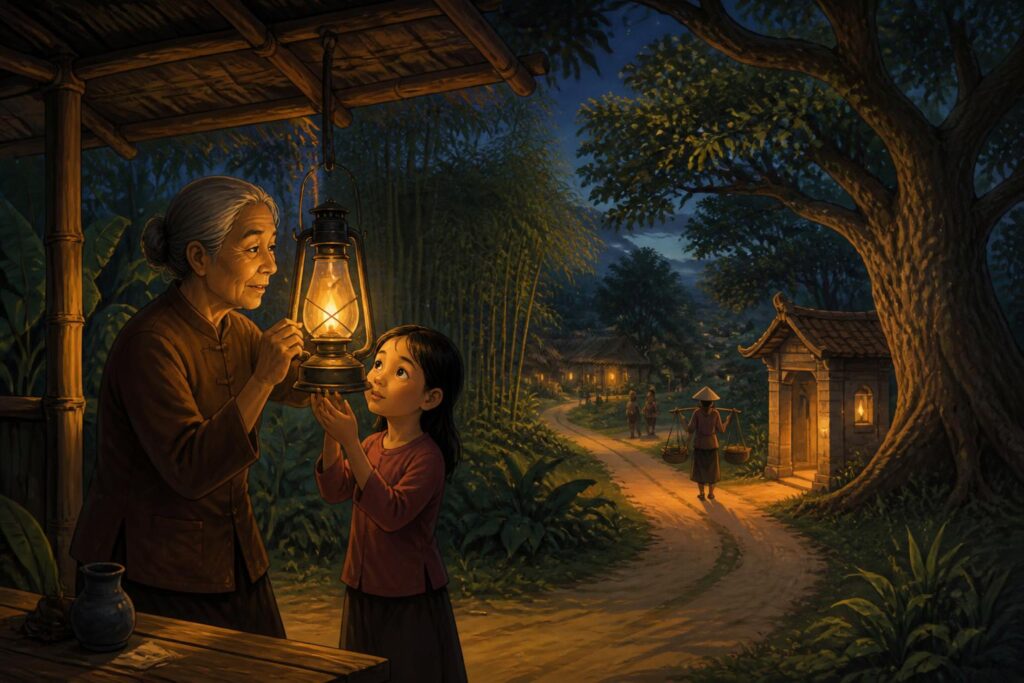
The Light Beside the Slope
At the far end of Mây Cói Village was a long, winding slope running between myrtle bushes and rows of old bamboo. During the day, there was nothing particularly remarkable about it except for a few uneven slabs of stone, a bank of earth that often became slippery after rain, and a banyan tree casting its shadow over the path. But as soon as the sky began to darken, a warm golden glow would appear there.
It was an oil lamp hanging beneath a wooden shelter. Its small flame was not bright enough to illuminate the entire road clearly, but it was sufficient for travelers returning from afar to recognize the turn and slow down before the rough patches. The lamp had been there for a very long time. The villagers were as accustomed to its light as they were to the sound of the rooster crowing at dawn or the smell of kitchen smoke drifting over the fences.
No one knew who lit the lamp. Every evening, after all the houses had closed their doors, someone would quietly walk up the slope. The next morning, the lamp would be clean, its oil reservoir adequately filled, and its wick neatly trimmed. On some nights, heavy rain poured down and the wind roared through the bamboo groves, putting out every lamp in the village, yet the lamp at the end of the slope would still flicker beneath the wooden shelter.
The adults often told the children not to be curious about it. They said that the person who tended the lamp must surely be kind, and if that person did not want to reveal themselves, everyone ought to respect that. But for An, a twelve-year-old girl who lived in a tiled-roof house beside the village well, that answer had never been enough.
An wanted to know why someone could faithfully do the same thing for so many years without needing anyone to thank them. She also wanted to know whether the person who tended the lamp ever grew tired, or whether they sometimes felt sad because no one noticed their efforts.
The Person Who Went Looking for an Answer
One late afternoon at the end of the northeast monsoon season, An brought a thin jacket, a matchbox, and her mother’s small lamp, then secretly made her way up the slope. She chose a bamboo thicket not far from the shelter and sat down to wait. It did not rain that day, but the clouds hung low and the cold wind slipped through her collar. An told herself she would sit still until the person who tended the lamp appeared.
The sun sank behind the mountains. The sound of dogs barking echoed up from the village at intervals. A night bird gave a hoarse call from a branch of the banyan tree. An began to feel sleepy, and both her feet went numb from sitting so long on the damp ground. She was just about to stand up when she heard slow footsteps coming up from the direction of the village.
A figure appeared behind the bamboo grove. It was Old Lady Lành, who lived alone in a small house near the cornfield. She wore a brown shirt frayed at the elbows and carried a bamboo basket in one hand. Her steps were slow but steady; whenever she passed a stone slab, she bent down to move the dry branches aside.
When she reached the shelter, she took a bottle of oil, a piece of cloth, and a small pair of scissors from the basket. She wiped the glass, adjusted the wick, and lit the lamp. When the flame began to burn, she stood still and looked at it for a moment, as if greeting an old friend.
An stepped out of the bamboo thicket.
Lady Lành was startled, but she did not appear angry. She only looked at the girl and asked:
“How long have you been standing there?”
“I wanted to know who lit the lamp.”
“Now you know.”
An looked at the lamp, then at the old woman. The answer felt far too simple compared with what she had imagined. The secret keeper of the light all these years was not a strange old man, nor a shadowy figure emerging from a fairy tale. It was simply Lady Lành, with her thin, bony hands and old bamboo basket.
“Why do you do this?” An asked.
Lady Lành did not answer immediately. She used the scissors to cut away the charred part of the wick, then put the cap back on the oil bottle.
“Because once, someone lit a lamp for me.”
The Debt of a Rainy Night
Lady Lành told An that many years earlier, when she was still a young woman, Mây Cói Village had experienced a prolonged storm. Water poured down from the mountains, the main road was flooded, and the smaller paths became slippery and pitch-black. That night, her father had not yet returned from working far away. Her mother had developed a severe fever and needed to be taken to the healer’s house on the other side of the slope.
There was no man in the house strong enough to carry her mother. Lady Lành had been only seventeen at the time, frightened and desperate. She hastily wrapped a blanket around her mother and helped her out of the house, but after only a few steps she had to stop. Rain lashed her face, mud reached her ankles, and the slope ahead was as black as if it had been swallowed up.
Just then, a small light suddenly appeared at the end of the slope. A man from the village carried a lamp ahead of them, illuminating the path while turning back to support her mother. He did not say much, only telling the two of them to walk very slowly. Guided by the light and his helping hand, they reached the house on the other side of the mountain before the fever became dangerous.
Her mother recovered. The man that night never mentioned what he had done. A few years later, he left the village to work elsewhere. The lamp beneath the shelter remained, but no one continued to care for it. One day, Lady Lành saw that it was covered in dust and that its wick had dried and hardened. She suddenly remembered that rainy night long ago and began lighting it again.
“Did you want to repay the person who helped your mother?” An asked.
“At first, that was the reason,” Lady Lành said. “But later I understood that he probably had not done it in order to receive anything in return. If I kept the light only to repay a debt, one day I would grow weary. I continued lighting it because I knew there would always be someone on this road who needed a little light.”
An sat down on the stone slab beside the shelter. She watched the flame flicker behind the glass. The small lamp could not drive away all the darkness of the mountains and forest, but it made the slope less frightening. She suddenly thought of all the good things she had received without ever asking who had quietly made them possible.
When the Lamp Met a Strong Wind
From that day on, An often went with Lady Lành to the end of the slope. At first, she only helped carry the oil and gather branches. Gradually, she learned how to wipe the glass, replace the wick, and reset the stones that had been dislodged by rain. Lady Lành did not immediately assign her tasks. She simply worked slowly, allowing An to observe and then try for herself.
One evening, just after the two of them had lit the lamp, a wind suddenly rose from the mountains. The bamboo thickets swayed wildly, and the shelter shook violently. Lady Lành hurried to hold the wooden door in place, while An used both hands to hold on to the base of a post. A sharp crack rang out, and the plank on the side of the shelter sprang loose from its frame.
The flame in the lamp wavered. An raised her hand to shield the glass, but the wind still slipped through the opening. In only a moment, the flame went out.
Lady Lành sighed. “It looks like we’ll have to endure the darkness tonight.”
An disagreed. She ran down to the village to call everyone. Before long, several people brought hammers, ropes, and wooden boards up the slope. One repaired the shelter, another cut bamboo, and others shoveled earth to rebuild the foundation. Some had never asked after Lady Lành before, while others had once thought the lamp was merely the private concern of an old woman with too much free time. Yet that night, everyone lent a hand.
The village head brought a new pane of glass. The shopkeeper brought oil. Several children gathered dry branches and collected stones. Without anyone telling them what to do, everyone worked together to make the shelter sturdier. When the work was finished, An lit the lamp. It burst into brightness in the middle of the night, its golden glow falling across faces smeared with dirt.
Lady Lành looked around, her eyes glistening.
“See?” she said to An. “The light never belongs to just one person. One person can begin it, but keeping it alive for a long time takes many hands.”
After that night, the villagers took turns caring for the lamp. Lady Lành was still the one who went there most often, but she no longer had to go alone. On days when her knees hurt, An and her mother took the oil in her place. During heavy rains, the men of the village inspected the shelter. Children were told not to play with fire, but they could help clear the slope.
The lamp remained old, and its light was still not very strong, yet the road at the end of the village seemed to have changed. Those who passed by saw not only the path, but also remembered that somewhere, there were people willing to do a small thing to make life a little easier for someone else.
What An Came to Understand
Many years later, An left the village to study a trade in a distant town. Before she departed, she went up the slope one last time that season. Lady Lành was weaker than before and needed a walking stick to reach the shelter. The two of them sat beside the lamp, listening to the insects humming in the grass.
An asked, “What will happen if you are no longer strong enough to light the lamp?”
Lady Lành smiled. “You already know the answer.”
An looked down at the village. In the houses scattered below in the valley, several lamps gradually came to life. Light from one window connected with the light from another, not dazzling but warm. She understood that what mattered was not whether the lamp remained exactly as it had been at the beginning. What mattered was that there were people who remembered to keep the flame alive.
An left the village the following morning. Far away, she began a new job and grew accustomed to busy roads. On tiring days, she thought of the lamp at the end of the slope. She realized that gratitude did not always need to be spoken aloud, nor did one necessarily have to find the exact person to repay it. Sometimes, the most sincere way was to continue doing something kind for someone else, so that the help one had received would not end with oneself.
Back in Mây Cói Village, the lamp continued to glow every evening. After Lady Lành passed away, An returned and worked with everyone to rebuild the shelter with new wood. They kept the old lamp inside, cleaned its glass, and replaced its wick. From then on, the slope also had a small bench where passersby could rest.
No one gave the place a name. The villagers simply called it the end of the slope. But whenever someone asked why the lamp was still lit, they would tell the story of a rainy night, a person who carried a lamp to guide the way, and an old woman who spent her whole life preserving that light.
Perhaps a single lamp cannot dispel all the darkness. A good deed cannot change the entire world at once, either. But for someone who is lost, a little light at the right moment can be what helps them keep going. And when each person is willing to protect a small flame in their own part of life, even the coldest-looking roads will gradually grow warm.

ARTICLES IN THE SAME CATEGORY
The Postman on the Nameless Slope
The Ferry Landing Behind the Bamboo Grove and the Keeper of Promises
The Wooden Box That Held the Rainy Season
The Watch Repairman and the Day Without Chimes
The Clock That Stopped at the Last Station
The Dry Well and the Keeper of the Rainy Season
ARTICLES IN THE SAME GENRE
Gratitude in Everyday Life: How Looking Back at the Ordinary Can Help Us Live More Lightly
The Keeper of Seeds by the Front Porch
The Lamp Beneath the Station Eaves
The Things No One Applauds Still Make a Decent Life
When the Meal Slows Down, Family Grows Closer
Gratitude in Everyday Life: From an Emotion to a Sustainable Way of Living